


Manufacturing & Technology
3D Metal Printing - Future of Aerospace Engineering
Printed brackets and engine components consolidate assemblies and cut weight where aerospace margins are tight.
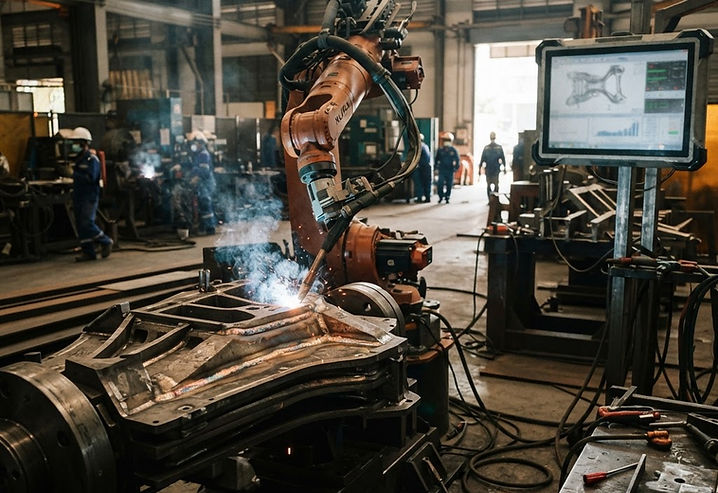
When fabricating aerospace components, it is essential to follow rigorous standards for safety and performance. Traditional manufacturing processes, such as casting and machining, have long been the backbone of the aerospace industry. However, these methods have limitations, especially at the forefront of creating complex, lightweight, and highly customized components. 3D metal printing, also known as additive manufacturing, has emerged as a game changer for the aerospace fabrication industry. This innovative technology allows manufacturers to create three dimensional objects by adding material layer by layer, rather than subtracting from a solid block. Let us examine the exciting potential 3D metal printing has for the future of aerospace manufacturing.
New Possibilities Unleashed
Here is a closer look at four ways 3D metal printing is propelling aerospace engineering into the future:
Complex Geometry: Aerospace components often require intricate designs to optimize their performance and efficiency. Traditional manufacturing methods, such as casting and machining, have limitations in producing complex shapes. 3D metal printing, on the other hand, excels at creating intricate geometries that were once deemed impossible or economically unviable.
Lightweight Structures: Weight reduction is a crucial factor in aerospace design. Lighter aircraft consume less fuel, produce fewer emissions, and are more manoeuvrable. 3D metal printing allows engineers to create structures that are up to 60% lighter with optimized internal geometries, reducing the overall weight of components without compromising strength.
Reduced Material Waste: Conventional manufacturing processes often produce significant material waste due to the need for subtractive machining. In fact, aircraft manufacturers cut away up to 90% of the material when fabricating metal parts. However, 3D metal printing is an additive process, so it only uses the material required for the final component, minimizing waste and conserving resources.
Rapid Prototyping: The aerospace industry thrives on innovation and iteration. 3D metal printing offers rapid prototyping capabilities, enabling engineers to design, print, and test components quickly and smoothly. This accelerated development process significantly reduces time to market and production costs for new aircraft and technologies.

Design Challenges of 3D Metal Printing
While the rapid rise of 3D metal printing has ushered in a new era of innovation and possibilities in the fields of aerospace and engineering, this transformative technology comes with its own set of unique design challenges. Aerospace engineers face four key challenges in 3D metal printing:
Heat Management: The layer by layer additive process using heat induction bending services can create thermal stresses within the component. Ensuring proper heat management during the printing process is crucial to prevent distortion or cracking.
Residual Stress: Residual stress in 3D printed components can affect their mechanical properties. Design modifications and postprocessing techniques are necessary to mitigate these stresses.
Support Structures: Complex geometries often require structural steel fabrication during printing to prevent deformation. These support structures must be carefully designed and removed after printing.
Quality Assurance: 3D printing quality assurance in aerospace is of paramount importance. Ensuring that printed components meet the required standards for strength, durability, and safety is a continuous challenge.
The key to overcoming these challenges is innovation, problem solving, and determination. With each challenge, we come one step closer to mastering 3D metal printing, revolutionizing industries, and reshaping the future of design and production.
Closing Comments
The aerospace industry is at the forefront of adopting 3D metal printing for the creation of complex components. This technology has revolutionized the way aerospace engineers design and manufacture critical parts, providing opportunities for lightweight structures and intricate geometries while reducing waste and production costs and improving lead time. With material innovations continuing to evolve and design challenges being addressed, we should expect 3D metal printing to play an increasingly pivotal role in the future of aerospace manufacturing.
K999 Thailand carries out work of this kind through its steel fabrication capability team in Rayong.
Further reading
Follow Critical Minerals across the wider market on Project Atlas Intel.
How K999 can help
How we apply the technology
Faster quoting, cleaner detailing and fewer site surprises come from the tools we use before the first cut, and the articles here explain how those tools change the work.
3D modelling and detailing- 01
3D modelling and shop detailing that resolves clashes before fabrication starts.
- 02
Fibre laser cutting for plate profiles, with nesting planned around the rolling schedule.
- 03
Project management that reports progress against the same model the client approved.
More on Manufacturing & Technology
All articles

Request for quotation
Need fabricated steel to that standard?
Every enquiry is answered within 48 hours by our estimating team in Rayong. The priced quotation follows once drawings, quantities and standards are confirmed. Stainless steel fabrication, structural steel fabrication, pipe spooling, pressure vessels, steel tanks, mining equipment and conveyors, pig launchers, chutes and hoppers, send the package and we will price it.
Before you request a quotation
Steel fabrication quotation questions
What structural steel fabrication, pressure vessel and pipe spooling packages cost, what to send with an enquiry, and how delivery to site works.
Structural steel fabrication is priced from the section and plate tonnage, the detailing and drawing hours, welding and fitting manhours, NDT requirements, blast and coating system, packing and freight. Grade matters as much as weight: AS/NZS, ASTM, JIS and BS sections carry different mill prices, and heavy built up members take longer than rolled sections. Our Rayong workshop produces around 10,000 tonnes of structural steel fabrication a year, so a clear bill of materials is usually enough to price. Send the drawings and we answer within 48 hours; the priced quotation follows once quantities, standards and delivery dates are confirmed.
For steel fabrication work, send the drawings or IFC package, a bill of materials with material grades, the welding and NDT requirements, the coating specification, the delivery port and your site dates. Add the inspection and test plan, any third party inspection requirement, and whether trial assembly or match marking is needed. Where drawings are still in progress, a scope list with sizes, quantities and duty is enough to start, and the estimate is refined once the final package arrives. Every enquiry is answered within 48 hours, and the priced quotation is issued after scope, standards and quantities are confirmed.
Yes. Pressure vessel fabrication is carried out to ASME Section VIII Div. 1 under our ASME U stamp No. 43,462, or to AS/NZS and BS where the project specifies, covering separators, air receivers, water drums, waste heat recovery units and pig launchers. Steel tanks for fuel, biofuel, chemical, water and food duty are designed in house with our E Tank programme to API, ASME, BS and AS/NZS. Because structural steel, vessels, tanks and their supports are built in the same workshops, one enquiry can cover the vessel package, the tank package and the structural steel that carries them, with a single coating and documentation system and one shipment.
Steel fabrication Australia packages are scheduled from a 33,000 m2 Rayong yard with an 80,000 m2 assembly yard inside Sattahip port, so fabrication, trial assembly, blasting, coating and packing run in one place. Programme length depends on tonnage, material lead times, the coating system and inspection scope, and it is confirmed with the quotation. We quote FOB Laem Chabang, Map Ta Phut or Sattahip, or CIF and DAP to your Australian port, with packing lists, weights, lifting points and a data book per shipment. Staged deliveries can follow your site erection sequence instead of shipping everything at once.
There is no fixed minimum. Pipe spooling Australia packages run at up to 3,000 diameter inches per shift on SCH.40, from a single replacement spool to a full plant piping scope, with spools numbered, X rayed where specified and coated to match erection order. Mining equipment fabrication covers chutes, hoppers, ore bins, transfer towers and conveyor structures with Bisalloy, Hardox, rubber lining or hardfacing fitted in house, from one wear liner set to modules of up to 2,500 tonnes assembled at Sattahip. Send the scope list and we will tell you what the smallest sensible batch is for your programme.