


Mining & Resources
Applications of Steel Fabrication in Mining Industry
Chutes, hoppers, conveyors, tanks and wear plate packages keep mining plants running, and all of it is fabricated steelwork.
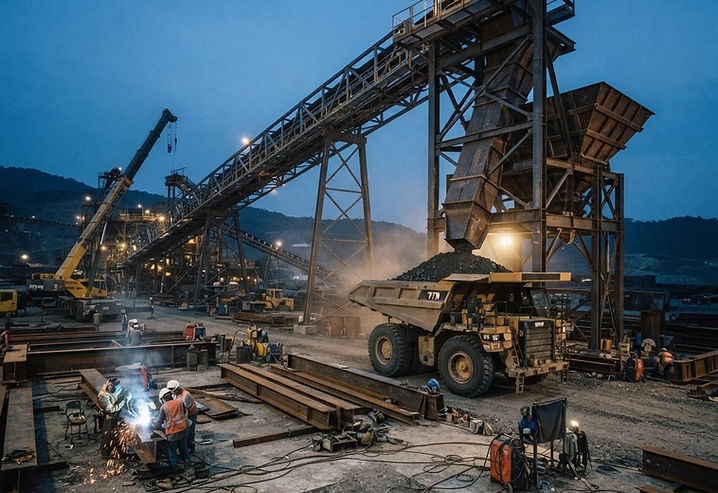
Due to their remote location and extreme conditions, mining projects require durable construction materials that can withstand the rigors of mining operations for many years. The remote location means very less access to replacements or repairs and mining infrastructure needs to be able to withstand searing heat, freezing nighttime temperatures, dust and sand storms and even hail and flooding. In this regard, steel fabrication is considered to be the prime raw material for the mining industry. So, what are the features and advantages of steel fabrication which makes it such a perfect fit for mining infrastructure? Let’s find out more in this blog.
Iron ore is a rock that metallic iron is extracted from. In the modern world, we use iron ore in our everyday lives. Most of the iron ore is used to make steel, which is used in building an incredible variety of things. From trains, planes and automobiles to high rise buildings and bridges, steel is used in the development of many, many products and industries. We use it to create everything from ships and pipe fabrication to machinery and tools, from building and construction to manufacturing cans of food and much, much more.
Steel is well known for its strength, but it is its malleable qualities that make it a preferred material of choice for most fabricators. Since steel is such a versatile material, it is ideal for applications that require heat induction bending as it can be bent or molded in many different ways without losing any of its durability. It is an essential material for the construction industry, automotive manufacturing, for the infrastructure required to generate and distribute energy and many other sectors ranging from household appliances to shipbuilding. It is a vital cog of the mining industry where the mining infrastructure itself is constructed using steel structural frameworks. It is also a critical part of the oil and gas industry, to know more click here.
Steel is the most common metal in the mining industry because of its benefits and properties, such as its low cost, strength, light weight, resistance to corrosion, durability, and sustainability. With computer aided design technology, steel can be manufactured with greater efficiency and precision than ever before, which means that it is used for advanced pieces of equipment that contribute to mining, including:

Vehicles and Machinery: Including bulldozers, crushers, excavators, drill rigs, front end loaders, surface feeder breakers, track loaders, trucks, graders and much more.
Tools: Steel is an essential material for manufacturing necessary tools like shovels, grinding equipment, demolition equipment and various handheld and machinery installed devices.
Infrastructure: Including water tanks, pipes, vessels, boilers, screens, stairs, handrails, elevators, mine cages, conveyor belts and even basic workplace essentials like workbenches and doors.
Equipment: like high strength plates, pumps, screens, filters, augers, blades, hammers, rippers and more.
Ensuring a safe work environment and preventing work related injuries or worse is as vital as it is challenging when dealing with underground mining operations. To protect workers underground, structures made of fabricated steel are used. Underground mine workings must have strong, rigid, flexible supports that meet the required technical requirements and fabricated steel ticks all boxes.
Now, steel is used in every aspect of mining around the world. To even build the mines requires structural steel frameworks. Stainless Steel fabrication has been used to create a wide range of equipment for mining purposes. In our modern age, this fabrication of steel is even more precise and efficient due to the use of computer aided design technology.
The dependency of the mining industry on steel is patently obvious and hence, the availability of iron ore and steel to develop robust infrastructure based on steel fabrication is essential. Safety is a must have requirement in mining and the qualities of steel help to meet this requirement in various mining global projects. Steel fabrication is also used in other industries like oil and gas, and this reinforces the fact that, in fabrication at least, steel is king!
K999 Thailand carries out work of this kind through its mining equipment fabrication team in Rayong.
Further reading
Follow tender opportunities across the wider market on Project Atlas Intel.
How K999 can help
Equipment built for the pit
Mining work is where wear life decides the maintenance budget, so the articles in this section feed directly into how we detail chutes, hoppers, conveyors and wear parts.
Mining equipment and conveyors- 01
Mining equipment and conveyor fabrication with replaceable wear liners and hardfaced contact surfaces.
- 02
Chutes, hoppers and transfer structures detailed for access, lifting and shutdown windows.
- 03
Site assembly planning from the Sattahip yard for modules that ship by sea.
More on Mining & Resources
All articles

Request for quotation
Need fabricated steel to that standard?
Every enquiry is answered within 48 hours by our estimating team in Rayong. The priced quotation follows once drawings, quantities and standards are confirmed. Stainless steel fabrication, structural steel fabrication, pipe spooling, pressure vessels, steel tanks, mining equipment and conveyors, pig launchers, chutes and hoppers, send the package and we will price it.
Before you request a quotation
Steel fabrication quotation questions
What structural steel fabrication, pressure vessel and pipe spooling packages cost, what to send with an enquiry, and how delivery to site works.
Structural steel fabrication is priced from the section and plate tonnage, the detailing and drawing hours, welding and fitting manhours, NDT requirements, blast and coating system, packing and freight. Grade matters as much as weight: AS/NZS, ASTM, JIS and BS sections carry different mill prices, and heavy built up members take longer than rolled sections. Our Rayong workshop produces around 10,000 tonnes of structural steel fabrication a year, so a clear bill of materials is usually enough to price. Send the drawings and we answer within 48 hours; the priced quotation follows once quantities, standards and delivery dates are confirmed.
For steel fabrication work, send the drawings or IFC package, a bill of materials with material grades, the welding and NDT requirements, the coating specification, the delivery port and your site dates. Add the inspection and test plan, any third party inspection requirement, and whether trial assembly or match marking is needed. Where drawings are still in progress, a scope list with sizes, quantities and duty is enough to start, and the estimate is refined once the final package arrives. Every enquiry is answered within 48 hours, and the priced quotation is issued after scope, standards and quantities are confirmed.
Yes. Pressure vessel fabrication is carried out to ASME Section VIII Div. 1 under our ASME U stamp No. 43,462, or to AS/NZS and BS where the project specifies, covering separators, air receivers, water drums, waste heat recovery units and pig launchers. Steel tanks for fuel, biofuel, chemical, water and food duty are designed in house with our E Tank programme to API, ASME, BS and AS/NZS. Because structural steel, vessels, tanks and their supports are built in the same workshops, one enquiry can cover the vessel package, the tank package and the structural steel that carries them, with a single coating and documentation system and one shipment.
Steel fabrication Australia packages are scheduled from a 33,000 m2 Rayong yard with an 80,000 m2 assembly yard inside Sattahip port, so fabrication, trial assembly, blasting, coating and packing run in one place. Programme length depends on tonnage, material lead times, the coating system and inspection scope, and it is confirmed with the quotation. We quote FOB Laem Chabang, Map Ta Phut or Sattahip, or CIF and DAP to your Australian port, with packing lists, weights, lifting points and a data book per shipment. Staged deliveries can follow your site erection sequence instead of shipping everything at once.
There is no fixed minimum. Pipe spooling Australia packages run at up to 3,000 diameter inches per shift on SCH.40, from a single replacement spool to a full plant piping scope, with spools numbered, X rayed where specified and coated to match erection order. Mining equipment fabrication covers chutes, hoppers, ore bins, transfer towers and conveyor structures with Bisalloy, Hardox, rubber lining or hardfacing fitted in house, from one wear liner set to modules of up to 2,500 tonnes assembled at Sattahip. Send the scope list and we will tell you what the smallest sensible batch is for your programme.