


Mining & Resources
Australian Manufacturers Reimagine Mining
Two Australian manufacturers are leveraging spaceborne particles and hyperspectral imaging technology to boost the safety and productivity of mining operations.
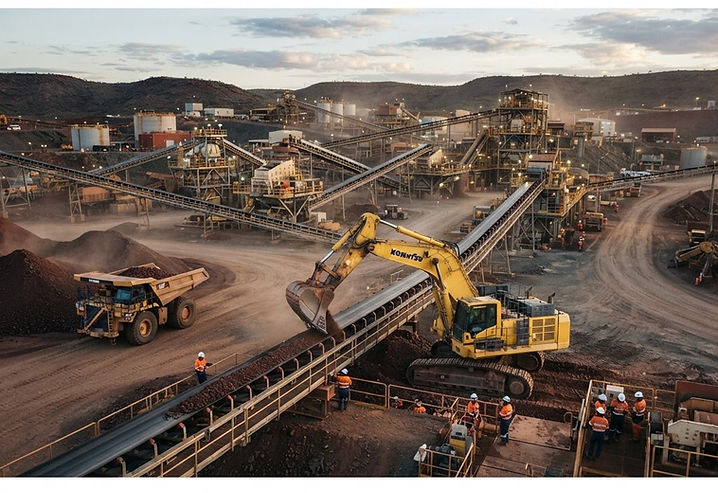
Two Australian manufacturers are leveraging spaceborne particles and hyperspectral imaging technology to boost the safety and productivity of mining operations. The Advanced Manufacturing Growth Centre (AMGC) has backed two mining technology projects that will have a positive impact on safety while generating substantial job and revenue opportunities onshore. A system to better manage tailings dams in mining has been commercialised by mDetect, while EQ Resources has created a system to detect and extract tungsten from previously unviable mining waste. Swinburne University spinout mDetect is specialising in astrophysics research into muons, a type of subatomic particle that results from the Earth’s atmosphere being hit by cosmic rays, which fall harmlessly and constantly down on us. They are sometimes described as the heavy cousin of electrons, with their mass helping them pass deep into objects; much further, for example, than ground penetrating radar. The company has commercialised telescopic devices and software in a system that uses muon behaviour to monitor and map tailings dams, providing real time information on stability of the critical infrastructure in mining operations.
Co Founder of mDetect Dr Jerome Donovan is excited by the next steps. “Thanks to AMGC, we’ve gone from idea to impact, developing our product for commercial sales, securing key agreements, and developing our design for scaling manufacturing, it has by far been our best government funded program experience. With high profile partnerships secured, mDetect is set to revolutionise global industries and enhance mining plant and equipment Australia,” Jerome says. “Taking highly technical IP, and which has heritage in dark matter research, no less, and delivering a market ready product is never easy. But we are very nearly there thanks to the support from AMGC.” Assisted by $248,191 in cofunding from AMGC’s Commercialisation Fund, mDetect has trialled its muography based imaging system at Oz Minerals (now part of BHP), and leveraged key partner Swinburne to assist with development, documentation, design for manufacture, production automation and other input ahead of scale manufacture.
The project is expected to lead to $7.7 million in revenue in the fifth year after completion and has already resulted in new jobs at the growing company. AMGC Managing Director Dr Jens Goennemann is proud to see an Australian heavy steel fabrication company harnessing the power of space to protect lives on Earth. “That’s Australian manufacturing at its best, globally relevant, collaborative, and highly complex. mDetect is truly a leader in their field, poised to make a global impact,” Jens says. From utilising space particles to leveraging electromagnetic imaging, EQ Resources, the owner of the formerly dormant Mount Carbine Tungsten Mine in North Queensland, has innovatively devised a method to identify and extract tungsten from waste sources, following its discovery at the site in 1895. EQ Resources CEO Kevin MacNeill says AMCG backing was critical.
“Early coinvestment form AMGC allowed EQ Resources to accelerate the commercial development of our technology, furthermore it gave us the credibility to apply for follow on programs and secure a $6 million grant from the Critical Minerals Accelerator Initiative to move from pilot to operational scale,” MacNeill says. Dr Jens Goennemann is excited about the project’s possibilities. “From lighting and heating our homes, to having a specialized welding technique ( TIG welding ), to forging a path to space, tungsten is a crucial element in modern life. In taking a step back two centuries ago and looking at the resources we already have, EQ Resources will be able to extract greater value from resources long thought unusable both here in Australia and abroad,” he says.
K999 Thailand carries out work of this kind through its mining equipment fabrication team in Rayong.
Further reading
Follow Renewable Energy across the wider market on Project Atlas Intel.
How K999 can help
Equipment built for the pit
Mining work is where wear life decides the maintenance budget, so the articles in this section feed directly into how we detail chutes, hoppers, conveyors and wear parts.
Mining equipment and conveyors- 01
Mining equipment and conveyor fabrication with replaceable wear liners and hardfaced contact surfaces.
- 02
Chutes, hoppers and transfer structures detailed for access, lifting and shutdown windows.
- 03
Site assembly planning from the Sattahip yard for modules that ship by sea.
More on Mining & Resources
All articles

Request for quotation
Need fabricated steel to that standard?
Every enquiry is answered within 48 hours by our estimating team in Rayong. The priced quotation follows once drawings, quantities and standards are confirmed. Stainless steel fabrication, structural steel fabrication, pipe spooling, pressure vessels, steel tanks, mining equipment and conveyors, pig launchers, chutes and hoppers, send the package and we will price it.
Before you request a quotation
Steel fabrication quotation questions
What structural steel fabrication, pressure vessel and pipe spooling packages cost, what to send with an enquiry, and how delivery to site works.
Structural steel fabrication is priced from the section and plate tonnage, the detailing and drawing hours, welding and fitting manhours, NDT requirements, blast and coating system, packing and freight. Grade matters as much as weight: AS/NZS, ASTM, JIS and BS sections carry different mill prices, and heavy built up members take longer than rolled sections. Our Rayong workshop produces around 10,000 tonnes of structural steel fabrication a year, so a clear bill of materials is usually enough to price. Send the drawings and we answer within 48 hours; the priced quotation follows once quantities, standards and delivery dates are confirmed.
For steel fabrication work, send the drawings or IFC package, a bill of materials with material grades, the welding and NDT requirements, the coating specification, the delivery port and your site dates. Add the inspection and test plan, any third party inspection requirement, and whether trial assembly or match marking is needed. Where drawings are still in progress, a scope list with sizes, quantities and duty is enough to start, and the estimate is refined once the final package arrives. Every enquiry is answered within 48 hours, and the priced quotation is issued after scope, standards and quantities are confirmed.
Yes. Pressure vessel fabrication is carried out to ASME Section VIII Div. 1 under our ASME U stamp No. 43,462, or to AS/NZS and BS where the project specifies, covering separators, air receivers, water drums, waste heat recovery units and pig launchers. Steel tanks for fuel, biofuel, chemical, water and food duty are designed in house with our E Tank programme to API, ASME, BS and AS/NZS. Because structural steel, vessels, tanks and their supports are built in the same workshops, one enquiry can cover the vessel package, the tank package and the structural steel that carries them, with a single coating and documentation system and one shipment.
Steel fabrication Australia packages are scheduled from a 33,000 m2 Rayong yard with an 80,000 m2 assembly yard inside Sattahip port, so fabrication, trial assembly, blasting, coating and packing run in one place. Programme length depends on tonnage, material lead times, the coating system and inspection scope, and it is confirmed with the quotation. We quote FOB Laem Chabang, Map Ta Phut or Sattahip, or CIF and DAP to your Australian port, with packing lists, weights, lifting points and a data book per shipment. Staged deliveries can follow your site erection sequence instead of shipping everything at once.
There is no fixed minimum. Pipe spooling Australia packages run at up to 3,000 diameter inches per shift on SCH.40, from a single replacement spool to a full plant piping scope, with spools numbered, X rayed where specified and coated to match erection order. Mining equipment fabrication covers chutes, hoppers, ore bins, transfer towers and conveyor structures with Bisalloy, Hardox, rubber lining or hardfacing fitted in house, from one wear liner set to modules of up to 2,500 tonnes assembled at Sattahip. Send the scope list and we will tell you what the smallest sensible batch is for your programme.