


Manufacturing & Technology
Automation in Intralogistics
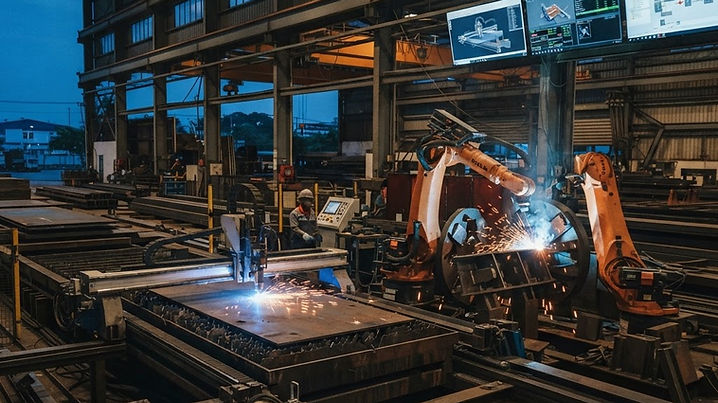
Automated storage and guided vehicles move plate, sections and finished modules without tying up crane time.
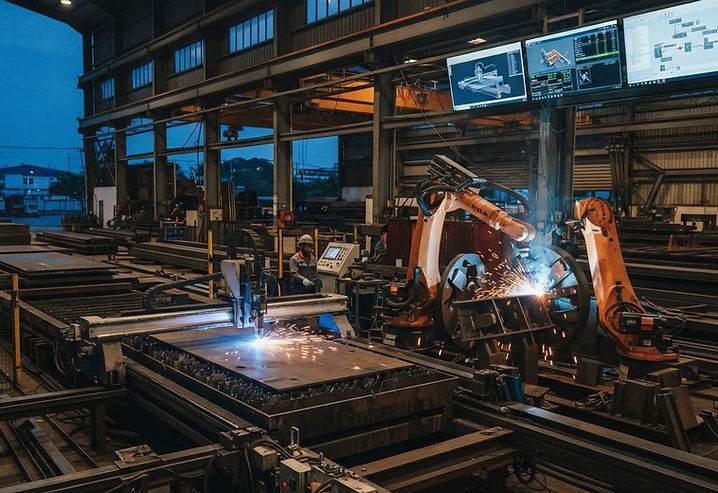
From the perspective of a warehouse CEO or executive, the importance of streamlining operations via intralogistics automation to create an efficient distribution centre cannot be overstated. Warehousing firms are always looking for ways to improve productivity and meet customer demand using means such as business process integration. Automation is one tool that can help to achieve those goals, but it may be unclear exactly how the intralogistics process can be improved by adding automated solutions. Intralogistics automation refers to the use of automated systems and technologies within a warehouse or distribution centre to improve efficiency, accuracy, and safety of processes like pipe fabrication. In this blog post, we will look at why intralogistics automation matters to warehouses, and steps to get started with facility automation.
Benefits of Intralogistics Automation
One of the main benefits of intralogistics automation is increased productivity. Automated systems can work faster and more accurately than human workers, which can lead to a significant increase in the amount of goods that can be processed in each time period. Additionally, automated systems can also reduce the number of errors that occur during the picking and packing process, which can lead to a reduction in the number of returns or customer complaints. Another benefit of intralogistics automation is improved protection from safety hazards in metal fabrication. Automated systems can reduce the need for human workers to perform dangerous tasks, such as climbing ladders or operating heavy machinery. Additionally, the use of automated systems can also reduce the risk of injuries caused by repetitive motions, such as picking and packing. Automated systems can also improve the accuracy of inventory tracking. It can help to ensure that the correct products are picked and packed, and that inventory levels are accurate. This can help to reduce the number of stockouts and overstocking of items such as pressure vessels, which can lead to cost savings.
Steps To Get Started
Evaluate facility’s suitability for automation
Before jumping into automating material handling equipment, assessing the facility’s readiness is essential. Intralogistics automation works best in multishift workplaces because the schedule leads to a faster return on investment. Facilities larger than 200,000 square feet will see a more rapid payback than smaller installations. Because the distances are longer in a larger plant, the time savings of decentralised automation are more significant. The optimal performance of automated forklifts, tuggers, and pallet jacks requires Wi Fi and a Warehouse Management System.

Consider material transportation workflows
It is necessary to focus on workflows that have well established automation practices. Case studies and success stories from similar industries are valuable resources and provide insight into the workflows that are easiest to automate and yield the most rapid results.
Reach out to vendors who have relevant experience
Intralogistics automation has many moving parts, and it makes sense to take advantage of other people’s knowledge and experience in this area. Look for vendors that have the specific know how to help an organization with a proven track record of quantifiable results.
Identify the best use cases
Warehouse owners need to look for applications that represent easy gains and that are scalable. It is better to start with an intralogistics solution in one location and let it prove itself. With the concept thus demonstrated, it can be easily implemented in other locations and large rewards can be reaped. Vendors can help to determine areas that represent easy successes and they can also assist with calculating the return on investment.
The Last Word
History has shown repeatedly: technology creates far more jobs than it displaces. Other studies show companies that invest in robotic automation grow faster than companies that do not. Thus the time is ripe for warehouse owners to dive into the world of automation and transform their intralogistics operations!
K999 Thailand carries out work of this kind through its steel fabrication capability team in Rayong.
Further reading
Follow tenders across the entire Middle East across the wider market on Project Atlas Intel.
Calculation tool
Run the numbers for this yourself with the free steel grade comparison from Engineering Toolbox Australia. Treat the result as a first check, then confirm the final design with your engineer.
How K999 can help
How we apply the technology
Faster quoting, cleaner detailing and fewer site surprises come from the tools we use before the first cut, and the articles here explain how those tools change the work.
3D modelling and detailing- 01
3D modelling and shop detailing that resolves clashes before fabrication starts.
- 02
Fibre laser cutting for plate profiles, with nesting planned around the rolling schedule.
- 03
Project management that reports progress against the same model the client approved.
More on Manufacturing & Technology
All articles

Request for quotation
Need fabricated steel to that standard?
Every enquiry is answered within 48 hours by our estimating team in Rayong. The priced quotation follows once drawings, quantities and standards are confirmed. Stainless steel fabrication, structural steel fabrication, pipe spooling, pressure vessels, steel tanks, mining equipment and conveyors, pig launchers, chutes and hoppers, send the package and we will price it.
Before you request a quotation
Steel fabrication quotation questions
What structural steel fabrication, pressure vessel and pipe spooling packages cost, what to send with an enquiry, and how delivery to site works.
Structural steel fabrication is priced from the section and plate tonnage, the detailing and drawing hours, welding and fitting manhours, NDT requirements, blast and coating system, packing and freight. Grade matters as much as weight: AS/NZS, ASTM, JIS and BS sections carry different mill prices, and heavy built up members take longer than rolled sections. Our Rayong workshop produces around 10,000 tonnes of structural steel fabrication a year, so a clear bill of materials is usually enough to price. Send the drawings and we answer within 48 hours; the priced quotation follows once quantities, standards and delivery dates are confirmed.
For steel fabrication work, send the drawings or IFC package, a bill of materials with material grades, the welding and NDT requirements, the coating specification, the delivery port and your site dates. Add the inspection and test plan, any third party inspection requirement, and whether trial assembly or match marking is needed. Where drawings are still in progress, a scope list with sizes, quantities and duty is enough to start, and the estimate is refined once the final package arrives. Every enquiry is answered within 48 hours, and the priced quotation is issued after scope, standards and quantities are confirmed.
Yes. Pressure vessel fabrication is carried out to ASME Section VIII Div. 1 under our ASME U stamp No. 43,462, or to AS/NZS and BS where the project specifies, covering separators, air receivers, water drums, waste heat recovery units and pig launchers. Steel tanks for fuel, biofuel, chemical, water and food duty are designed in house with our E Tank programme to API, ASME, BS and AS/NZS. Because structural steel, vessels, tanks and their supports are built in the same workshops, one enquiry can cover the vessel package, the tank package and the structural steel that carries them, with a single coating and documentation system and one shipment.
Steel fabrication Australia packages are scheduled from a 33,000 m2 Rayong yard with an 80,000 m2 assembly yard inside Sattahip port, so fabrication, trial assembly, blasting, coating and packing run in one place. Programme length depends on tonnage, material lead times, the coating system and inspection scope, and it is confirmed with the quotation. We quote FOB Laem Chabang, Map Ta Phut or Sattahip, or CIF and DAP to your Australian port, with packing lists, weights, lifting points and a data book per shipment. Staged deliveries can follow your site erection sequence instead of shipping everything at once.
There is no fixed minimum. Pipe spooling Australia packages run at up to 3,000 diameter inches per shift on SCH.40, from a single replacement spool to a full plant piping scope, with spools numbered, X rayed where specified and coated to match erection order. Mining equipment fabrication covers chutes, hoppers, ore bins, transfer towers and conveyor structures with Bisalloy, Hardox, rubber lining or hardfacing fitted in house, from one wear liner set to modules of up to 2,500 tonnes assembled at Sattahip. Send the scope list and we will tell you what the smallest sensible batch is for your programme.