


Industry News
Battery Electric Vehicles and New Opportunities for Fabricators
Battery plants, charging infrastructure and lightweight structures create new fabrication packages beyond automotive assembly.
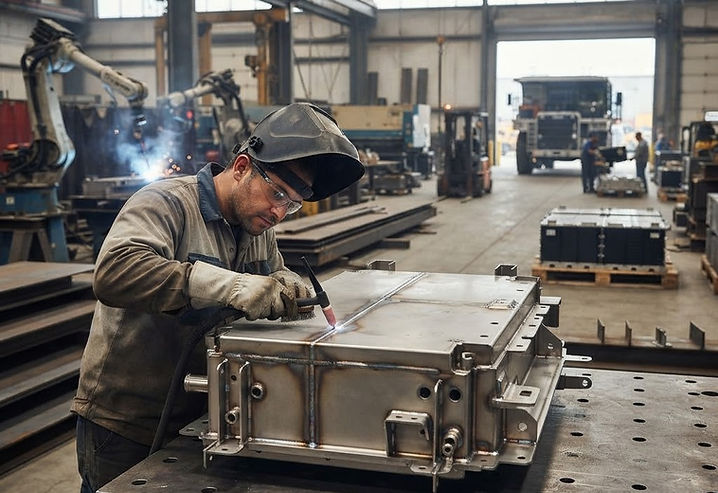
Elon Musk, and by association Tesla, are well known across the world. But do you know what is the major product developed by Tesla which has made Musk one of the richest people in the world? It’s batteries for energy vehicles (EVs), the demand for which is expected to increase exponentially as awareness about climate and ESG risks enable governments and people to move towards a clean air future. This industry is also offering new and exciting opportunities for heavy steel fabrication companies and stamping manufacturers to produce quality, lightweight components. As battery electric vehicles (BEVs) gain market share, manufacturers will need to address issues with mineral supply chains and vehicle curb weight.
Adequate Range, As BEVs migrate from novel vehicles to niche vehicles, the industry needs to ensure the BEVs have adequate range, especially since BEV charging infrastructure is in its infancy. Currently, BEV manufacturers are using lightweight materials, but the batteries are heavy.
Battery Capacity, Production improvements over the past 10 years have led to a dramatic reduction in the cost per kilowatt hour for lithium ion batteries. This enables manufacturers to add greater battery capacity without negatively influencing vehicle costs.
Bloated weight, Adding battery capacity can’t fully compensate for bloated weight. Battery researchers agree that future improvements in battery technologies will lead to marginal cost improvements. To achieve acceptable range, manufacturers need to work on reducing the curb weight of current BEVs by leveraging fabrication types such as pipe fabrication. For instance, GM’s Hummer three motor version has an estimated curb weight of 10,000 to 14,000 lbs. Its 200 kwH battery capacity is twice that of Tesla’s, but with lesser range. Reducing curb weight to gain acceptable range will need to be an aggressive effort by OEMs, especially given the weight of batteries, safety equipment, and consumer demand for entertainment and comfort amenities.

Minerals cost, As BEV sales become a more significant market segment, costs of essential minerals will increase both because of supply and demand and because increased demand will further expose issues in the mineral supply chain.
The issues that will drive a push for even lighter weight components include the following:,
Lithium mining environmental impact, Steel fabrication has many applications in mining and lithium mining uses tremendous amounts of water, an estimated 500,000 gallons per ton of lithium. In Argentina, Bolivia and Chile, where half the world’s lithium reserves are estimated to be located, the water usage is negatively affecting the nearby agricultural industry. Also, poisons leach off from the evaporation ponds and are known to kill downstream fish populations.
Human rights issues in cobalt and element extraction, Cobalt mining in the Democratic Republic of the Congo is known for abusive labor practices and child labor.
Political relationships, Energy is a strong economic and political motivator. As minerals like lithium, cobalt, and nickel become major drivers in transportation energy, unstable political relationships will have an effect. China is dominant in both global mineral extraction and lithium ion battery production. The U.S. political relationship with an increasingly aggressive Chinese government may lead to market instability.
Vulnerable supply chains, As energy supply chains change in their basic character, the structural steel fabrication industry must act to ensure that supply and transportation are robust enough to support a growing market.
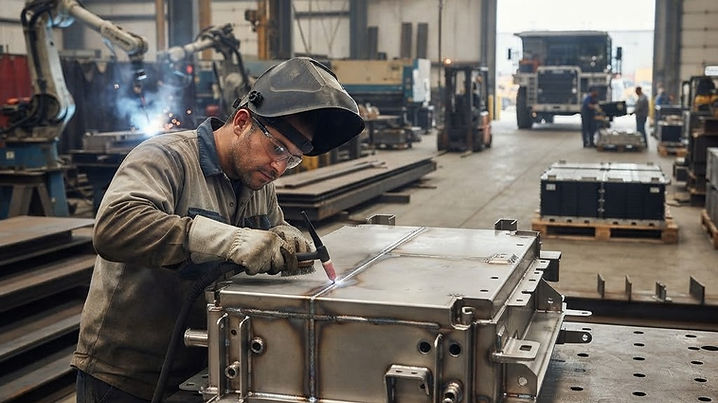
Firms pertaining to stamping and supply of sheet metal components have been presented with an opportunity to address BEV range by replacing with lightweight components. Companies need to start thinking beyond the design of traditional gasoline run vehicles and look to make BEVs light and fast by making full use of sheet metal fabrication techniques and products. As discussed above, there are many considerations and issues in this regard, however BEV companies need to strike the iron when it’s hot!
Further reading
Follow Mining across the wider market on Project Atlas Intel.
How K999 can help
Where we fit the story
Trade policy, commodity cycles and energy markets decide when projects move, and they decide what gets fabricated. These articles collect the changes we track for our clients.
See our projects- 01
Work delivered for mining, energy, processing and manufacturing clients across Australia and Southeast Asia.
- 02
Fabrication in Rayong with assembly at Sattahip, shipping from Laem Chabang and Map Ta Phut.
- 03
Enquiries answered within 48 hours by our estimating team.
More on Industry News
All articles


Request for quotation
Need fabricated steel to that standard?
Every enquiry is answered within 48 hours by our estimating team in Rayong. The priced quotation follows once drawings, quantities and standards are confirmed. Stainless steel fabrication, structural steel fabrication, pipe spooling, pressure vessels, steel tanks, mining equipment and conveyors, pig launchers, chutes and hoppers, send the package and we will price it.
Before you request a quotation
Steel fabrication quotation questions
What structural steel fabrication, pressure vessel and pipe spooling packages cost, what to send with an enquiry, and how delivery to site works.
Structural steel fabrication is priced from the section and plate tonnage, the detailing and drawing hours, welding and fitting manhours, NDT requirements, blast and coating system, packing and freight. Grade matters as much as weight: AS/NZS, ASTM, JIS and BS sections carry different mill prices, and heavy built up members take longer than rolled sections. Our Rayong workshop produces around 10,000 tonnes of structural steel fabrication a year, so a clear bill of materials is usually enough to price. Send the drawings and we answer within 48 hours; the priced quotation follows once quantities, standards and delivery dates are confirmed.
For steel fabrication work, send the drawings or IFC package, a bill of materials with material grades, the welding and NDT requirements, the coating specification, the delivery port and your site dates. Add the inspection and test plan, any third party inspection requirement, and whether trial assembly or match marking is needed. Where drawings are still in progress, a scope list with sizes, quantities and duty is enough to start, and the estimate is refined once the final package arrives. Every enquiry is answered within 48 hours, and the priced quotation is issued after scope, standards and quantities are confirmed.
Yes. Pressure vessel fabrication is carried out to ASME Section VIII Div. 1 under our ASME U stamp No. 43,462, or to AS/NZS and BS where the project specifies, covering separators, air receivers, water drums, waste heat recovery units and pig launchers. Steel tanks for fuel, biofuel, chemical, water and food duty are designed in house with our E Tank programme to API, ASME, BS and AS/NZS. Because structural steel, vessels, tanks and their supports are built in the same workshops, one enquiry can cover the vessel package, the tank package and the structural steel that carries them, with a single coating and documentation system and one shipment.
Steel fabrication Australia packages are scheduled from a 33,000 m2 Rayong yard with an 80,000 m2 assembly yard inside Sattahip port, so fabrication, trial assembly, blasting, coating and packing run in one place. Programme length depends on tonnage, material lead times, the coating system and inspection scope, and it is confirmed with the quotation. We quote FOB Laem Chabang, Map Ta Phut or Sattahip, or CIF and DAP to your Australian port, with packing lists, weights, lifting points and a data book per shipment. Staged deliveries can follow your site erection sequence instead of shipping everything at once.
There is no fixed minimum. Pipe spooling Australia packages run at up to 3,000 diameter inches per shift on SCH.40, from a single replacement spool to a full plant piping scope, with spools numbered, X rayed where specified and coated to match erection order. Mining equipment fabrication covers chutes, hoppers, ore bins, transfer towers and conveyor structures with Bisalloy, Hardox, rubber lining or hardfacing fitted in house, from one wear liner set to modules of up to 2,500 tonnes assembled at Sattahip. Send the scope list and we will tell you what the smallest sensible batch is for your programme.