


Manufacturing & Technology
Foreign steel Approved for American EV Charging Stations
Metal fabricators supplying components for electric vehicle (EV) battery charging stations will have broad leeway to use steel from foreign suppliers.
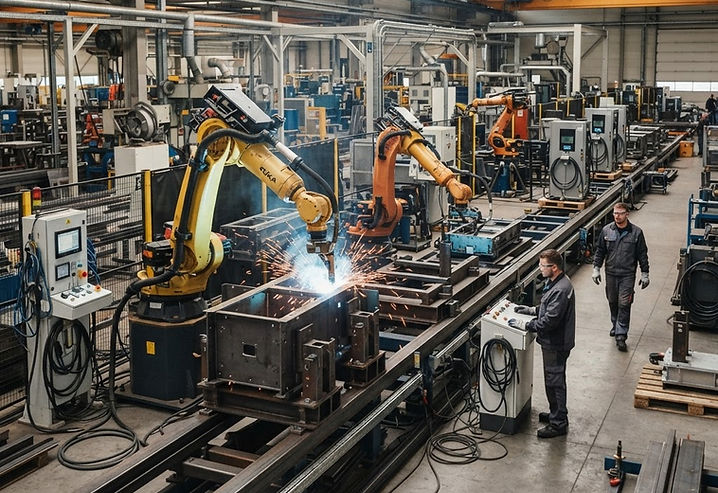
Metal fabricators supplying components for electric vehicle (EV) battery charging stations will have broad leeway to use steel from foreign suppliers.
That is the decision made by the Federal Highway Administration (FHWA) in announcing “Buy America” exclusions for EV chargers funded over the next five years through the new National Electric Vehicle Infrastructure (NEVI) Formula Program. This effectively gives the green light for $5 billion set aside for the EV chargers. NEVI was authorized by the $550 billion Infrastructure Investment and Jobs Act (IIJA), which was signed into law by President Joe Biden on Nov. 15, 2021.
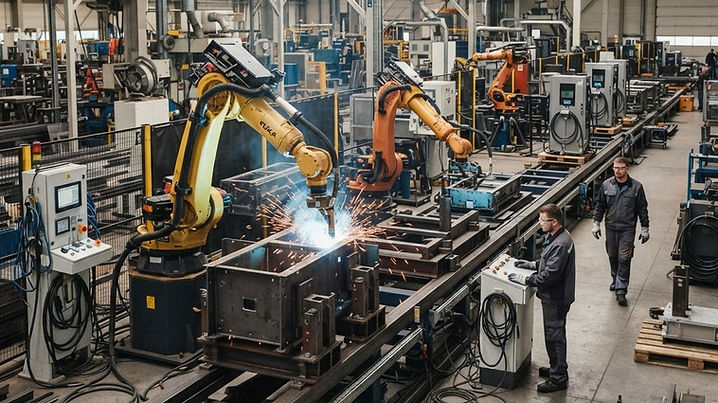
The IIJA had significant domestic content requirements that FHWA has interpreted liberally because of its concerns regarding the ability of states and industry to effectively certify compliance with domestic content requirements. The Steel Manufacturers Association, which represents U.S. steelmakers that rely on electric arc furnaces and scrap metal to make metal, called this “false logic” and argued: “In fact, mill test certificates for steel inputs are routinely provided to both distributors and fabricators so that complete traceability is maintained throughout the distribution chain.” Form Energy has recently stated its plan to build a battery manufacturing plant in West Virginia.
FHWA said that as of 2021, only ChargePoint, FreeWire Technologies Inc. (FreeWire), and Rhombus were U.S. companies that believed they had existing direct current fast charging systems that could comply with the IIJA’s Buy America requirement. “FHWA remains uncertain regarding their immediate ability to meet demand on all FHWA projects for EV chargers that satisfy FHWA’s Buy America requirement within the next 12 months,” the agency said in a statement. That view was seconded by the American Association of State Highway and Transportation Officials (AASHTO). “It is in the public interest that EV infrastructure deployment not be delayed unnecessarily while industry makes good faith efforts to integrate the new Buy America requirements into their sourcing and manufacturing processes,” AASHTO officials said in their own statement.
The new FHWA rule implements a two phase EV charger specific Buy America waiver. From March 23 through June 30, 2024, domestic content requirements are waived for all EV chargers where final assembly takes place in the U.S. Starting on July 1, 2024, domestic content requirements are waived for all EV chargers where final assembly takes place in the U.S. and where the cost of components manufactured in the U.S. exceeds 55% of the total cost of all components. The waiver remains in place until terminated, but it is required to be revisited after five years. U.S. steel and steel using fabrication companies and manufacturers opposed several aspects in the proposed exclusion when it was initially proposed a year ago.
But the FHWA, in the final waiver issued in February, appears to have satisfied just a few of its objections. One change is that the final waiver excludes such things as associated payment systems, distribution systems, telecommunications and networking equipment, energy storage systems, and other supporting equipment and systems. They had initially been included. The final waiver also excludes EV charger housing components that are predominantly steel and iron. The final waiver also gave heartburn to aluminium extruders represented by the Aluminium Extruders Council, which argued aluminium extrusions, which are commonly used in EV charging station manufacturing, are readily available from U.S. manufacturers. Extrusions are used for various structural components like heat sinks, support feet, hinges, and doors. Some EV charging station producers also use aluminium for the outer shell of the charging station itself.
K999 Thailand carries out work of this kind through its steel fabrication capability team in Rayong.
Further reading
Follow procurement opportunities across the wider market on Project Atlas Intel.
How K999 can help
How we apply the technology
Faster quoting, cleaner detailing and fewer site surprises come from the tools we use before the first cut, and the articles here explain how those tools change the work.
3D modelling and detailing- 01
3D modelling and shop detailing that resolves clashes before fabrication starts.
- 02
Fibre laser cutting for plate profiles, with nesting planned around the rolling schedule.
- 03
Project management that reports progress against the same model the client approved.
More on Manufacturing & Technology
All articles

Request for quotation
Need fabricated steel to that standard?
Every enquiry is answered within 48 hours by our estimating team in Rayong. The priced quotation follows once drawings, quantities and standards are confirmed. Stainless steel fabrication, structural steel fabrication, pipe spooling, pressure vessels, steel tanks, mining equipment and conveyors, pig launchers, chutes and hoppers, send the package and we will price it.
Before you request a quotation
Steel fabrication quotation questions
What structural steel fabrication, pressure vessel and pipe spooling packages cost, what to send with an enquiry, and how delivery to site works.
Structural steel fabrication is priced from the section and plate tonnage, the detailing and drawing hours, welding and fitting manhours, NDT requirements, blast and coating system, packing and freight. Grade matters as much as weight: AS/NZS, ASTM, JIS and BS sections carry different mill prices, and heavy built up members take longer than rolled sections. Our Rayong workshop produces around 10,000 tonnes of structural steel fabrication a year, so a clear bill of materials is usually enough to price. Send the drawings and we answer within 48 hours; the priced quotation follows once quantities, standards and delivery dates are confirmed.
For steel fabrication work, send the drawings or IFC package, a bill of materials with material grades, the welding and NDT requirements, the coating specification, the delivery port and your site dates. Add the inspection and test plan, any third party inspection requirement, and whether trial assembly or match marking is needed. Where drawings are still in progress, a scope list with sizes, quantities and duty is enough to start, and the estimate is refined once the final package arrives. Every enquiry is answered within 48 hours, and the priced quotation is issued after scope, standards and quantities are confirmed.
Yes. Pressure vessel fabrication is carried out to ASME Section VIII Div. 1 under our ASME U stamp No. 43,462, or to AS/NZS and BS where the project specifies, covering separators, air receivers, water drums, waste heat recovery units and pig launchers. Steel tanks for fuel, biofuel, chemical, water and food duty are designed in house with our E Tank programme to API, ASME, BS and AS/NZS. Because structural steel, vessels, tanks and their supports are built in the same workshops, one enquiry can cover the vessel package, the tank package and the structural steel that carries them, with a single coating and documentation system and one shipment.
Steel fabrication Australia packages are scheduled from a 33,000 m2 Rayong yard with an 80,000 m2 assembly yard inside Sattahip port, so fabrication, trial assembly, blasting, coating and packing run in one place. Programme length depends on tonnage, material lead times, the coating system and inspection scope, and it is confirmed with the quotation. We quote FOB Laem Chabang, Map Ta Phut or Sattahip, or CIF and DAP to your Australian port, with packing lists, weights, lifting points and a data book per shipment. Staged deliveries can follow your site erection sequence instead of shipping everything at once.
There is no fixed minimum. Pipe spooling Australia packages run at up to 3,000 diameter inches per shift on SCH.40, from a single replacement spool to a full plant piping scope, with spools numbered, X rayed where specified and coated to match erection order. Mining equipment fabrication covers chutes, hoppers, ore bins, transfer towers and conveyor structures with Bisalloy, Hardox, rubber lining or hardfacing fitted in house, from one wear liner set to modules of up to 2,500 tonnes assembled at Sattahip. Send the scope list and we will tell you what the smallest sensible batch is for your programme.