


Manufacturing & Technology
Future proofing Supply Chains
Dual sourcing, buffer stock at the right point and visible lead times protect fabrication schedules from disruption.
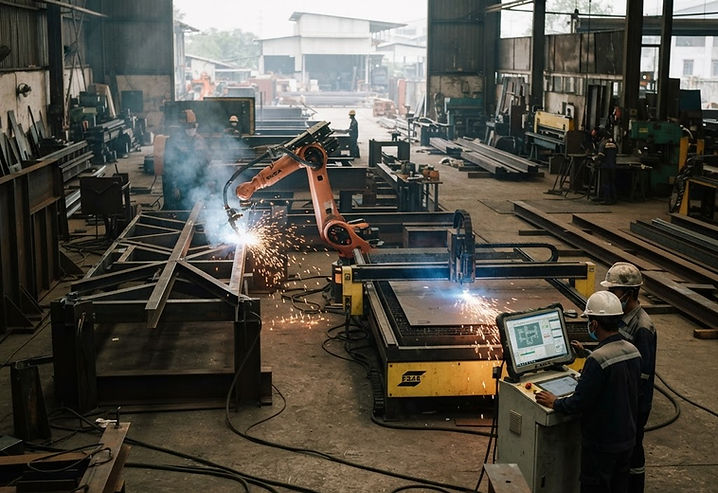
As discussed in a previous blog on postpandemic fabrication supply chain, the COVID years were harrowing for supply chains with the imminent threat of lockdowns creating volatility in demand and supply patterns. With the return to normalcy, the future of global logistics has become significantly brighter, however there are lessons to be learnt during the pandemic and which should be avoided in case of a similar situation in the future. There is a gradual realization that many forces need to be considered when creating truly resilient, dynamic supply chains. So, what are these forces and how should they be leveraged correctly? This writeup looks to decode this subject in greater detail.
Supply Demand Mismatch
In a perfect world, supply and demand sync evenly but in the real world, often one outpaces the other, such as the shortage of certain consumer goods of 2020. Oversupply can also cause issues which can pile up and quickly eat through a business’ bottom line. A common issue is where to store the overstock and how to continue to sell it and profit, and this can cause issues up and down the supply chain of heavy steel fabrication companies. These pockets of exponential demand will continue to exist as will moments of oversupply. Both need to be built into forecasts to help stakeholders better manage inventory and adapt as forces shift the balance.
Commodity Shortages


Commodities like lithium and cobalt are in high demand but not always easy to procure. Producers that need hard to replace materials must factor in forces such as potential tariffs, weather patterns, upcoming environmental regulations, and variable pricing of mining plant and equipment to ensure production does not suffer. The emergence of innovative design is a trend which can be used to resolve shortages. Engineers are using smaller geometries, so the required amount of the given commodity is reduced without sacrificing product capability. An example would be the small size of computers today compared with earlier days when they were the size of a room and exponentially less powerful.
Economy and Pricing
The state of the economy is a major factor which is a bell weather for consumption trends, such as using local steel companies in Australia. With rising inflation, consumers are looking to spend less but still get that bang for their buck, and that translates all the way up the chain. At the same time, between labour, the rising cost of materials, tariffs, and more, suppliers are getting squeezed on cost. While there will never be a perfect model for economic forecasting, knowledge of known forces and their impact on consumer behavior can be built into pricing projections.
Labour Shortages
Forces such as labour shortages always impact product availability. For instance, Japan needs more than 200,000 engineers in the next couple of years to maintain current production levels. In 2030 it is expected that Japan will not be able to fill 270,000 artificial intelligence and IoT jobs. One of the drivers of this trend is ageing populations. The engineers who have been designing and building components worldwide are now retiring and there are fewer people available to fill those gaps. Not only is there an inverted population pyramid at play here, but the increased need for these products is driving up the demand and exacerbating this skill gap. Consider how many things require technologies that did not exist even 10 years ago. The demand is going to skyrocket, which means even more engineers and IT professionals will be needed going forward.
Final Thoughts
In the context of future planning for supply chains, none of these forces are new but the need to accurately build them into supply chain forecasts is increasingly important. The pandemic helped highlight the need to take all these forces into account to ensure that disruptions are limited when a black swan event occurs. Hence, supply chains are ever evolving and it is up to us to keep pace with its evolutionary development!
K999 Thailand carries out work of this kind through its steel fabrication capability team in Rayong.
Further reading
Follow Power Generation across the wider market on Project Atlas Intel.
How K999 can help
How we apply the technology
Faster quoting, cleaner detailing and fewer site surprises come from the tools we use before the first cut, and the articles here explain how those tools change the work.
3D modelling and detailing- 01
3D modelling and shop detailing that resolves clashes before fabrication starts.
- 02
Fibre laser cutting for plate profiles, with nesting planned around the rolling schedule.
- 03
Project management that reports progress against the same model the client approved.
More on Manufacturing & Technology
All articles

Request for quotation
Need fabricated steel to that standard?
Every enquiry is answered within 48 hours by our estimating team in Rayong. The priced quotation follows once drawings, quantities and standards are confirmed. Stainless steel fabrication, structural steel fabrication, pipe spooling, pressure vessels, steel tanks, mining equipment and conveyors, pig launchers, chutes and hoppers, send the package and we will price it.
Before you request a quotation
Steel fabrication quotation questions
What structural steel fabrication, pressure vessel and pipe spooling packages cost, what to send with an enquiry, and how delivery to site works.
Structural steel fabrication is priced from the section and plate tonnage, the detailing and drawing hours, welding and fitting manhours, NDT requirements, blast and coating system, packing and freight. Grade matters as much as weight: AS/NZS, ASTM, JIS and BS sections carry different mill prices, and heavy built up members take longer than rolled sections. Our Rayong workshop produces around 10,000 tonnes of structural steel fabrication a year, so a clear bill of materials is usually enough to price. Send the drawings and we answer within 48 hours; the priced quotation follows once quantities, standards and delivery dates are confirmed.
For steel fabrication work, send the drawings or IFC package, a bill of materials with material grades, the welding and NDT requirements, the coating specification, the delivery port and your site dates. Add the inspection and test plan, any third party inspection requirement, and whether trial assembly or match marking is needed. Where drawings are still in progress, a scope list with sizes, quantities and duty is enough to start, and the estimate is refined once the final package arrives. Every enquiry is answered within 48 hours, and the priced quotation is issued after scope, standards and quantities are confirmed.
Yes. Pressure vessel fabrication is carried out to ASME Section VIII Div. 1 under our ASME U stamp No. 43,462, or to AS/NZS and BS where the project specifies, covering separators, air receivers, water drums, waste heat recovery units and pig launchers. Steel tanks for fuel, biofuel, chemical, water and food duty are designed in house with our E Tank programme to API, ASME, BS and AS/NZS. Because structural steel, vessels, tanks and their supports are built in the same workshops, one enquiry can cover the vessel package, the tank package and the structural steel that carries them, with a single coating and documentation system and one shipment.
Steel fabrication Australia packages are scheduled from a 33,000 m2 Rayong yard with an 80,000 m2 assembly yard inside Sattahip port, so fabrication, trial assembly, blasting, coating and packing run in one place. Programme length depends on tonnage, material lead times, the coating system and inspection scope, and it is confirmed with the quotation. We quote FOB Laem Chabang, Map Ta Phut or Sattahip, or CIF and DAP to your Australian port, with packing lists, weights, lifting points and a data book per shipment. Staged deliveries can follow your site erection sequence instead of shipping everything at once.
There is no fixed minimum. Pipe spooling Australia packages run at up to 3,000 diameter inches per shift on SCH.40, from a single replacement spool to a full plant piping scope, with spools numbered, X rayed where specified and coated to match erection order. Mining equipment fabrication covers chutes, hoppers, ore bins, transfer towers and conveyor structures with Bisalloy, Hardox, rubber lining or hardfacing fitted in house, from one wear liner set to modules of up to 2,500 tonnes assembled at Sattahip. Send the scope list and we will tell you what the smallest sensible batch is for your programme.