


Materials & Coatings
History of Iron Casting
From ancient furnaces to modern foundries, iron casting shaped the industrial base that steel fabrication later built on.
Cast iron has been used in metal work since the Bronze Age. The process has been refined over time to develop castings that were both strong and resilient, with less susceptibility to breakage. Castings were formed by pouring molten metal into a sand or clay mold. Since each component could be easily accounted for and cast separately, this method was ideal for mass producing a limited number of products. This blog will map the history of casting iron and how it has developed through the ages from its use in ancient civilizations to the innovations brought about by the Industrial Revolution.
Iron Casting in Early Days
Ancient Egypt: The Hittites of ancient Egypt are credited with discovering the metal iron between 5000 and 3000 BCE. In this period, tools and weapons were made by pounding or hammering metal. The Hittites refined the method of smelting iron between 2000 and 1200 BCE, heating the ore to remove impurities and thus increasing the metal’s utility.
Iron Age: Much of Europe, Asia, and Africa entered the Iron Age when they began to produce iron and steel tools and weapons. Though iron may have been smelted occasionally during the Bronze Age as a primitive sheet metal fabrication technique, it was likely viewed as subpar at the time. As a result, iron tools and weapons weren’t as robust or durable as their bronze equivalents.
Persian Empire: Once mankind had mastered steel, it led to the Persians developing their weaponry and this was significant towards building of their empire. Compared to their bronze or stone counterparts, steel swords were sharper and more durable; however there were more safety hazards attached to metal fabrication during this period.

Casting in China: Cast components made from bronze and copper by Chinese metallurgists were once employed extensively in China’s agriculture sector. The introduction of the iron plough greatly facilitated the process of ploughing in agricultural settings. In 645 BCE, China began utilizing sand molding and this made a substantial impact on the iron casting process.
Later Developments
Blast Furnace: The blast furnace was another technological breakthrough invented in China where iron was refined before being utilized to create steel. In Europe, the blast furnace was originally used in Sweden, then spread to France and Belgium in the 1300s and finally to England in 1491.
America Iron Works: The Virginia Company of London built North America’s first iron foundries in 1619. The Saugus Iron Works, located in what is now Lynn, Massachusetts, was the first iron foundry in the Americas in 1642. The first iron casting in the United States, the Saugus pot, was created in this area as well and was used to develop mining plant and equipment.
Britain: The 1700s saw a flurry of innovations, the first of which was in 1709 when Abraham Darby used a coke fired furnace to process iron instead of charcoal, thus playing a pivotal role in the development of the iron casting industry. James Watt created the steam engine in the late 1700s that could be used to power machines, locomotives, and ships. This improved the speed and efficiency with which raw materials and finished commodities could be transported using tanks throughout the iron casting industry.
Closing Remarks
As can be observed, the iron casting industry came a long way since its introduction in the ancient civilizations of China and Mesopotamia. War played a part in boosting the industry in recent times, with iron production in Britain increased between 1793 to 1815 in response to rising demand from the military. As of recently, Britain had the highest rate of iron and steel production in Europe. The innovation of iron casting techniques had a profound impact on the country’s economy and way of life, and was one of the major factors behind the rise and rise of the British Empire!
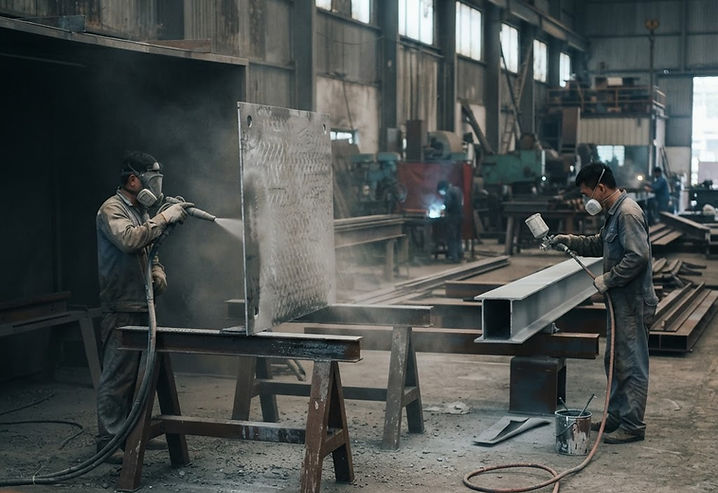
K999 Thailand carries out work of this kind through its abrasive blasting and protective coating team in Rayong.
Further reading
Follow EPC contractors in the United States across the wider market on Project Atlas Intel.
How K999 can help
Material selection and surface protection
We fabricate in stainless, duplex, carbon steel and nickel alloys, and we finish those materials for the environment they will live in, from coastal yards to process plants.
Stainless steel fabrication- 01
Stainless and duplex fabrication with matched filler metals and controlled interpass temperature.
- 02
Abrasive blasting to the specified surface profile before protective coating application.
- 03
Rubber lining and hardfacing for abrasive slurries, chutes and wear plates.
More on Materials & Coatings
All articles


Request for quotation
Need fabricated steel to that standard?
Every enquiry is answered within 48 hours by our estimating team in Rayong. The priced quotation follows once drawings, quantities and standards are confirmed. Stainless steel fabrication, structural steel fabrication, pipe spooling, pressure vessels, steel tanks, mining equipment and conveyors, pig launchers, chutes and hoppers, send the package and we will price it.
Before you request a quotation
Steel fabrication quotation questions
What structural steel fabrication, pressure vessel and pipe spooling packages cost, what to send with an enquiry, and how delivery to site works.
Structural steel fabrication is priced from the section and plate tonnage, the detailing and drawing hours, welding and fitting manhours, NDT requirements, blast and coating system, packing and freight. Grade matters as much as weight: AS/NZS, ASTM, JIS and BS sections carry different mill prices, and heavy built up members take longer than rolled sections. Our Rayong workshop produces around 10,000 tonnes of structural steel fabrication a year, so a clear bill of materials is usually enough to price. Send the drawings and we answer within 48 hours; the priced quotation follows once quantities, standards and delivery dates are confirmed.
For steel fabrication work, send the drawings or IFC package, a bill of materials with material grades, the welding and NDT requirements, the coating specification, the delivery port and your site dates. Add the inspection and test plan, any third party inspection requirement, and whether trial assembly or match marking is needed. Where drawings are still in progress, a scope list with sizes, quantities and duty is enough to start, and the estimate is refined once the final package arrives. Every enquiry is answered within 48 hours, and the priced quotation is issued after scope, standards and quantities are confirmed.
Yes. Pressure vessel fabrication is carried out to ASME Section VIII Div. 1 under our ASME U stamp No. 43,462, or to AS/NZS and BS where the project specifies, covering separators, air receivers, water drums, waste heat recovery units and pig launchers. Steel tanks for fuel, biofuel, chemical, water and food duty are designed in house with our E Tank programme to API, ASME, BS and AS/NZS. Because structural steel, vessels, tanks and their supports are built in the same workshops, one enquiry can cover the vessel package, the tank package and the structural steel that carries them, with a single coating and documentation system and one shipment.
Steel fabrication Australia packages are scheduled from a 33,000 m2 Rayong yard with an 80,000 m2 assembly yard inside Sattahip port, so fabrication, trial assembly, blasting, coating and packing run in one place. Programme length depends on tonnage, material lead times, the coating system and inspection scope, and it is confirmed with the quotation. We quote FOB Laem Chabang, Map Ta Phut or Sattahip, or CIF and DAP to your Australian port, with packing lists, weights, lifting points and a data book per shipment. Staged deliveries can follow your site erection sequence instead of shipping everything at once.
There is no fixed minimum. Pipe spooling Australia packages run at up to 3,000 diameter inches per shift on SCH.40, from a single replacement spool to a full plant piping scope, with spools numbered, X rayed where specified and coated to match erection order. Mining equipment fabrication covers chutes, hoppers, ore bins, transfer towers and conveyor structures with Bisalloy, Hardox, rubber lining or hardfacing fitted in house, from one wear liner set to modules of up to 2,500 tonnes assembled at Sattahip. Send the scope list and we will tell you what the smallest sensible batch is for your programme.