


Industry News
How Steel Manufacturing Impacts Global Trade and Industry
Steel remains the backbone of industrial trade, and its cycles drive construction and equipment investment worldwide.
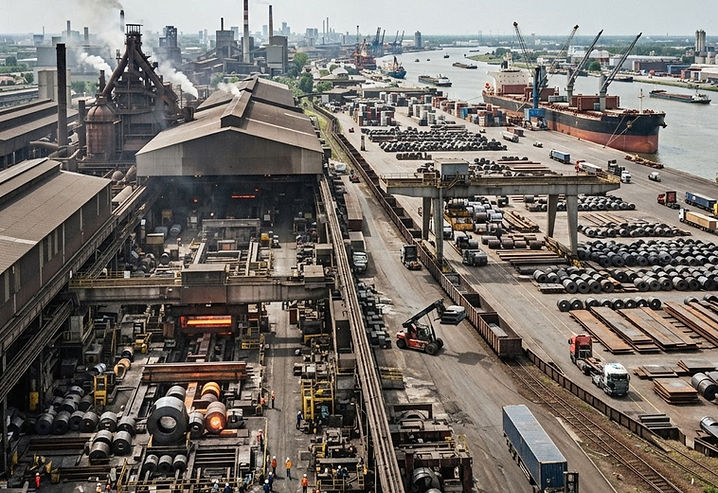
Steel manufacturing lies at the heart of modern society, playing a crucial role in the growth and development of various industries and global supply chains. Its final products can be found in our homes and offices, within our vehicles, as well as industrial machinery. As a result, it has an extensive impact on global trade and industry. In this article, this blog aims to explore the many dimensions of steel manufacturing and fabrication, focusing on the key players, economic and environmental impacts, and coming challenges and opportunities.
Key Players in the Global Steel Industry
Steel mining projects and manufacturing sites employ millions of people within a multifaceted global supply chain. The current steel industry generates trillions of dollars each year, with nations like Australia offering standard steel from a wealth of iron ore, transported to leading steel producing countries, such as China, India, and the United States, who are then responsible for the majority of global steel output.
From here, key industries consuming steel include:
Construction: The construction industry is the largest consumer of steel, capitalizing on its strength, durability, and ability to be molded into various shapes. This makes it an ideal material for building infrastructure, residential and commercial buildings, and bridges.
Automotive: Steel is a critical component in the automotive industry, too, found in the chassis, body panels, engine components, and suspension systems. Steel’s strength, versatility, and cost effectiveness make it the material of choice for many manufacturers.
Machinery and equipment manufacturing: Steel is a core material in agriculture, mining plant and equipment, and industrial manufacturing, used to create components for heavy machinery, tools, and equipment.

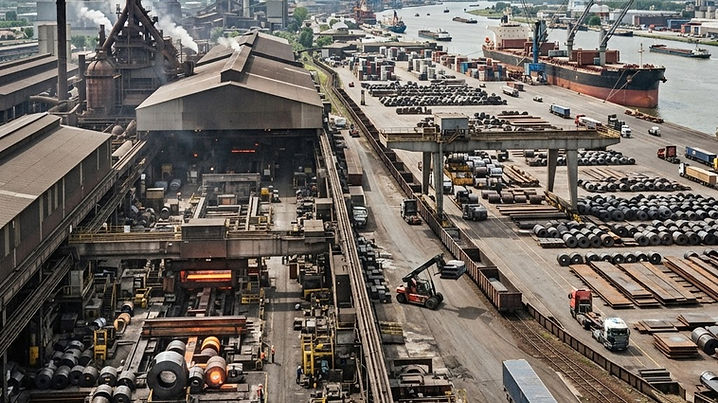
Energy: The energy sector, including oil and gas, renewable energy, and power generation, relies on steel for constructing infrastructure such as pipelines, wind turbines, and power plants.
Shipbuilding: Steel is the primary material used in shipbuilding, providing the necessary strength, durability, and resistance to corrosion needed for marine environments. Ships, submarines, tankers for oil transportation and offshore platforms all require large amounts of steel for their construction and maintenance.
Economic and Environmental Impacts of Steel Manufacturing
Steel manufacturing often dictates the dynamics of various industries, such as structural steel construction and mining. Price fluctuations and market volatility can have far reaching effects on international trade, often leading to the negotiation of trade agreements and the imposition of tariffs. Steel production has significant environmental consequences, including greenhouse gas emissions, resource consumption, and waste generation. As a result, sustainability in steel manufacturing has become a priority for many modern steel manufacturers.
Additionally, environmental regulations substantially impact global trade, as countries and companies strive to comply with new standards. Fortunately, innovative production techniques, such as introducing electric arc furnaces and developing new materials, have improved efficiency and reduced the environmental impact of steel manufacturing. What’s more, these advancements have also altered global competitiveness, with various nations and industry leaders investing in new technologies to maintain their market positions.
Challenges and Opportunities in the Global Steel Market
Overcapacity and market imbalances remain significant challenges for the global steel industry, while trade barriers and protectionism can further complicate matters. Geopolitical tensions can also have a profound effect on the steel trade. With that said, there are opportunities available for growth in emerging markets, particularly for Australian steel producers and those adhering to Australian standard steel.
Closing Thoughts
It is clear that the steel industry has become a driving force behind establishing a thriving global steel trade, creating an interdependence among nations that encourages collaboration, but is also used as a tool amid geopolitical tensions. In the coming decades, demand is only expected to increase with modern economies, likely leading to a new evolution of manufacturing processes and the wider steel industry to become more environmentally and socially conscious.
K999 Thailand carries out work of this kind through its structural steel fabrication team in Rayong.
Further reading
Follow tender intelligence across the wider market on Project Atlas Intel.
Calculation tool
Run the numbers for this yourself with the free metric to imperial converter from Engineering Toolbox Australia. Treat the result as a first check, then confirm the final design with your engineer.
How K999 can help
Where we fit the story
Trade policy, commodity cycles and energy markets decide when projects move, and they decide what gets fabricated. These articles collect the changes we track for our clients.
See our projects- 01
Work delivered for mining, energy, processing and manufacturing clients across Australia and Southeast Asia.
- 02
Fabrication in Rayong with assembly at Sattahip, shipping from Laem Chabang and Map Ta Phut.
- 03
Enquiries answered within 48 hours by our estimating team.
More on Industry News
All articles


Request for quotation
Need fabricated steel to that standard?
Every enquiry is answered within 48 hours by our estimating team in Rayong. The priced quotation follows once drawings, quantities and standards are confirmed. Stainless steel fabrication, structural steel fabrication, pipe spooling, pressure vessels, steel tanks, mining equipment and conveyors, pig launchers, chutes and hoppers, send the package and we will price it.
Before you request a quotation
Steel fabrication quotation questions
What structural steel fabrication, pressure vessel and pipe spooling packages cost, what to send with an enquiry, and how delivery to site works.
Structural steel fabrication is priced from the section and plate tonnage, the detailing and drawing hours, welding and fitting manhours, NDT requirements, blast and coating system, packing and freight. Grade matters as much as weight: AS/NZS, ASTM, JIS and BS sections carry different mill prices, and heavy built up members take longer than rolled sections. Our Rayong workshop produces around 10,000 tonnes of structural steel fabrication a year, so a clear bill of materials is usually enough to price. Send the drawings and we answer within 48 hours; the priced quotation follows once quantities, standards and delivery dates are confirmed.
For steel fabrication work, send the drawings or IFC package, a bill of materials with material grades, the welding and NDT requirements, the coating specification, the delivery port and your site dates. Add the inspection and test plan, any third party inspection requirement, and whether trial assembly or match marking is needed. Where drawings are still in progress, a scope list with sizes, quantities and duty is enough to start, and the estimate is refined once the final package arrives. Every enquiry is answered within 48 hours, and the priced quotation is issued after scope, standards and quantities are confirmed.
Yes. Pressure vessel fabrication is carried out to ASME Section VIII Div. 1 under our ASME U stamp No. 43,462, or to AS/NZS and BS where the project specifies, covering separators, air receivers, water drums, waste heat recovery units and pig launchers. Steel tanks for fuel, biofuel, chemical, water and food duty are designed in house with our E Tank programme to API, ASME, BS and AS/NZS. Because structural steel, vessels, tanks and their supports are built in the same workshops, one enquiry can cover the vessel package, the tank package and the structural steel that carries them, with a single coating and documentation system and one shipment.
Steel fabrication Australia packages are scheduled from a 33,000 m2 Rayong yard with an 80,000 m2 assembly yard inside Sattahip port, so fabrication, trial assembly, blasting, coating and packing run in one place. Programme length depends on tonnage, material lead times, the coating system and inspection scope, and it is confirmed with the quotation. We quote FOB Laem Chabang, Map Ta Phut or Sattahip, or CIF and DAP to your Australian port, with packing lists, weights, lifting points and a data book per shipment. Staged deliveries can follow your site erection sequence instead of shipping everything at once.
There is no fixed minimum. Pipe spooling Australia packages run at up to 3,000 diameter inches per shift on SCH.40, from a single replacement spool to a full plant piping scope, with spools numbered, X rayed where specified and coated to match erection order. Mining equipment fabrication covers chutes, hoppers, ore bins, transfer towers and conveyor structures with Bisalloy, Hardox, rubber lining or hardfacing fitted in house, from one wear liner set to modules of up to 2,500 tonnes assembled at Sattahip. Send the scope list and we will tell you what the smallest sensible batch is for your programme.