


Mining & Resources
Hyperspectral Imaging Technology for Mining
Hyperspectral sensors identify ore mineralogy on the belt, improving recovery decisions in mineral processing plants.
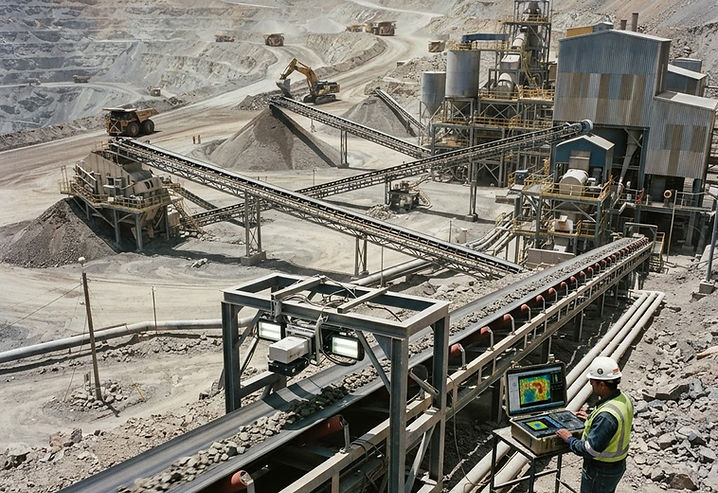
Mineral resources are essential to Australia’s national security as well as to economic prosperity. There is an increased thrust towards a green industry and cities like Queensland are well positioned to play a lead role in this regard. Growth in demand for critical minerals, now referred to as ‘green minerals’, is being stimulated by the move towards a renewable economy, and this calls for innovative approaches in mining. One such innovative technology is hyperspectral imaging. So, what is hyperspectral imaging, and can it be even more useful to miners?
Overview Of Hyperspectral Imaging
Hyperspectral imaging, or imaging spectroscopy, combines the power of digital imaging and spectroscopy. Digital imaging has applications in the medical industry via steel fabrication and hyperspectral cameras scan an item or area, collecting the light intensity of each pixel across the electromagnetic spectrum. The light striking each pixel is broken down into many different bands of colours. This provides thousands more colours than what our eyes can see or what a RGB camera in a smart phone for example, can capture. Humans can only see or collect three colour bands: red, green, and blue, whereas a hyperspectral camera collects and analyses a wide spectrum of light instead of just three colours. This provides an enormous amount of data which results in three dimensional image cubes comprising two spatial dimensions and one spectral dimension.
Hyperspectral Imaging in Mining

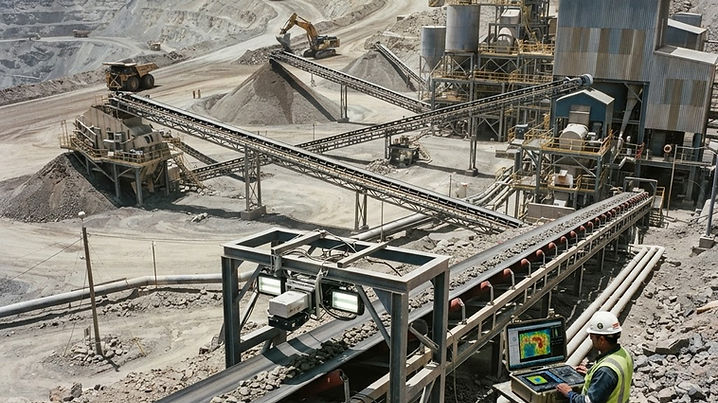
HySpex NEO hyperspectral cameras are advancing the use of spectral imaging in the mining sector for identifying minerals. One example is analysing the reflected light scanning from a drill core sample. Broken down into hundreds of different wavelengths, the unique spectral signatures for each mineral can be recognised, enabling geologists to identify rock types in a core sample. This process is so valuable to geologists that CSIRO has developed a ‘spectral library’ or database of sample types to help with fast identification of mineral types. Modern exploration techniques from multiple platforms, for example spaceborne and airborne, to detect and map the spectral characteristics of the materials, require spectral libraries as an essential reference.
Mineral resource exploration using mining plant and equipment is an essential part of today’s high tech industries and elements such as rare earth elements (REEs) and copper are in especially high demand. Rare earth elements are necessary components of more than 200 products in a wide range of applications. They are used in high tech consumer products, such as cell phones, computer hard drives, electric and hybrid vehicles, and even flat screen monitors and televisions.
Challenges Involved
Reference libraries of spectral data such as the CSIRO’s on its site (and app) called MyLogger are needed to improve hyperspectral scanning of large areas of Australia. A research team was involved in gathering predictive information about ore grades from the outcrop of a former gold, copper, and pyrite mine in Cyprus using hyperspectral data gathered from cameras on the ground and from UAV scans. In mapping the distribution of surface minerals, the team tested ’spectral libraries’. However, compiling, interpreting, and analysing the hyperspectral data requires significant expertise. It can also be time consuming and extend the turnover rate required for proactive intervention. This is not ideal for on site mining and steel fabrication operations.
To meet this challenge, HySpex NEO have joined forces with a consortium of European partners and the Sustainable Minerals Institute in Queensland, enabled by AusScope, in a project called M4Mining. The challenge for this group is to deliver a hyperspectral camera mounted on a drone that can provide calibrated, corrected, and even interpreted data from a scan within 24 hours, making decisions at mine sites far more useful as well as far more economical.
Closing Thoughts
It can be observed that hyperspectral imaging has the potential to add a layer of dynamism to on site mining operations and production. It is a cutting edge technique which can be quickly used to identify mineral types, however efficient data analyzing methods need to be incorporated to ensure that hyperspectral imaging is effective. Expect Australia’s mining industry to gravitate towards this technique, we will be hearing a lot more about hyperspectral imaging soon!
K999 Thailand carries out work of this kind through its mining equipment fabrication team in Rayong.
Further reading
Follow project lifecycle intelligence across the wider market on Project Atlas Intel.
Calculation tool
Run the numbers for this yourself with the free engineering unit converter from Engineering Toolbox Australia. Treat the result as a first check, then confirm the final design with your engineer.
How K999 can help
Equipment built for the pit
Mining work is where wear life decides the maintenance budget, so the articles in this section feed directly into how we detail chutes, hoppers, conveyors and wear parts.
Mining equipment and conveyors- 01
Mining equipment and conveyor fabrication with replaceable wear liners and hardfaced contact surfaces.
- 02
Chutes, hoppers and transfer structures detailed for access, lifting and shutdown windows.
- 03
Site assembly planning from the Sattahip yard for modules that ship by sea.
More on Mining & Resources
All articles

Request for quotation
Need fabricated steel to that standard?
Every enquiry is answered within 48 hours by our estimating team in Rayong. The priced quotation follows once drawings, quantities and standards are confirmed. Stainless steel fabrication, structural steel fabrication, pipe spooling, pressure vessels, steel tanks, mining equipment and conveyors, pig launchers, chutes and hoppers, send the package and we will price it.
Before you request a quotation
Steel fabrication quotation questions
What structural steel fabrication, pressure vessel and pipe spooling packages cost, what to send with an enquiry, and how delivery to site works.
Structural steel fabrication is priced from the section and plate tonnage, the detailing and drawing hours, welding and fitting manhours, NDT requirements, blast and coating system, packing and freight. Grade matters as much as weight: AS/NZS, ASTM, JIS and BS sections carry different mill prices, and heavy built up members take longer than rolled sections. Our Rayong workshop produces around 10,000 tonnes of structural steel fabrication a year, so a clear bill of materials is usually enough to price. Send the drawings and we answer within 48 hours; the priced quotation follows once quantities, standards and delivery dates are confirmed.
For steel fabrication work, send the drawings or IFC package, a bill of materials with material grades, the welding and NDT requirements, the coating specification, the delivery port and your site dates. Add the inspection and test plan, any third party inspection requirement, and whether trial assembly or match marking is needed. Where drawings are still in progress, a scope list with sizes, quantities and duty is enough to start, and the estimate is refined once the final package arrives. Every enquiry is answered within 48 hours, and the priced quotation is issued after scope, standards and quantities are confirmed.
Yes. Pressure vessel fabrication is carried out to ASME Section VIII Div. 1 under our ASME U stamp No. 43,462, or to AS/NZS and BS where the project specifies, covering separators, air receivers, water drums, waste heat recovery units and pig launchers. Steel tanks for fuel, biofuel, chemical, water and food duty are designed in house with our E Tank programme to API, ASME, BS and AS/NZS. Because structural steel, vessels, tanks and their supports are built in the same workshops, one enquiry can cover the vessel package, the tank package and the structural steel that carries them, with a single coating and documentation system and one shipment.
Steel fabrication Australia packages are scheduled from a 33,000 m2 Rayong yard with an 80,000 m2 assembly yard inside Sattahip port, so fabrication, trial assembly, blasting, coating and packing run in one place. Programme length depends on tonnage, material lead times, the coating system and inspection scope, and it is confirmed with the quotation. We quote FOB Laem Chabang, Map Ta Phut or Sattahip, or CIF and DAP to your Australian port, with packing lists, weights, lifting points and a data book per shipment. Staged deliveries can follow your site erection sequence instead of shipping everything at once.
There is no fixed minimum. Pipe spooling Australia packages run at up to 3,000 diameter inches per shift on SCH.40, from a single replacement spool to a full plant piping scope, with spools numbered, X rayed where specified and coated to match erection order. Mining equipment fabrication covers chutes, hoppers, ore bins, transfer towers and conveyor structures with Bisalloy, Hardox, rubber lining or hardfacing fitted in house, from one wear liner set to modules of up to 2,500 tonnes assembled at Sattahip. Send the scope list and we will tell you what the smallest sensible batch is for your programme.