


Manufacturing & Technology
Importance of Communication in Manufacturing
Clear drawing queries, shift handovers and client updates prevent the misunderstandings that cost fabrication hours.
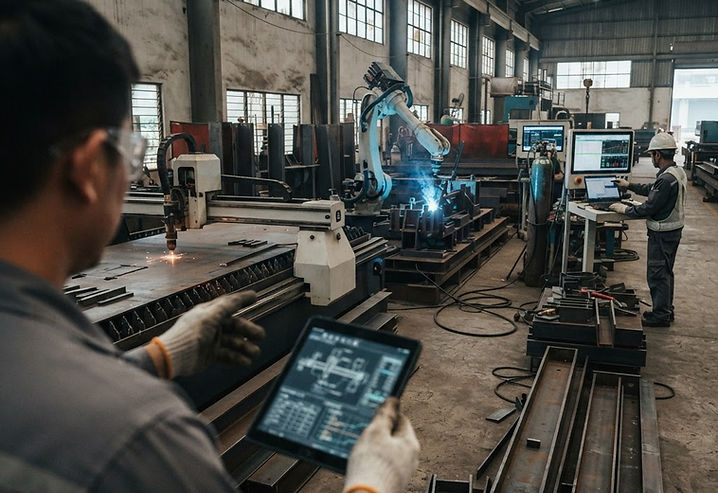
In manufacturing, efficient communication is not just a desirable attribute; it is an absolute necessity. The seamless flow of information within a manufacturing plant can significantly impact productivity, product quality, employee morale, and the overall bottom line. Conversely, the cost of bad communication can be staggering, both in financial terms and in terms of the long term health of the organization. In this blog post, we will explore the various facets of this issue and understand why investing in effective communication is a crucial consideration for manufacturing plants.
Production Delays and Quality Control
One of the most immediate and obvious consequences of bad communication in a manufacturing plant is production delays. When critical information fails to reach the right people at the right time, it can lead to bottlenecks, downtime, and missed deadlines. Delays in production not only impact customer satisfaction but also increase operational costs as resources are underutilized and overtime pay may be required to catch up.
Quality management and control is paramount in manufacturing, and bad communication can undermine it significantly. Without clear communication channels, employees may not be aware of changes in production processes, quality standards, or product specifications. This can result in defective products, increased rework, higher scrap rates, and the potential for costly recalls or customer returns.
Employee Morale and Retention
Effective communication is not just about transmitting information; it is also about fostering a positive work environment. When employees feel that their voices are not heard or that they are not well informed about company policies and decisions, morale can suffer. It is detrimental to employee morale when employees do not feel heard or are unaware of company policies and decisions. Consequently, it can lead to increased turnover rates, which come with their own set of recruitment and training costs.

Safety Risks
Safety (such as fire safety ) should always be a top priority in manufacturing, and bad communication can pose significant safety risks. Failure to communicate essential safety protocols, hazards, or emergency procedures can result in accidents, injuries, and even fatalities. These incidents not only have devastating human costs but also legal and financial ramifications for the organization.
Inventory Management
Manufacturing plants often rely on efficient inventory management to minimize storage costs and maintain just in time production. However, when communication breakdowns occur between production and supply chain teams, inventory levels can become inaccurate. Overstocked or understocked items can lead to financial losses due to carrying costs or production halts when necessary materials (e.g. mining plant and equipment ) are unavailable.
Decision Making and Reputation Damage
In an era of data driven decision making, timely access to accurate information is crucial. Bad communication can lead to confusion and misinformation, making it difficult for leaders to make informed choices. This can result in poor strategic decisions, missed opportunities, and financial losses in the long run.
Lastly, the cost of bad communication extends beyond the internal operations of a manufacturing plant. Negative publicity or customer complaints stemming from communication failures can damage the company’s reputation. Rebuilding trust and credibility can be a costly and time consuming endeavour.
Final Thoughts
The cost of bad communication in manufacturing plants is multifaceted and can have far reaching consequences. From production delays and quality control issues to safety risks and damage to the company’s reputation, the impacts are significant. To mitigate these costs, steel fabrication Australia companies should invest in robust communication systems, foster a culture of open and transparent communication, and provide training and tools to enhance communication skills at all levels of the organization. In doing so, they can not only reduce costs but also position themselves for long term success in a highly competitive industry!
K999 Thailand carries out work of this kind through its steel fabrication capability team in Rayong.
Further reading
Follow fabrication yards in Southeast Asia across the wider market on Project Atlas Intel.
How K999 can help
How we apply the technology
Faster quoting, cleaner detailing and fewer site surprises come from the tools we use before the first cut, and the articles here explain how those tools change the work.
3D modelling and detailing- 01
3D modelling and shop detailing that resolves clashes before fabrication starts.
- 02
Fibre laser cutting for plate profiles, with nesting planned around the rolling schedule.
- 03
Project management that reports progress against the same model the client approved.
More on Manufacturing & Technology
All articles

Request for quotation
Need fabricated steel to that standard?
Every enquiry is answered within 48 hours by our estimating team in Rayong. The priced quotation follows once drawings, quantities and standards are confirmed. Stainless steel fabrication, structural steel fabrication, pipe spooling, pressure vessels, steel tanks, mining equipment and conveyors, pig launchers, chutes and hoppers, send the package and we will price it.
Before you request a quotation
Steel fabrication quotation questions
What structural steel fabrication, pressure vessel and pipe spooling packages cost, what to send with an enquiry, and how delivery to site works.
Structural steel fabrication is priced from the section and plate tonnage, the detailing and drawing hours, welding and fitting manhours, NDT requirements, blast and coating system, packing and freight. Grade matters as much as weight: AS/NZS, ASTM, JIS and BS sections carry different mill prices, and heavy built up members take longer than rolled sections. Our Rayong workshop produces around 10,000 tonnes of structural steel fabrication a year, so a clear bill of materials is usually enough to price. Send the drawings and we answer within 48 hours; the priced quotation follows once quantities, standards and delivery dates are confirmed.
For steel fabrication work, send the drawings or IFC package, a bill of materials with material grades, the welding and NDT requirements, the coating specification, the delivery port and your site dates. Add the inspection and test plan, any third party inspection requirement, and whether trial assembly or match marking is needed. Where drawings are still in progress, a scope list with sizes, quantities and duty is enough to start, and the estimate is refined once the final package arrives. Every enquiry is answered within 48 hours, and the priced quotation is issued after scope, standards and quantities are confirmed.
Yes. Pressure vessel fabrication is carried out to ASME Section VIII Div. 1 under our ASME U stamp No. 43,462, or to AS/NZS and BS where the project specifies, covering separators, air receivers, water drums, waste heat recovery units and pig launchers. Steel tanks for fuel, biofuel, chemical, water and food duty are designed in house with our E Tank programme to API, ASME, BS and AS/NZS. Because structural steel, vessels, tanks and their supports are built in the same workshops, one enquiry can cover the vessel package, the tank package and the structural steel that carries them, with a single coating and documentation system and one shipment.
Steel fabrication Australia packages are scheduled from a 33,000 m2 Rayong yard with an 80,000 m2 assembly yard inside Sattahip port, so fabrication, trial assembly, blasting, coating and packing run in one place. Programme length depends on tonnage, material lead times, the coating system and inspection scope, and it is confirmed with the quotation. We quote FOB Laem Chabang, Map Ta Phut or Sattahip, or CIF and DAP to your Australian port, with packing lists, weights, lifting points and a data book per shipment. Staged deliveries can follow your site erection sequence instead of shipping everything at once.
There is no fixed minimum. Pipe spooling Australia packages run at up to 3,000 diameter inches per shift on SCH.40, from a single replacement spool to a full plant piping scope, with spools numbered, X rayed where specified and coated to match erection order. Mining equipment fabrication covers chutes, hoppers, ore bins, transfer towers and conveyor structures with Bisalloy, Hardox, rubber lining or hardfacing fitted in house, from one wear liner set to modules of up to 2,500 tonnes assembled at Sattahip. Send the scope list and we will tell you what the smallest sensible batch is for your programme.