


Manufacturing & Technology
In House vs. Outsourced Additive Manufacturing
Owning a metal printer suits iterative design work, while outsourcing covers occasional parts and certified processes.
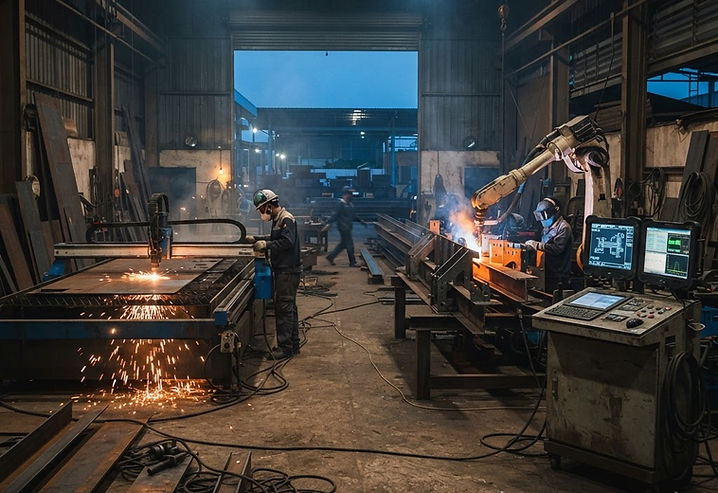
Additive manufacturing, more commonly known as 3D printing, has revolutionized the manufacturing industry by enabling the creation of complex geometries and customized parts with unprecedented speed and efficiency. As businesses embrace this transformative technology, they face a critical decision: whether to invest in in house 3D printing capabilities or outsource their additive manufacturing needs to specialized service providers. Each approach offers distinct advantages and considerations, tailored to different business goals and operational requirements.
In House: Empowering Control and Flexibility
Investing in in house additive manufacturing involves procuring 3D printers, hiring skilled operators, and establishing a dedicated workspace within the facility. This approach offers several compelling benefits:
Control Over Production: With in house 3D printing, you have direct control over the entire manufacturing process, from design iterations to final production. This enables greater flexibility in adjusting designs and timelines based on evolving project requirements.
Confidentiality and Intellectual Property: Keeping additive manufacturing in house ensures that sensitive designs and proprietary information remain within the organization, minimizing the risk of data breaches or intellectual property theft.
Speed and Responsiveness: By eliminating the need for external communication and logistics, in house printing reduces lead times and enables rapid prototyping and production of parts on demand such as additive manufacturing in the meat processing industry.
Cost Efficiency in the Long Run: While initial setup costs can be substantial, particularly for high end printers and specialized materials, in house additive manufacturing can yield significant cost savings over time, especially for businesses with consistent or high volume printing needs such as mining plant and equipment Australia.
Outsourced: Leveraging Expertise and Scalability
Alternatively, outsourcing additive manufacturing to specialized service providers offers its own set of advantages:

Access to Advanced Technology: Service providers often invest in state of the art 3D printing equipment and technologies that may be prohibitively expensive for individual businesses to acquire. This provides access to a wider range of materials and printing capabilities without upfront capital investment.
Scalability and Flexibility: Outsourcing allows businesses to scale production up or down quickly in response to fluctuating demand, without the constraints of equipment capacity or operational overhead.
Expertise and Quality Assurance: Reputable service providers employ skilled technicians who are proficient in postprocessing techniques for additive manufacturing and ensuring consistent quality across batches. This expertise can result in superior part performance and reliability.
Risk Mitigation: Outsourcing reduces the operational risks associated with equipment maintenance, material management, and technological obsolescence. Service agreements often include guarantees on quality, delivery timelines, and service levels.
Making the Decision: Factors to Consider
When deciding between in house and outsourced additive manufacturing, businesses should carefully evaluate the following factors:
Cost Considerations: Assess upfront investment costs, operational expenses, and potential cost savings over the long term.
Production Volume and Frequency: Determine whether the production volumes justify the investment in in house equipment or if outsourcing provides more cost effective scalability.
Technological Requirements: Consider the complexity of the designs and the specific material properties required. Evaluate whether in house capabilities align with the technological needs or if outsourcing offers access to superior pipe fabrication Australia and expertise.
Strategic Goals and Timelines: Align the additive manufacturing strategy with the business objectives, including time to market considerations, product customization requirements, and supply chain optimization.
Final Thoughts
In conclusion, both in house and outsourced additive manufacturing present viable pathways to harnessing the transformative potential of 3D printing in manufacturing. The choice between these approaches ultimately hinges on the organization’s specific needs, strategic objectives, and operational capabilities. Whether prioritizing control and flexibility through in house capabilities or leveraging external expertise and scalability through outsourcing, embracing additive manufacturing promises to enhance innovation, efficiency, and competitiveness in the evolving landscape of modern manufacturing.
K999 Thailand carries out work of this kind through its steel fabrication capability team in Rayong.
Further reading
Follow project contacts directory across the wider market on Project Atlas Intel.
How K999 can help
How we apply the technology
Faster quoting, cleaner detailing and fewer site surprises come from the tools we use before the first cut, and the articles here explain how those tools change the work.
3D modelling and detailing- 01
3D modelling and shop detailing that resolves clashes before fabrication starts.
- 02
Fibre laser cutting for plate profiles, with nesting planned around the rolling schedule.
- 03
Project management that reports progress against the same model the client approved.
More on Manufacturing & Technology
All articles

Request for quotation
Need fabricated steel to that standard?
Every enquiry is answered within 48 hours by our estimating team in Rayong. The priced quotation follows once drawings, quantities and standards are confirmed. Stainless steel fabrication, structural steel fabrication, pipe spooling, pressure vessels, steel tanks, mining equipment and conveyors, pig launchers, chutes and hoppers, send the package and we will price it.
Before you request a quotation
Steel fabrication quotation questions
What structural steel fabrication, pressure vessel and pipe spooling packages cost, what to send with an enquiry, and how delivery to site works.
Structural steel fabrication is priced from the section and plate tonnage, the detailing and drawing hours, welding and fitting manhours, NDT requirements, blast and coating system, packing and freight. Grade matters as much as weight: AS/NZS, ASTM, JIS and BS sections carry different mill prices, and heavy built up members take longer than rolled sections. Our Rayong workshop produces around 10,000 tonnes of structural steel fabrication a year, so a clear bill of materials is usually enough to price. Send the drawings and we answer within 48 hours; the priced quotation follows once quantities, standards and delivery dates are confirmed.
For steel fabrication work, send the drawings or IFC package, a bill of materials with material grades, the welding and NDT requirements, the coating specification, the delivery port and your site dates. Add the inspection and test plan, any third party inspection requirement, and whether trial assembly or match marking is needed. Where drawings are still in progress, a scope list with sizes, quantities and duty is enough to start, and the estimate is refined once the final package arrives. Every enquiry is answered within 48 hours, and the priced quotation is issued after scope, standards and quantities are confirmed.
Yes. Pressure vessel fabrication is carried out to ASME Section VIII Div. 1 under our ASME U stamp No. 43,462, or to AS/NZS and BS where the project specifies, covering separators, air receivers, water drums, waste heat recovery units and pig launchers. Steel tanks for fuel, biofuel, chemical, water and food duty are designed in house with our E Tank programme to API, ASME, BS and AS/NZS. Because structural steel, vessels, tanks and their supports are built in the same workshops, one enquiry can cover the vessel package, the tank package and the structural steel that carries them, with a single coating and documentation system and one shipment.
Steel fabrication Australia packages are scheduled from a 33,000 m2 Rayong yard with an 80,000 m2 assembly yard inside Sattahip port, so fabrication, trial assembly, blasting, coating and packing run in one place. Programme length depends on tonnage, material lead times, the coating system and inspection scope, and it is confirmed with the quotation. We quote FOB Laem Chabang, Map Ta Phut or Sattahip, or CIF and DAP to your Australian port, with packing lists, weights, lifting points and a data book per shipment. Staged deliveries can follow your site erection sequence instead of shipping everything at once.
There is no fixed minimum. Pipe spooling Australia packages run at up to 3,000 diameter inches per shift on SCH.40, from a single replacement spool to a full plant piping scope, with spools numbered, X rayed where specified and coated to match erection order. Mining equipment fabrication covers chutes, hoppers, ore bins, transfer towers and conveyor structures with Bisalloy, Hardox, rubber lining or hardfacing fitted in house, from one wear liner set to modules of up to 2,500 tonnes assembled at Sattahip. Send the scope list and we will tell you what the smallest sensible batch is for your programme.