


Manufacturing & Technology
Industrial Robots and Humans
The practical split between robot and human work in a fabrication shop, and the safety envelope that keeps them apart.
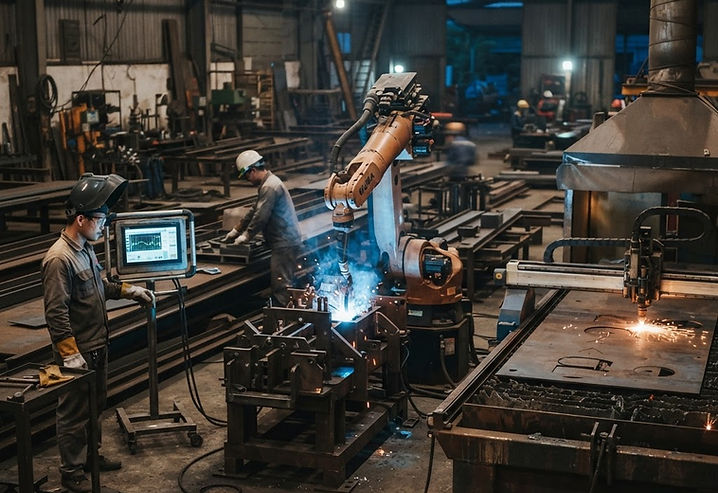
The conversation around robots and their use in steel fabrication Australia has long been controversial. Many fear the introduction of robots into the workplace will displace human jobs. In some respects, yes, robots will replace some jobs, but it is not that simple. Robots will replace lower level menial jobs such as quality control on a factory line and lead to new opportunities for employees. This blog will explore the often misunderstood implications of introducing industrial robots in the manufacturing workplace.
Benefits of Cobots
People have off days and are subject to fatigue, illness, and complacency. Robots and machines (such as mining plant and equipment Australia) do not. But the question is, what happens to those employees after their jobs are made obsolete? This is where the employee benefits. Those employees who were underutilised in the past can move into better quality jobs that require problem solving or roles that require more job fulfillment. These are higher quality jobs and many of them are done in concert with robotics. These are called collaborative robots, or cobots for short. Cobots have come a long way over the past decade, to the extent that they can potentially bridge Australia’s welder shortage. With safety in mind, these robots work alongside human counterparts and can handle the heavy lifting for humans, allowing them to focus on the mental workload. For example, at Amazon, cobots are used to move products to pickers rather than the picker going to the shelf, pulling the product, and returning to their station. This saves the worker time, steps, and possibly a lot of heavy lifting. The cobot saves the worker’s energy and reduces wear and tear on their bodies.
Regulatory Considerations
Today’s safety standards for cobots are exceptionally stringent, as they should be. There are numerous safety features on cobots as defined by ISO/TS 15066, which provides guidelines for the design and implementation of collaborative workspaces. This enables shop manufacturers and heavy steel fabrication companies to safely incorporate cobots into overlapping workspaces between humans and their mechanical counterparts.
Some examples:

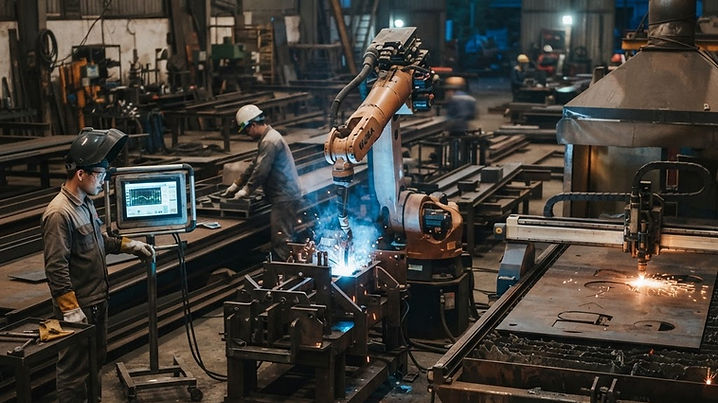
Maximum allowable speed, this is set at the point of the EOAT (End of arm tooling). These speeds are in line with human equivalent speeds.
Speed and separation monitoring, this defines the minimum safety distance between the worker and the robot system to prevent contact between the robot and the human. This can be achieved using safety scanners, light curtains, and operator presence mats.
Power, force and torque Limits, cobots are designed to measure torque at every joint in case of excessive torques or forces and monitor for sudden impacts, including soft obstructions.
Redundant checking systems diagnostics, if the robot detects an anomaly or error at any point, the robot will disable motor power instantly.
Safety rated stop modes, cobots are required to act based on the level of risk. That could be a full emergency stop if a safety mishap has occurred, or it may be a protective stop if a human has entered its operating area.
Ergonomic design, six axis robots have a number of potential pinch points. By designing those joints ergonomically, the worker can avoid injury should their hand, fingers, or even loose clothing get trapped in a joint.
Closing Comments
With the installation of robots in a production setting, great care must be taken to ensure a truly safe workspace. This is particularly true in an overlapping workspace shared by humans and their robot counterparts. It is important to consult a professional installer or integrator to do a full risk assessment and ensure all applicable safety codes and regulations with regard to cobots are met. Cobots have the ability to reduce manufacturing downtime, increase production rates and increase quality, all while reducing waste. They can be a force multiplier for your production force. In today’s world, where we all face labour shortages, increased competition, and high consumer demand, cobots can be an equaliser while creating higher quality jobs.
K999 Thailand carries out work of this kind through its steel fabrication capability team in Rayong.
Further reading
Follow Hydrogen across the wider market on Project Atlas Intel.
Calculation tool
Run the numbers for this yourself with the free engineering unit converter from Engineering Toolbox Australia. Treat the result as a first check, then confirm the final design with your engineer.
How K999 can help
How we apply the technology
Faster quoting, cleaner detailing and fewer site surprises come from the tools we use before the first cut, and the articles here explain how those tools change the work.
3D modelling and detailing- 01
3D modelling and shop detailing that resolves clashes before fabrication starts.
- 02
Fibre laser cutting for plate profiles, with nesting planned around the rolling schedule.
- 03
Project management that reports progress against the same model the client approved.
More on Manufacturing & Technology
All articles

Request for quotation
Need fabricated steel to that standard?
Every enquiry is answered within 48 hours by our estimating team in Rayong. The priced quotation follows once drawings, quantities and standards are confirmed. Stainless steel fabrication, structural steel fabrication, pipe spooling, pressure vessels, steel tanks, mining equipment and conveyors, pig launchers, chutes and hoppers, send the package and we will price it.
Before you request a quotation
Steel fabrication quotation questions
What structural steel fabrication, pressure vessel and pipe spooling packages cost, what to send with an enquiry, and how delivery to site works.
Structural steel fabrication is priced from the section and plate tonnage, the detailing and drawing hours, welding and fitting manhours, NDT requirements, blast and coating system, packing and freight. Grade matters as much as weight: AS/NZS, ASTM, JIS and BS sections carry different mill prices, and heavy built up members take longer than rolled sections. Our Rayong workshop produces around 10,000 tonnes of structural steel fabrication a year, so a clear bill of materials is usually enough to price. Send the drawings and we answer within 48 hours; the priced quotation follows once quantities, standards and delivery dates are confirmed.
For steel fabrication work, send the drawings or IFC package, a bill of materials with material grades, the welding and NDT requirements, the coating specification, the delivery port and your site dates. Add the inspection and test plan, any third party inspection requirement, and whether trial assembly or match marking is needed. Where drawings are still in progress, a scope list with sizes, quantities and duty is enough to start, and the estimate is refined once the final package arrives. Every enquiry is answered within 48 hours, and the priced quotation is issued after scope, standards and quantities are confirmed.
Yes. Pressure vessel fabrication is carried out to ASME Section VIII Div. 1 under our ASME U stamp No. 43,462, or to AS/NZS and BS where the project specifies, covering separators, air receivers, water drums, waste heat recovery units and pig launchers. Steel tanks for fuel, biofuel, chemical, water and food duty are designed in house with our E Tank programme to API, ASME, BS and AS/NZS. Because structural steel, vessels, tanks and their supports are built in the same workshops, one enquiry can cover the vessel package, the tank package and the structural steel that carries them, with a single coating and documentation system and one shipment.
Steel fabrication Australia packages are scheduled from a 33,000 m2 Rayong yard with an 80,000 m2 assembly yard inside Sattahip port, so fabrication, trial assembly, blasting, coating and packing run in one place. Programme length depends on tonnage, material lead times, the coating system and inspection scope, and it is confirmed with the quotation. We quote FOB Laem Chabang, Map Ta Phut or Sattahip, or CIF and DAP to your Australian port, with packing lists, weights, lifting points and a data book per shipment. Staged deliveries can follow your site erection sequence instead of shipping everything at once.
There is no fixed minimum. Pipe spooling Australia packages run at up to 3,000 diameter inches per shift on SCH.40, from a single replacement spool to a full plant piping scope, with spools numbered, X rayed where specified and coated to match erection order. Mining equipment fabrication covers chutes, hoppers, ore bins, transfer towers and conveyor structures with Bisalloy, Hardox, rubber lining or hardfacing fitted in house, from one wear liner set to modules of up to 2,500 tonnes assembled at Sattahip. Send the scope list and we will tell you what the smallest sensible batch is for your programme.