


Fabrication
Laser Cutting vs. Plasma Cutting
Edge quality, thickness range and running cost compared, so plate is cut on the process that suits the job rather than the default.
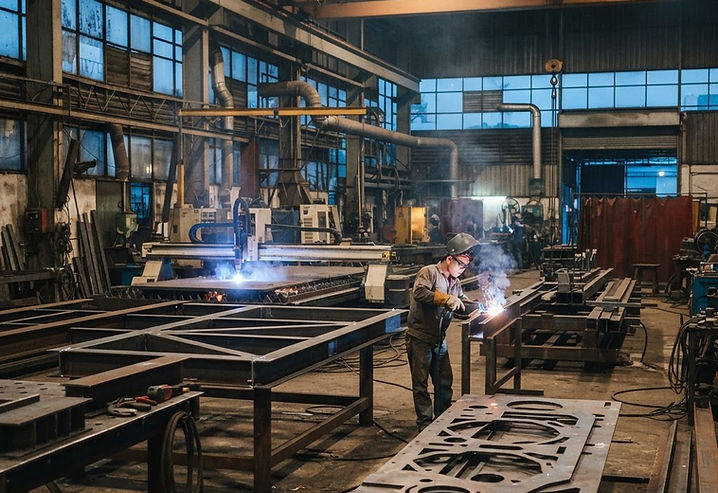
There are many factors which determine the metal cutting process to be used in fabrication projects such as, budget, timeline, costs, production rates, precision levels, and methods of configuring parts. In this regard, laser cutting and plasma cutting stand out as effective solutions for a range of industries. Laser cutting is a process that uses a highly concentrated, intense pulsed or continuous beam of light to cut various metals while plasma cutting uses a melting technique to deliver precise work (e.g., water tanks ). So, what are the considerations to be kept in mind when choosing the best cutting method? We will look to dive deeper into this topic.
Overview of Laser and Plasma Cutting
Laser cutting utilizes laser optics and the use of computer numerical control (CNC) to heat and melt the metal while partially vaporizing it. It creates pristine, accurate cuts and works with a range of metals. This technique is often used for various industrial manufacturing applications such as manufacturing pressure vessels, as well as for engraving details, creating intricate notches, and cutting small shapes. Laser cutting is especially useful in cases when the products require precision, whether it is a complex or simple part. Advantages of laser cutting include cutting a wider variety of metals, having a standard tolerance of +/- 0.005″ and being equipped to cut thinner, more intricate metals.
In Plasma cutting, ionized gas, also known as plasma, melts the metal and then expels it. Essentially, compressed air and inert gasses like nitrogen and hydrogen shoot through a nozzle at extreme speeds to essentially blast metals such as stainless steel, copper, aluminum, steel, brass, and others with plasma. This cutting process supports applications like automotive repair, industrial construction, and hopper and tank fabrication, among others.
Choosing the Right Cutting Method

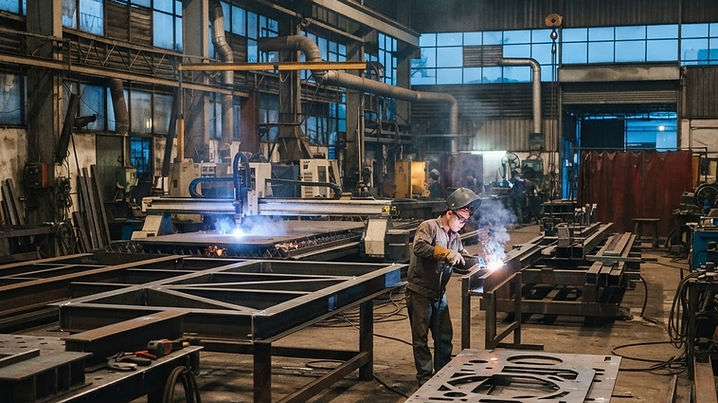
Working with a plasma cutting machine vs. a laser cutting machine can produce different solutions depending on many factors, two of which are the type and thickness of the metal. Some considerations involved when choosing the best cutting method are as follows:,
Cut edge quality: The quality of a part’s cut edge refers to the squareness of a product’s finished borders. Laser cutting creates a square cut while plasma cutting results in a lower edge quality level, as it is beveled.
Cut part precision: This precision depends on many aspects, such as heat distortion and the kerf width, as well as the size of the part vs. its programmed size. Laser cutting creates better part precision compared to the plasma technique, hence it adds value as part of custom metal fabrication techniques.
Cost: The cost of laser vs. plasma metal cutting takes factors such as power, abrasives, gases, consumables, and maintenance into consideration. While plasma cutting is often more cost effective, the laser technique is faster if thick metals are not being used.
Production rate: The time taken to cut the metal should also be considered. Plasma cutting will be more efficient with thicker metals, while the laser method is faster and more precise with thinner resources.
Metal thickness: Laser cutters can cut metals up to 1 inch thick, while plasma can cut up to 5 inches or more.
The Verdict
Laser cutting is a superior option to plasma cutting when direct comparisons are made regarding precision, flexibility, production, edge quality and metal thickness. Understanding how a plasma cutting machine works compared to the laser technique indicates that the latter can help produce products with better precision and quality irrespective of the type of metal. Though laser cutting can be more expensive, it provides a lot of freedom to businesses and is the preferred cutting method of industries!
K999 Thailand carries out work of this kind through its laser cutting and profile cutting team in Rayong.
Further reading
Follow Hydrogen across the wider market on Project Atlas Intel.
Calculation tool
Run the numbers for this yourself with the free engineering unit converter from Engineering Toolbox Australia. Treat the result as a first check, then confirm the final design with your engineer.
How K999 can help
Fabrication capacity behind the article
Articles in this section describe work we run every week in Rayong: cutting, forming, welding and assembly, under cover and in the yard, with the documentation that goes with it.
Structural steel fabrication- 01
Two workshops totalling more than 33,000 m² plus an 80,000 m² assembly yard at Sattahip.
- 02
Structural steel fabrication to 10,000 tonnes a year, with the largest single module built at 2,500 tonnes.
- 03
Blast, prime and paint before dispatch, with dimensional reports issued against the approved drawings.
More on Fabrication
All articles


Request for quotation
Need fabricated steel to that standard?
Every enquiry is answered within 48 hours by our estimating team in Rayong. The priced quotation follows once drawings, quantities and standards are confirmed. Stainless steel fabrication, structural steel fabrication, pipe spooling, pressure vessels, steel tanks, mining equipment and conveyors, pig launchers, chutes and hoppers, send the package and we will price it.
Before you request a quotation
Steel fabrication quotation questions
What structural steel fabrication, pressure vessel and pipe spooling packages cost, what to send with an enquiry, and how delivery to site works.
Structural steel fabrication is priced from the section and plate tonnage, the detailing and drawing hours, welding and fitting manhours, NDT requirements, blast and coating system, packing and freight. Grade matters as much as weight: AS/NZS, ASTM, JIS and BS sections carry different mill prices, and heavy built up members take longer than rolled sections. Our Rayong workshop produces around 10,000 tonnes of structural steel fabrication a year, so a clear bill of materials is usually enough to price. Send the drawings and we answer within 48 hours; the priced quotation follows once quantities, standards and delivery dates are confirmed.
For steel fabrication work, send the drawings or IFC package, a bill of materials with material grades, the welding and NDT requirements, the coating specification, the delivery port and your site dates. Add the inspection and test plan, any third party inspection requirement, and whether trial assembly or match marking is needed. Where drawings are still in progress, a scope list with sizes, quantities and duty is enough to start, and the estimate is refined once the final package arrives. Every enquiry is answered within 48 hours, and the priced quotation is issued after scope, standards and quantities are confirmed.
Yes. Pressure vessel fabrication is carried out to ASME Section VIII Div. 1 under our ASME U stamp No. 43,462, or to AS/NZS and BS where the project specifies, covering separators, air receivers, water drums, waste heat recovery units and pig launchers. Steel tanks for fuel, biofuel, chemical, water and food duty are designed in house with our E Tank programme to API, ASME, BS and AS/NZS. Because structural steel, vessels, tanks and their supports are built in the same workshops, one enquiry can cover the vessel package, the tank package and the structural steel that carries them, with a single coating and documentation system and one shipment.
Steel fabrication Australia packages are scheduled from a 33,000 m2 Rayong yard with an 80,000 m2 assembly yard inside Sattahip port, so fabrication, trial assembly, blasting, coating and packing run in one place. Programme length depends on tonnage, material lead times, the coating system and inspection scope, and it is confirmed with the quotation. We quote FOB Laem Chabang, Map Ta Phut or Sattahip, or CIF and DAP to your Australian port, with packing lists, weights, lifting points and a data book per shipment. Staged deliveries can follow your site erection sequence instead of shipping everything at once.
There is no fixed minimum. Pipe spooling Australia packages run at up to 3,000 diameter inches per shift on SCH.40, from a single replacement spool to a full plant piping scope, with spools numbered, X rayed where specified and coated to match erection order. Mining equipment fabrication covers chutes, hoppers, ore bins, transfer towers and conveyor structures with Bisalloy, Hardox, rubber lining or hardfacing fitted in house, from one wear liner set to modules of up to 2,500 tonnes assembled at Sattahip. Send the scope list and we will tell you what the smallest sensible batch is for your programme.