


Fabrication
Metal Bending - K and Y Factors
Bend allowance depends on the K and Y factors, and understanding them keeps flat patterns accurate across material types.
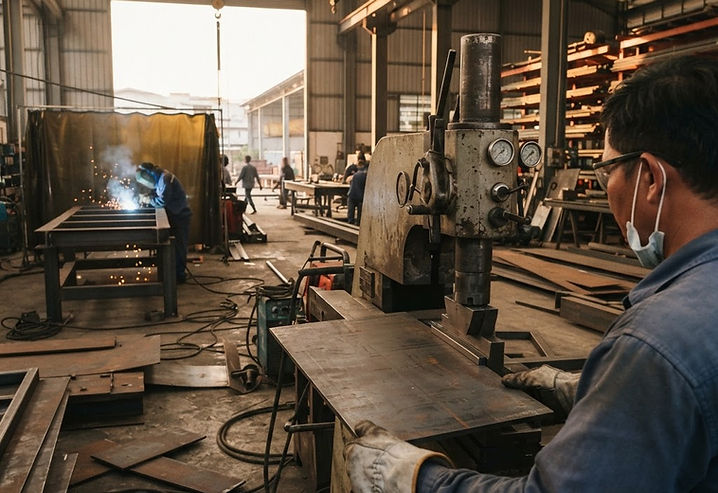
Bending of metal is an important process in metal fabrication operations, an application of which are I beams in structural steel construction. When metal sheets are bent, the top surface contracts and the bottom surface stretches. The neutral radius is the internal border between these two phases inside the metal. This border exactly divides the thickness of the metal while the metal is flat, but it moves when the metal is bent. The K factor and Y factor of sheet metal are two measures of its ductility and flexibility, respectively, during bending. What are these measures and how do they assist fabricators in the metal bending process? This blog will look to delve deeper in this topic and also provide an overview of types of metal bending.
Types of Metal Bending
Minimum radius, perfect radius, sharp radius, and sharp bends are the four fundamental categories of metal bending in light metal fabrication operations. The metal is manipulated until its radius is the shortest it can be without creases being formed, and this is known as the minimum radius bend. Using this number, the sharpest and most precise of bends can be located. Perfect bends have radii that range from the minimum to 125% of the material’s thickness. To generate a radius bend, the deviation must be greater than 125% of the metal’s thickness. At the other extreme of the spectrum are 90 degree angles. These appear when the metal is bent beyond its bending radius, creating a sharp crease.
What are K and Y Factors?

The K factor describes the relationship between the neutral axis and the thickness of a sheet of metal. A metal sheet is bent by compressing the inner area and expanding the outside using heat induction bending services. The neutral axis shifts from its initial position at 50% of the material thickness towards the inner surface of the bend, but no further changes take place in this region where compression and expansion meet. Elongation happens during bending because the neutral axis moves, but its length remains constant. The thickness, inner bend radius, and forming process all have a role in how much the neutral axis moves. On standard charts, the K factor is found by dividing the neutral radius by the thickness of the material, and it ranges from 0.3 to 0.5.
The Y Factor is a derivative of the more standard K Factor. It is calculated by reducing the K Factor by 0.5, then multiplying that result by pi. The Y factor is comparable to the K factor but more accurately accounts for the stresses present in the material being examined.
How is K factor determined?
Measuring multiple different metals will provide data points required to calculate the K factor. It is necessary to know the interior radius along with the outside dimensions and the pre- and postbent dimensions. Gauge pins, radius gauges, or an optical comparator may be used to determine these values. The BA, or bend allowance can be calculated using this data. Sheet elongation may be determined with the bend allowance. Readings of the included angle, which is 180 degrees, and the complimentary bend angle, which is Ir minus the included angle should be taken. Discovering the material’s thickness, Mt, allows one to compute the K factor for bending sheet metal. The K factor may be calculated by dividing 180 by the product of BA and the ratio of Ir to Mt, and by the difference between the product of pi, Mt, and the corresponding bend angle. This formula may be written mathematically as:
K factor = 180 x BA ( x Complementary Bend Angle x Mt), (Ir x Mt)
Concluding Thoughts
The degree to which a metal is stretched while bending is a vital metric to be considered when designing large scale infrastructure like bridges, airports, offices etc. It is here that K and Y factors play a role by making metal bending more precise without damaging the material during steel fabrication. K and Y factors may be mathematically complex concepts; however, fabricators swear by them when it comes to bending a length of flat sheet metal!
Further reading
Follow Mineral Processing across the wider market on Project Atlas Intel.
Calculation tool
Run the numbers for this yourself with the free materials and metallurgy articles from Engineering Toolbox Australia. Treat the result as a first check, then confirm the final design with your engineer.
How K999 can help
Fabrication capacity behind the article
Articles in this section describe work we run every week in Rayong: cutting, forming, welding and assembly, under cover and in the yard, with the documentation that goes with it.
Structural steel fabrication- 01
Two workshops totalling more than 33,000 m² plus an 80,000 m² assembly yard at Sattahip.
- 02
Structural steel fabrication to 10,000 tonnes a year, with the largest single module built at 2,500 tonnes.
- 03
Blast, prime and paint before dispatch, with dimensional reports issued against the approved drawings.
More on Fabrication
All articles


Request for quotation
Need fabricated steel to that standard?
Every enquiry is answered within 48 hours by our estimating team in Rayong. The priced quotation follows once drawings, quantities and standards are confirmed. Stainless steel fabrication, structural steel fabrication, pipe spooling, pressure vessels, steel tanks, mining equipment and conveyors, pig launchers, chutes and hoppers, send the package and we will price it.
Before you request a quotation
Steel fabrication quotation questions
What structural steel fabrication, pressure vessel and pipe spooling packages cost, what to send with an enquiry, and how delivery to site works.
Structural steel fabrication is priced from the section and plate tonnage, the detailing and drawing hours, welding and fitting manhours, NDT requirements, blast and coating system, packing and freight. Grade matters as much as weight: AS/NZS, ASTM, JIS and BS sections carry different mill prices, and heavy built up members take longer than rolled sections. Our Rayong workshop produces around 10,000 tonnes of structural steel fabrication a year, so a clear bill of materials is usually enough to price. Send the drawings and we answer within 48 hours; the priced quotation follows once quantities, standards and delivery dates are confirmed.
For steel fabrication work, send the drawings or IFC package, a bill of materials with material grades, the welding and NDT requirements, the coating specification, the delivery port and your site dates. Add the inspection and test plan, any third party inspection requirement, and whether trial assembly or match marking is needed. Where drawings are still in progress, a scope list with sizes, quantities and duty is enough to start, and the estimate is refined once the final package arrives. Every enquiry is answered within 48 hours, and the priced quotation is issued after scope, standards and quantities are confirmed.
Yes. Pressure vessel fabrication is carried out to ASME Section VIII Div. 1 under our ASME U stamp No. 43,462, or to AS/NZS and BS where the project specifies, covering separators, air receivers, water drums, waste heat recovery units and pig launchers. Steel tanks for fuel, biofuel, chemical, water and food duty are designed in house with our E Tank programme to API, ASME, BS and AS/NZS. Because structural steel, vessels, tanks and their supports are built in the same workshops, one enquiry can cover the vessel package, the tank package and the structural steel that carries them, with a single coating and documentation system and one shipment.
Steel fabrication Australia packages are scheduled from a 33,000 m2 Rayong yard with an 80,000 m2 assembly yard inside Sattahip port, so fabrication, trial assembly, blasting, coating and packing run in one place. Programme length depends on tonnage, material lead times, the coating system and inspection scope, and it is confirmed with the quotation. We quote FOB Laem Chabang, Map Ta Phut or Sattahip, or CIF and DAP to your Australian port, with packing lists, weights, lifting points and a data book per shipment. Staged deliveries can follow your site erection sequence instead of shipping everything at once.
There is no fixed minimum. Pipe spooling Australia packages run at up to 3,000 diameter inches per shift on SCH.40, from a single replacement spool to a full plant piping scope, with spools numbered, X rayed where specified and coated to match erection order. Mining equipment fabrication covers chutes, hoppers, ore bins, transfer towers and conveyor structures with Bisalloy, Hardox, rubber lining or hardfacing fitted in house, from one wear liner set to modules of up to 2,500 tonnes assembled at Sattahip. Send the scope list and we will tell you what the smallest sensible batch is for your programme.