


Industry News
Metal Fabrication in Aboriginal Australian Communities
Training and local fabrication capability create employment pathways for remote Australian communities.
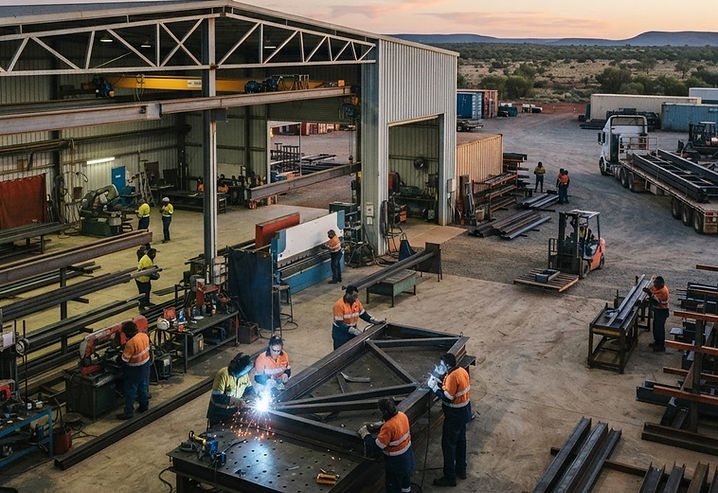
Metal fabrication is often associated with industrial and modern contexts, but its significance extends into traditional and contemporary practices in Aboriginal Australian communities. For Indigenous Australians, metalworking is not just a practical skill but also an integral part of their cultural heritage and innovation. This blog explores how metal fabrication intersects with Aboriginal traditions, craftsmanship, and modern practices.
Traditional Contexts and Tools
Aboriginal Australians are renowned for their intricate craftsmanship and deep connection to the land. Traditionally, Aboriginal communities employed a range of tools made from natural materials such as wood, bone, and stone. These tools were essential for survival, including digging sticks, boomerangs, and hunting spears. Metalworking was introduced to Aboriginal communities through European contact (e.g. preliminary iron casting ), but its integration into traditional practices has been both innovative and respectful of cultural heritage. The introduction of metal tools revolutionized many aspects of daily life for Aboriginal people. Early metal items, often sourced from discarded or surplus European materials, were adapted, and repurposed to enhance traditional practices. Metal blades replaced stone ones in tools and weapons, which significantly improved efficiency and effectiveness. For instance, metal axes and knives allowed for easier clearing of land and processing of food.
Cultural Adaptation and Innovation

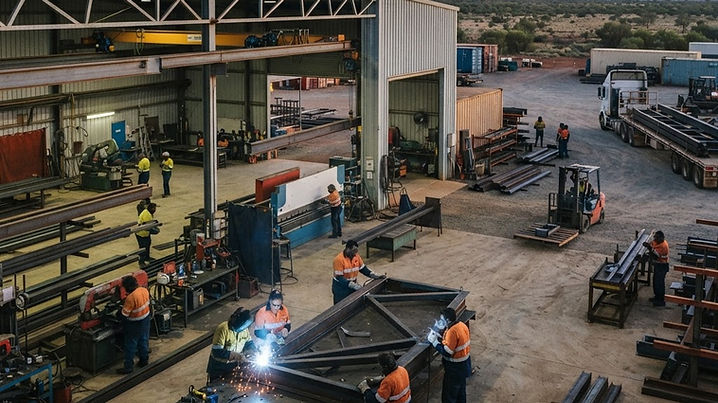
Aboriginal Australians did not merely adopt metalworking; they adapted it to fit their cultural context and needs. Hand tools for sheet metal work were often integrated into traditional craft practices, blending old techniques with new materials. This fusion is evident in various art forms, including metal jewellery and decorations that incorporate both traditional Aboriginal designs and modern metalworking techniques. Artists and craftspeople have used metal to create intricate and meaningful works, combining traditional motifs with contemporary metal fabrication. This blend of traditional knowledge with modern materials allows for the preservation and evolution of cultural practices. For instance, some Aboriginal artists use metal to create sculptures and art pieces that reflect their connection to the land, spirituality, and ancestry.
Modern Metal Fabrication
In contemporary Aboriginal Australian communities, metal fabrication has evolved to incorporate advanced technologies and techniques. Modern metalworking methods, such as welding and laser cutting, are employed alongside traditional practices. This integration reflects a broader trend of incorporating contemporary technologies into traditional lifestyles while maintaining cultural integrity. The use of metal in mining plant and equipment Australia extends beyond traditional craftsmanship. Modern Aboriginal artists and designers utilize metalworking techniques to create contemporary art installations, functional objects, and public artworks. These creations often carry strong cultural messages and serve to promote Aboriginal heritage and identity in a modern context.
Challenges and Future Direction
While metal fabrication has brought many benefits to Aboriginal communities, it also presents challenges. The introduction of new technologies and materials can sometimes create tensions between traditional practices and modern innovations. Balancing these aspects requires careful consideration and respect for cultural values and traditions. Future developments in steel fabrication Australia within Aboriginal communities will likely continue to embrace both traditional craftsmanship and modern techniques. As technology advances, there will be opportunities to explore new forms of artistic expression and practical applications while maintaining a strong connection to cultural heritage.
Final Thoughts
Metal fabrication has played a significant role in the evolution of Aboriginal Australian craftsmanship and daily life. From the adaptation of European metal tools to the incorporation of modern metalworking techniques, Aboriginal communities have demonstrated resilience, innovation, and a deep connection to their cultural heritage. As metal fabrication continues to evolve, it offers exciting possibilities for preserving and celebrating Aboriginal traditions while embracing contemporary practices. This dynamic intersection of tradition and innovation highlights the ongoing relevance and adaptability of Aboriginal Australian culture in the modern world.
Further reading
Follow global industrial project database across the wider market on Project Atlas Intel.
How K999 can help
Where we fit the story
Trade policy, commodity cycles and energy markets decide when projects move, and they decide what gets fabricated. These articles collect the changes we track for our clients.
See our projects- 01
Work delivered for mining, energy, processing and manufacturing clients across Australia and Southeast Asia.
- 02
Fabrication in Rayong with assembly at Sattahip, shipping from Laem Chabang and Map Ta Phut.
- 03
Enquiries answered within 48 hours by our estimating team.
More on Industry News
All articles


Request for quotation
Need fabricated steel to that standard?
Every enquiry is answered within 48 hours by our estimating team in Rayong. The priced quotation follows once drawings, quantities and standards are confirmed. Stainless steel fabrication, structural steel fabrication, pipe spooling, pressure vessels, steel tanks, mining equipment and conveyors, pig launchers, chutes and hoppers, send the package and we will price it.
Before you request a quotation
Steel fabrication quotation questions
What structural steel fabrication, pressure vessel and pipe spooling packages cost, what to send with an enquiry, and how delivery to site works.
Structural steel fabrication is priced from the section and plate tonnage, the detailing and drawing hours, welding and fitting manhours, NDT requirements, blast and coating system, packing and freight. Grade matters as much as weight: AS/NZS, ASTM, JIS and BS sections carry different mill prices, and heavy built up members take longer than rolled sections. Our Rayong workshop produces around 10,000 tonnes of structural steel fabrication a year, so a clear bill of materials is usually enough to price. Send the drawings and we answer within 48 hours; the priced quotation follows once quantities, standards and delivery dates are confirmed.
For steel fabrication work, send the drawings or IFC package, a bill of materials with material grades, the welding and NDT requirements, the coating specification, the delivery port and your site dates. Add the inspection and test plan, any third party inspection requirement, and whether trial assembly or match marking is needed. Where drawings are still in progress, a scope list with sizes, quantities and duty is enough to start, and the estimate is refined once the final package arrives. Every enquiry is answered within 48 hours, and the priced quotation is issued after scope, standards and quantities are confirmed.
Yes. Pressure vessel fabrication is carried out to ASME Section VIII Div. 1 under our ASME U stamp No. 43,462, or to AS/NZS and BS where the project specifies, covering separators, air receivers, water drums, waste heat recovery units and pig launchers. Steel tanks for fuel, biofuel, chemical, water and food duty are designed in house with our E Tank programme to API, ASME, BS and AS/NZS. Because structural steel, vessels, tanks and their supports are built in the same workshops, one enquiry can cover the vessel package, the tank package and the structural steel that carries them, with a single coating and documentation system and one shipment.
Steel fabrication Australia packages are scheduled from a 33,000 m2 Rayong yard with an 80,000 m2 assembly yard inside Sattahip port, so fabrication, trial assembly, blasting, coating and packing run in one place. Programme length depends on tonnage, material lead times, the coating system and inspection scope, and it is confirmed with the quotation. We quote FOB Laem Chabang, Map Ta Phut or Sattahip, or CIF and DAP to your Australian port, with packing lists, weights, lifting points and a data book per shipment. Staged deliveries can follow your site erection sequence instead of shipping everything at once.
There is no fixed minimum. Pipe spooling Australia packages run at up to 3,000 diameter inches per shift on SCH.40, from a single replacement spool to a full plant piping scope, with spools numbered, X rayed where specified and coated to match erection order. Mining equipment fabrication covers chutes, hoppers, ore bins, transfer towers and conveyor structures with Bisalloy, Hardox, rubber lining or hardfacing fitted in house, from one wear liner set to modules of up to 2,500 tonnes assembled at Sattahip. Send the scope list and we will tell you what the smallest sensible batch is for your programme.