


Industry News
Metal Fabrication in Agriculture
Implements, silos, conveyors and structural sheds make agriculture one of the steadiest markets for fabricated steel.
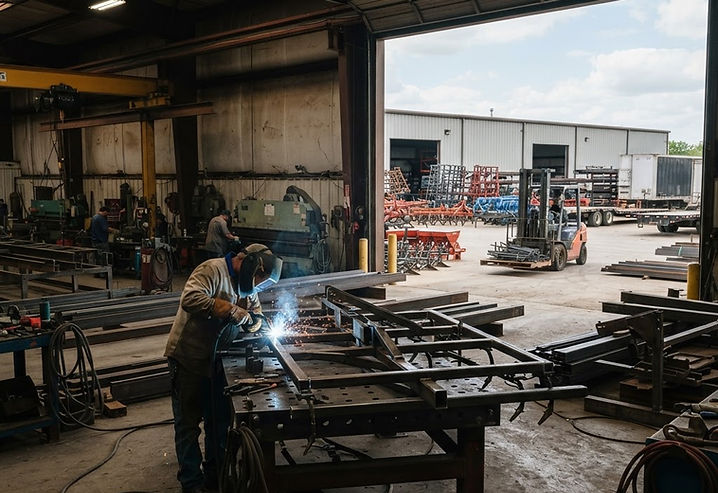
The applications of metal fabrication in industries like mining and medicine are well known, however fabrication also has a huge role to play in the agriculture industry. It is a crucial aspect of modern agriculture that enables farmers to increase efficiency and productivity. From customizing machinery to improving the durability of tools, metal fabrication has numerous benefits for the agricultural industry. In the field of agricultural mechanization, there have been significant advances such as precision agriculture and autonomous tractors. In this post, we will explore the different processes involved in metal fabrication and how they can positively impact the agricultural industry.
New Fabrication Technologies in Agriculture
With manufacturing companies becoming increasingly environmentally conscious and farmers become more demanding of high efficiency machines, new technologies are starting to gain popularity, not just in agricultural machinery manufacturing, but across all manufacturing industries. Some of these new technologies are:
Additive Manufacturing (3D Printing): This is a process in which three dimensional objects are built up layer by layer from a digital model, allowing for the creation of complex shapes and structures. This process is being used in the production of small and lightweight parts for tractors and other agricultural machinery.
Robotic Welding: This is a process in which a robot is used to perform welding tasks, improving efficiency, and reducing the risk of human error. This process is commonly used in the production of large, complex agricultural machinery components.
Hydroforming: This is a process in which a metal tube is placed inside a die and then subjected to high pressure to form it into a complex shape using pipe fabrication. This process is being used in the production of high strength and lightweight structural components for tractors and other agricultural machinery.
Composite Material Processing: This is a process in which composite materials, such as fiber reinforced plastics, are molded and shaped into complex components. This process is being used in the production of lightweight, corrosion resistant components for tractors and other agricultural machinery.

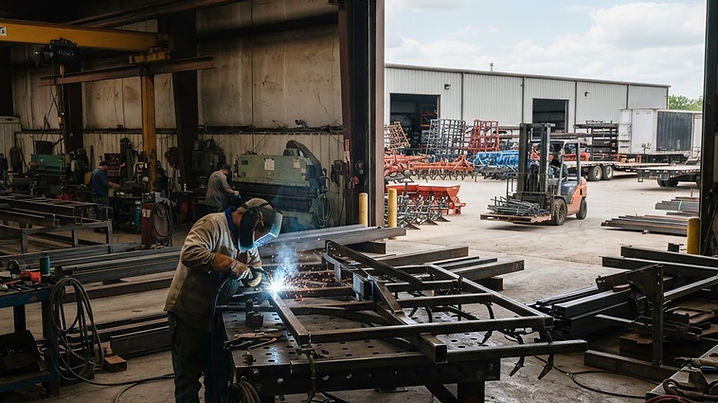
Applications of Fabrication in Agriculture
There are several common applications of metal fabrication in the agriculture industry, as follows:,
Tractors: Tractors are widely used in Australian farming for a variety of tasks, such as ploughing, cultivations, planting, and harvesting. They are also used to power a variety of implements, such as tillage equipment, cultivators, and mowers.
Combine Harvesters: Combine harvesters are used for the simultaneous harvesting of crops such as wheat, barley, and canola. They cut and thresh the grain, separating the grain from the straw.
Sprayers: Sprayers are used to apply fertilizers, herbicides, and pesticides to crops. There are both ground based and aerial sprayers available, depending on the type of crops and the size of the farm.
Hay Balers: Hay balers are used to make bales of hay and silage, which are then stored for use in pressure vessels as animal feed. Round balers and square balers are the two most common types of hay balers used in Australia.
Irrigation Equipment: Irrigation equipment, such as center pivot irrigation systems and drip irrigation systems, are used to supply water to crops in areas where rainfall is insufficient.
Conclusion
Metal fabrication has revolutionized the agricultural industry in countless ways, from improving the efficiency and productivity of farming operations to enhancing the durability and longevity of equipment. Custom metal fabrication enables farmers to design and build machinery and tools that are specific to their needs, offering cost effective solutions that can improve crop yield and quality. The use of advanced techniques such as CNC machining has further expanded the possibilities for custom metal fabrication in agriculture. It is clear that metal fabrication will continue to play a critical role in the agricultural industry for years to come!
K999 Thailand carries out work of this kind through its structural steel fabrication team in Rayong.
Further reading
Follow EPC contractors in the United States across the wider market on Project Atlas Intel.
How K999 can help
Where we fit the story
Trade policy, commodity cycles and energy markets decide when projects move, and they decide what gets fabricated. These articles collect the changes we track for our clients.
See our projects- 01
Work delivered for mining, energy, processing and manufacturing clients across Australia and Southeast Asia.
- 02
Fabrication in Rayong with assembly at Sattahip, shipping from Laem Chabang and Map Ta Phut.
- 03
Enquiries answered within 48 hours by our estimating team.
More on Industry News
All articles


Request for quotation
Need fabricated steel to that standard?
Every enquiry is answered within 48 hours by our estimating team in Rayong. The priced quotation follows once drawings, quantities and standards are confirmed. Stainless steel fabrication, structural steel fabrication, pipe spooling, pressure vessels, steel tanks, mining equipment and conveyors, pig launchers, chutes and hoppers, send the package and we will price it.
Before you request a quotation
Steel fabrication quotation questions
What structural steel fabrication, pressure vessel and pipe spooling packages cost, what to send with an enquiry, and how delivery to site works.
Structural steel fabrication is priced from the section and plate tonnage, the detailing and drawing hours, welding and fitting manhours, NDT requirements, blast and coating system, packing and freight. Grade matters as much as weight: AS/NZS, ASTM, JIS and BS sections carry different mill prices, and heavy built up members take longer than rolled sections. Our Rayong workshop produces around 10,000 tonnes of structural steel fabrication a year, so a clear bill of materials is usually enough to price. Send the drawings and we answer within 48 hours; the priced quotation follows once quantities, standards and delivery dates are confirmed.
For steel fabrication work, send the drawings or IFC package, a bill of materials with material grades, the welding and NDT requirements, the coating specification, the delivery port and your site dates. Add the inspection and test plan, any third party inspection requirement, and whether trial assembly or match marking is needed. Where drawings are still in progress, a scope list with sizes, quantities and duty is enough to start, and the estimate is refined once the final package arrives. Every enquiry is answered within 48 hours, and the priced quotation is issued after scope, standards and quantities are confirmed.
Yes. Pressure vessel fabrication is carried out to ASME Section VIII Div. 1 under our ASME U stamp No. 43,462, or to AS/NZS and BS where the project specifies, covering separators, air receivers, water drums, waste heat recovery units and pig launchers. Steel tanks for fuel, biofuel, chemical, water and food duty are designed in house with our E Tank programme to API, ASME, BS and AS/NZS. Because structural steel, vessels, tanks and their supports are built in the same workshops, one enquiry can cover the vessel package, the tank package and the structural steel that carries them, with a single coating and documentation system and one shipment.
Steel fabrication Australia packages are scheduled from a 33,000 m2 Rayong yard with an 80,000 m2 assembly yard inside Sattahip port, so fabrication, trial assembly, blasting, coating and packing run in one place. Programme length depends on tonnage, material lead times, the coating system and inspection scope, and it is confirmed with the quotation. We quote FOB Laem Chabang, Map Ta Phut or Sattahip, or CIF and DAP to your Australian port, with packing lists, weights, lifting points and a data book per shipment. Staged deliveries can follow your site erection sequence instead of shipping everything at once.
There is no fixed minimum. Pipe spooling Australia packages run at up to 3,000 diameter inches per shift on SCH.40, from a single replacement spool to a full plant piping scope, with spools numbered, X rayed where specified and coated to match erection order. Mining equipment fabrication covers chutes, hoppers, ore bins, transfer towers and conveyor structures with Bisalloy, Hardox, rubber lining or hardfacing fitted in house, from one wear liner set to modules of up to 2,500 tonnes assembled at Sattahip. Send the scope list and we will tell you what the smallest sensible batch is for your programme.