


Manufacturing & Technology
Mid Size Manufacturers and ERP
Mid size fabricators gain most from ERP when it covers estimating, material traceability and job costing rather than everything at once.
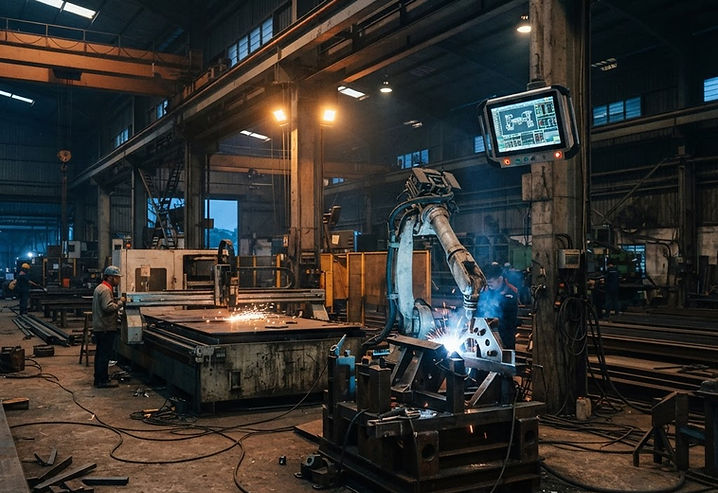
Mid sized manufacturers implementing ERP systems have typically faced one of two dilemmas: overspend with one of the “Big Four” consultants who will lump you into their mid size practice, or cobble together a solution that is more cost effective, but does not truly match the need, leading to inefficiencies and continued spend to connect relevant structural steel fabrication systems. Unlike larger global manufacturers, mid sized manufacturers do not have deep pockets, and often lack the internal resources to guide an ERP rollout from start to finish. These challenges leave many mid sized manufacturers stuck in limbo, wasting time searching for a middle ground solution, questioning which path to take, or making no forward progress at all. Luckily, resources do exist designed specifically to address this gap. But to find the right partner and be successful, companies need to follow a few best practices as discussed in this blog.
Define Short- and Long Term Goals
ERP rollouts can be a lengthy process, so breaking them into manageable pieces can be helpful. This eliminates spreading internal resources too thin and has the added benefit of parceling budget out over a longer timeframe. But all ERP rollouts should still track toward an end goal, whether that is end to end visibility across the supply chain, creating operational efficiencies, minimizing unplanned downtime, boosting productivity, or a combination of factors. It is important too, to acknowledge that predicting long term outcomes can be challenging, especially in light of uncertainties like regulatory changes, political pressures or potential recessions. Tapping into an ERP consultant that has a broad view of the market and potential changes that could derail success is one way to reduce the risk of incorrectly prioritizing elements of the rollout.
Look Beyond the Data

Data is a real, yet intangible asset. Its value lies in our ability to glean information out of massive volumes of data, and that requires context. Beyond the act of interconnecting systems, companies must outline a vision for what they hope to gain from their data. For example, interconnected or aggregated data within mining plant and equipment Australia that drives better demand forecasting may require a different type of analysis and reporting than data needed for streamlined production planning, or inventory optimization. Without experience building systems to deliver this type of context, manufacturers can struggle to achieve business process integration across manufacturing processes. A consultant with mid size experience can offer guidance on how other similar sized organizations have handled scenarios like yours, which can be a big time saver. Furthermore, they can shed light on how data can be used beyond ERP systems to extend the value of the investment.
Seek a Partner
Due to the multiyear deployment structure of most ERP systems, it is important to seek out a partner that will stick with you through all stages and demonstrate how value is delivered at each step. During the procurement stage, lay out expectations for technical deliverables as well as strategic and soft skills required, such as a project roadmap, timelines, dedicated consultants, training, and service level guarantees. Ensure that any partner brought on is applying creative thought processes, such as design thinking, to your program, versus trying to fit your organization into their standard project management template. Work to develop a complete timeline, with stages of the rollout clearly defined so expectations are managed on each side.
Concluding Statement
Mid sized manufacturers do not have to be locked in to choosing between a pricey ERP partner or sacrificing quality for cost. At the end of the day, mid size organizations face the same operational challenges as their larger counterparts, and should experience the same high level of service, optimized for their budget and needs. With a more active guidance mindset, the right partner can help pave the path toward greater efficiency, productivity, and knowledge, making it easier to compete in today’s market.
K999 Thailand carries out work of this kind through its steel fabrication capability team in Rayong.
Further reading
Follow tenders across the entire Middle East across the wider market on Project Atlas Intel.
How K999 can help
How we apply the technology
Faster quoting, cleaner detailing and fewer site surprises come from the tools we use before the first cut, and the articles here explain how those tools change the work.
3D modelling and detailing- 01
3D modelling and shop detailing that resolves clashes before fabrication starts.
- 02
Fibre laser cutting for plate profiles, with nesting planned around the rolling schedule.
- 03
Project management that reports progress against the same model the client approved.
More on Manufacturing & Technology
All articles

Request for quotation
Need fabricated steel to that standard?
Every enquiry is answered within 48 hours by our estimating team in Rayong. The priced quotation follows once drawings, quantities and standards are confirmed. Stainless steel fabrication, structural steel fabrication, pipe spooling, pressure vessels, steel tanks, mining equipment and conveyors, pig launchers, chutes and hoppers, send the package and we will price it.
Before you request a quotation
Steel fabrication quotation questions
What structural steel fabrication, pressure vessel and pipe spooling packages cost, what to send with an enquiry, and how delivery to site works.
Structural steel fabrication is priced from the section and plate tonnage, the detailing and drawing hours, welding and fitting manhours, NDT requirements, blast and coating system, packing and freight. Grade matters as much as weight: AS/NZS, ASTM, JIS and BS sections carry different mill prices, and heavy built up members take longer than rolled sections. Our Rayong workshop produces around 10,000 tonnes of structural steel fabrication a year, so a clear bill of materials is usually enough to price. Send the drawings and we answer within 48 hours; the priced quotation follows once quantities, standards and delivery dates are confirmed.
For steel fabrication work, send the drawings or IFC package, a bill of materials with material grades, the welding and NDT requirements, the coating specification, the delivery port and your site dates. Add the inspection and test plan, any third party inspection requirement, and whether trial assembly or match marking is needed. Where drawings are still in progress, a scope list with sizes, quantities and duty is enough to start, and the estimate is refined once the final package arrives. Every enquiry is answered within 48 hours, and the priced quotation is issued after scope, standards and quantities are confirmed.
Yes. Pressure vessel fabrication is carried out to ASME Section VIII Div. 1 under our ASME U stamp No. 43,462, or to AS/NZS and BS where the project specifies, covering separators, air receivers, water drums, waste heat recovery units and pig launchers. Steel tanks for fuel, biofuel, chemical, water and food duty are designed in house with our E Tank programme to API, ASME, BS and AS/NZS. Because structural steel, vessels, tanks and their supports are built in the same workshops, one enquiry can cover the vessel package, the tank package and the structural steel that carries them, with a single coating and documentation system and one shipment.
Steel fabrication Australia packages are scheduled from a 33,000 m2 Rayong yard with an 80,000 m2 assembly yard inside Sattahip port, so fabrication, trial assembly, blasting, coating and packing run in one place. Programme length depends on tonnage, material lead times, the coating system and inspection scope, and it is confirmed with the quotation. We quote FOB Laem Chabang, Map Ta Phut or Sattahip, or CIF and DAP to your Australian port, with packing lists, weights, lifting points and a data book per shipment. Staged deliveries can follow your site erection sequence instead of shipping everything at once.
There is no fixed minimum. Pipe spooling Australia packages run at up to 3,000 diameter inches per shift on SCH.40, from a single replacement spool to a full plant piping scope, with spools numbered, X rayed where specified and coated to match erection order. Mining equipment fabrication covers chutes, hoppers, ore bins, transfer towers and conveyor structures with Bisalloy, Hardox, rubber lining or hardfacing fitted in house, from one wear liner set to modules of up to 2,500 tonnes assembled at Sattahip. Send the scope list and we will tell you what the smallest sensible batch is for your programme.