


Welding & Testing
Minimizing Distortion in Critical Heavy Plate Structural Welds
Learn practical methods to control structural distortion during heavy plate fabrication. This guide focuses on heat management, sequence planning, and mechanical restraint techniques for high-integrity steel projects.
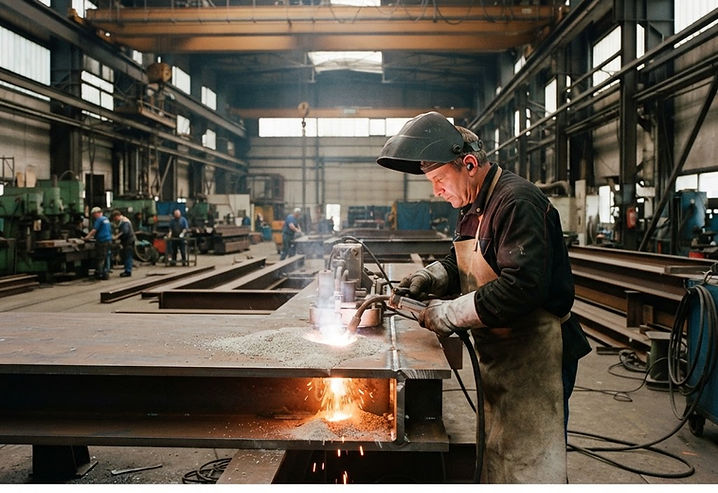
Managing thermal distortion is one of the most persistent challenges in industrial steel fabrication. When welding heavy plates for mineral processing projects, the localized heat input often leads to buckling or angular misalignment. Even a minor deviation can cause significant delays during final fit-up. Understanding the physics of cooling is essential to maintaining dimensional tolerances.
Why does balancing welding sequence prevent plate buckling?
Uneven thermal expansion and contraction are the primary drivers of plate movement. If you weld one side of a joint completely before starting the other, the metal will pull toward the hot side. This creates a permanent angular distortion that is difficult to correct without heat straightening.
To mitigate this, adopt a balanced welding approach. By alternating passes between the top and bottom of a double V-groove joint, you equalize the force across the neutral axis. This method works especially well during large scale module assembly at Sattahip for offshore energy platforms.
Consider these tactics for better control:
- Use back-stepping to distribute longitudinal shrinkage over shorter segments.
- Weld from the center of the joint outward toward the ends.
- Keep weld bead sizes consistent to prevent irregular contraction forces.
How can mechanical restraint improve structural integrity?
Mechanical restraint is often underutilized during complex fabrications. By pinning heavy sections to the floor or using heavy-duty strongbacks, you physically limit the metal's ability to move while the weld pool solidifies. This forces the stresses to dissipate through the weld metal itself rather than warping the base plate.
However, you must be careful with excessive restraint. If the joint is too rigid, the shrinkage stresses can lead to cold cracking in the heat affected zone. This is particularly relevant when working with high-strength low-alloy steels common in mining equipment.
Always monitor your interpass temperatures closely during this process. If the steel becomes too cold between passes, the risk of hydrogen cracking increases significantly under restraint. Pre-heating requirements must be strictly followed to ensure the material remains ductile throughout the welding cycle.
Effective shop floor management relies on anticipating how steel will behave under fire. By combining smart sequencing with measured mechanical restraint, you reduce the need for costly rework and heat straightening. These habits ensure your heavy structural components remain within tight design tolerances from the first pass to the final inspection.
Further reading
Follow EPC contractors in the United States across the wider market on Project Atlas Intel.
How K999 can help
Welding and inspection practice
The welding procedures, welder qualifications and inspection routines described here are the ones applied to every spool, vessel and frame that leaves our workshop.
Inspection and expediting- 01
Qualified procedures for carbon steel, stainless steel and nickel alloys, with welder performance records held per joint type.
- 02
Dimensional and weld inspection in house, with third party witness arranged for client hold points.
- 03
Inspection and expediting support that follows the job from raw material receipt through to load out.
More on Welding & Testing
All articles


Request for quotation
Need fabricated steel to that standard?
Every enquiry is answered within 48 hours by our estimating team in Rayong. The priced quotation follows once drawings, quantities and standards are confirmed. Stainless steel fabrication, structural steel fabrication, pipe spooling, pressure vessels, steel tanks, mining equipment and conveyors, pig launchers, chutes and hoppers, send the package and we will price it.
Before you request a quotation
Steel fabrication quotation questions
What structural steel fabrication, pressure vessel and pipe spooling packages cost, what to send with an enquiry, and how delivery to site works.
Structural steel fabrication is priced from the section and plate tonnage, the detailing and drawing hours, welding and fitting manhours, NDT requirements, blast and coating system, packing and freight. Grade matters as much as weight: AS/NZS, ASTM, JIS and BS sections carry different mill prices, and heavy built up members take longer than rolled sections. Our Rayong workshop produces around 10,000 tonnes of structural steel fabrication a year, so a clear bill of materials is usually enough to price. Send the drawings and we answer within 48 hours; the priced quotation follows once quantities, standards and delivery dates are confirmed.
For steel fabrication work, send the drawings or IFC package, a bill of materials with material grades, the welding and NDT requirements, the coating specification, the delivery port and your site dates. Add the inspection and test plan, any third party inspection requirement, and whether trial assembly or match marking is needed. Where drawings are still in progress, a scope list with sizes, quantities and duty is enough to start, and the estimate is refined once the final package arrives. Every enquiry is answered within 48 hours, and the priced quotation is issued after scope, standards and quantities are confirmed.
Yes. Pressure vessel fabrication is carried out to ASME Section VIII Div. 1 under our ASME U stamp No. 43,462, or to AS/NZS and BS where the project specifies, covering separators, air receivers, water drums, waste heat recovery units and pig launchers. Steel tanks for fuel, biofuel, chemical, water and food duty are designed in house with our E Tank programme to API, ASME, BS and AS/NZS. Because structural steel, vessels, tanks and their supports are built in the same workshops, one enquiry can cover the vessel package, the tank package and the structural steel that carries them, with a single coating and documentation system and one shipment.
Steel fabrication Australia packages are scheduled from a 33,000 m2 Rayong yard with an 80,000 m2 assembly yard inside Sattahip port, so fabrication, trial assembly, blasting, coating and packing run in one place. Programme length depends on tonnage, material lead times, the coating system and inspection scope, and it is confirmed with the quotation. We quote FOB Laem Chabang, Map Ta Phut or Sattahip, or CIF and DAP to your Australian port, with packing lists, weights, lifting points and a data book per shipment. Staged deliveries can follow your site erection sequence instead of shipping everything at once.
There is no fixed minimum. Pipe spooling Australia packages run at up to 3,000 diameter inches per shift on SCH.40, from a single replacement spool to a full plant piping scope, with spools numbered, X rayed where specified and coated to match erection order. Mining equipment fabrication covers chutes, hoppers, ore bins, transfer towers and conveyor structures with Bisalloy, Hardox, rubber lining or hardfacing fitted in house, from one wear liner set to modules of up to 2,500 tonnes assembled at Sattahip. Send the scope list and we will tell you what the smallest sensible batch is for your programme.