


Welding & Testing
Mitigating Distortion in Heavy Plate Butt Welds
This article explores effective strategies for managing thermal distortion during heavy plate fabrication in industrial settings. It highlights the importance of mechanical restraint, strategic weld sequencing, and empirical site experience to maintain geometric precision in high-stakes manufacturing projects.
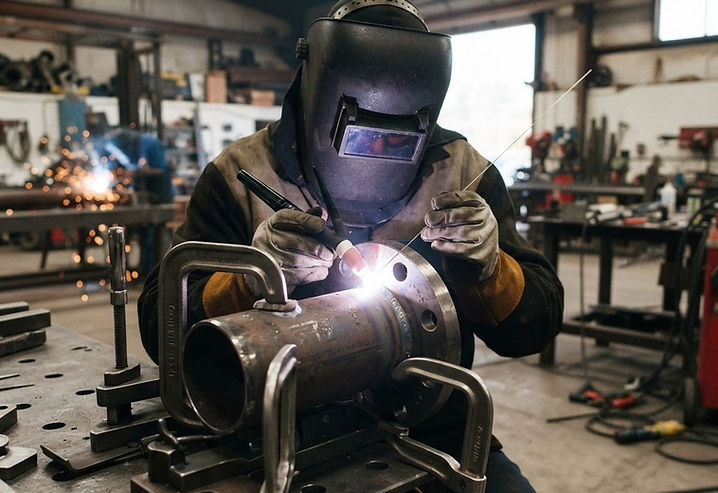
Managing thermal distortion is a persistent challenge for workshop managers during heavy plate fabrication. When welding thick structural sections or complex components, heat input can compromise geometric tolerances early in the process.
Success relies on preparation and mechanical restraint strategies employed before the welding arc is struck. These preventive measures are vital for industrial steel fabricators aiming for high-quality outcomes.
How can fabricators effectively manage longitudinal shrinkage?
Thermal contraction is an inevitable byproduct of the welding process as molten metal cools. In long butt joints on heavy plate, continuous welding often leads to bowing or significant angular distortion.
Using a back-stepping welding sequence is a highly effective shop floor practice. By welding in short, intermittent segments that progress in the opposite direction to the overall weld path, thermal stresses are distributed uniformly across the joint.
This approach prevents the localized accumulation of heat that pulls plate ends together. When material thickness requires multiple passes, fabricators should consider these steps:
- Alternate the weld sequence between the top and bottom of the bevel.
- Maintain a neutral stress axis throughout the process.
- Ensure precise diameter requirements for critical high pressure components.
Staying updated on regional market demands and tender intelligence helps teams forecast the material sizes they will likely handle in upcoming quarters. This foresight allows teams to prepare appropriate jigs and fixtures in advance.
What mechanical methods best prevent distortion in thick plates?
Fabricators must consider the workpiece geometry before committing to full penetration welds. Simple fixtures or tack welds are often insufficient to overcome the massive forces generated during the cooling phase.
Heavy duty mechanical clamps and strongback stiffeners are essential for maintaining alignment. Another technique involves pre-setting or reverse cambering.
By angling the plates slightly out of alignment before welding, the fabricator allows the natural contraction of the weldment to pull components into a flush position. Calculating the degree of pre-setting requires trial runs on sample coupons to account for material grade and joint design.
Copper backing bars also serve as an effective heat sink. They draw away excess energy and limit the heat affected zone, which reduces the potential for material deformation. Our expertise in these methods is essential for pressure vessel fabrication and other critical industrial tasks.
Is empirical data more reliable than simulation for shop floor planning?
Experienced supervisors often find that empirical data gathered from past projects provides more reliable guidance than simulation software. Relying on physical methods requires a disciplined approach to shop floor planning and an understanding of material behavior under heat.
By focusing on mechanical restraint and deliberate weld sequencing, fabrication teams can consistently meet tight tolerances. This is crucial even when working with materials that are prone to significant movement.
Achieving consistent quality requires balancing the speed of production with these necessary setup steps. These measures ensure that rework is minimized and the final assembly meets the stringent requirements of the energy and mining sectors. K999 consistently applies these rigorous standards to ensure operational excellence across global projects.
For the calculations behind this topic, the free fabrication calculator from Engineering Toolbox Australia is a practical starting point.
Further reading
Follow project contacts directory across the wider market on Project Atlas Intel.
Calculation tool
Run the numbers for this yourself with the free fabrication calculator from Engineering Toolbox Australia. Treat the result as a first check, then confirm the final design with your engineer.
How K999 can help
Welding and inspection practice
The welding procedures, welder qualifications and inspection routines described here are the ones applied to every spool, vessel and frame that leaves our workshop.
Inspection and expediting- 01
Qualified procedures for carbon steel, stainless steel and nickel alloys, with welder performance records held per joint type.
- 02
Dimensional and weld inspection in house, with third party witness arranged for client hold points.
- 03
Inspection and expediting support that follows the job from raw material receipt through to load out.
More on Welding & Testing
All articles


Request for quotation
Need fabricated steel to that standard?
Every enquiry is answered within 48 hours by our estimating team in Rayong. The priced quotation follows once drawings, quantities and standards are confirmed. Stainless steel fabrication, structural steel fabrication, pipe spooling, pressure vessels, steel tanks, mining equipment and conveyors, pig launchers, chutes and hoppers, send the package and we will price it.
Before you request a quotation
Steel fabrication quotation questions
What structural steel fabrication, pressure vessel and pipe spooling packages cost, what to send with an enquiry, and how delivery to site works.
Structural steel fabrication is priced from the section and plate tonnage, the detailing and drawing hours, welding and fitting manhours, NDT requirements, blast and coating system, packing and freight. Grade matters as much as weight: AS/NZS, ASTM, JIS and BS sections carry different mill prices, and heavy built up members take longer than rolled sections. Our Rayong workshop produces around 10,000 tonnes of structural steel fabrication a year, so a clear bill of materials is usually enough to price. Send the drawings and we answer within 48 hours; the priced quotation follows once quantities, standards and delivery dates are confirmed.
For steel fabrication work, send the drawings or IFC package, a bill of materials with material grades, the welding and NDT requirements, the coating specification, the delivery port and your site dates. Add the inspection and test plan, any third party inspection requirement, and whether trial assembly or match marking is needed. Where drawings are still in progress, a scope list with sizes, quantities and duty is enough to start, and the estimate is refined once the final package arrives. Every enquiry is answered within 48 hours, and the priced quotation is issued after scope, standards and quantities are confirmed.
Yes. Pressure vessel fabrication is carried out to ASME Section VIII Div. 1 under our ASME U stamp No. 43,462, or to AS/NZS and BS where the project specifies, covering separators, air receivers, water drums, waste heat recovery units and pig launchers. Steel tanks for fuel, biofuel, chemical, water and food duty are designed in house with our E Tank programme to API, ASME, BS and AS/NZS. Because structural steel, vessels, tanks and their supports are built in the same workshops, one enquiry can cover the vessel package, the tank package and the structural steel that carries them, with a single coating and documentation system and one shipment.
Steel fabrication Australia packages are scheduled from a 33,000 m2 Rayong yard with an 80,000 m2 assembly yard inside Sattahip port, so fabrication, trial assembly, blasting, coating and packing run in one place. Programme length depends on tonnage, material lead times, the coating system and inspection scope, and it is confirmed with the quotation. We quote FOB Laem Chabang, Map Ta Phut or Sattahip, or CIF and DAP to your Australian port, with packing lists, weights, lifting points and a data book per shipment. Staged deliveries can follow your site erection sequence instead of shipping everything at once.
There is no fixed minimum. Pipe spooling Australia packages run at up to 3,000 diameter inches per shift on SCH.40, from a single replacement spool to a full plant piping scope, with spools numbered, X rayed where specified and coated to match erection order. Mining equipment fabrication covers chutes, hoppers, ore bins, transfer towers and conveyor structures with Bisalloy, Hardox, rubber lining or hardfacing fitted in house, from one wear liner set to modules of up to 2,500 tonnes assembled at Sattahip. Send the scope list and we will tell you what the smallest sensible batch is for your programme.