


Industry News
Navigating Global Steel Supply Volatility and Decarbonization Shifts
Global steel markets face supply constraints and shifting decarbonization strategies. Fabricators must prioritize supply chain resilience and precise planning to manage material availability and the transition to green steel production.
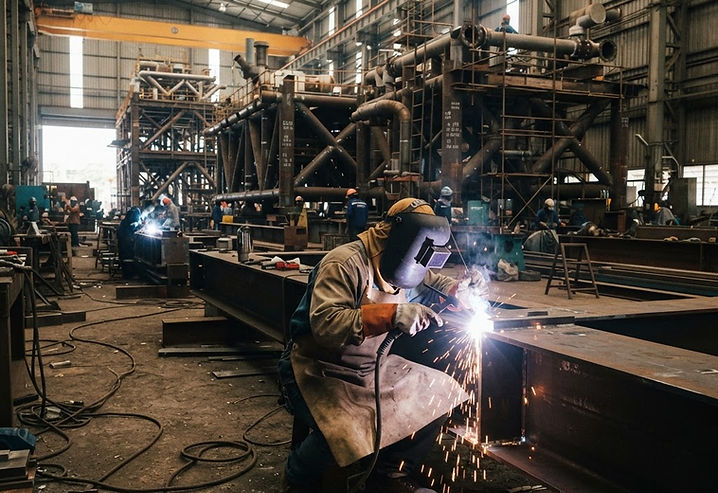
The global steel landscape is currently defined by a complex interplay of supply chain disruptions, trade protectionism, and the high-stakes transition toward hydrogen-based production. As of late 2026, fabricators and project owners are navigating a market where traditional supply routes are being reshaped by geopolitical instability and aggressive industrial policy. Understanding these shifts is essential for maintaining project schedules and cost control in an era of structural uncertainty.
How do supply chain disruptions and trade barriers impact project delivery?
Recent data indicates that structural steel shortages are creating significant bottlenecks for downstream fabricators. The closure of major long-steel production facilities in regions like South Africa has forced firms to scramble for alternative sources, often while facing increased anti-dumping duties on imports. These trade barriers, intended to protect domestic industries, have inadvertently limited the options for contractors who require specific steel grades on tight timelines.
When material availability becomes unpredictable, the ability to price and execute projects with certainty evaporates. Fabricators are increasingly forced to reconsider designs or substitute materials, which introduces costly delays and engineering revisions. To mitigate these risks, firms must invest in robust 3D modelling and shop detailing to ensure that any necessary design changes are validated quickly and accurately before fabrication begins.
What does the shift toward hydrogen-based steelmaking mean for buyers?
Major steelmakers are aggressively pursuing hydrogen-based direct reduction iron production to meet decarbonization targets. While projects like those in India and Germany signal a long-term commitment to green steel, the transition is proving economically challenging due to high energy costs and limited hydrogen infrastructure. For project owners, this means that the premium for low-carbon steel remains high and supply is not yet guaranteed at scale.
The industry is currently in a phase where multiple technology pathways are being tested, and the economic viability of these processes depends heavily on government funding and consistent energy pricing. Buyers should anticipate that the cost of green steel will remain volatile until hydrogen production reaches competitive price points. It is critical for procurement teams to monitor these developments closely, as the availability of specific low-carbon steel products may become a project requirement in the near future.
How should fabricators and owners manage material risk in 2027?
With global steel demand expected to see a modest recovery in 2027, the pressure on supply chains will likely persist. Fabricators must adopt a more proactive approach to procurement by diversifying their supplier base and avoiding reliance on single-source materials that are subject to trade volatility. Project owners should prioritize early engagement with their fabrication partners to align material specifications with current market realities.
By focusing on transparency and long-term planning, stakeholders can better navigate the current period of structural contraction and energy-market disruptions. Success in this environment requires a disciplined focus on operational efficiency and a realistic assessment of the global steel supply chain.
More detail on how we deliver this work is on our 3D modelling and shop detailing page.
For the calculations behind this topic, the free engineering knowledge centre from Engineering Toolbox Australia is a practical starting point.
Calculation tool
Run the numbers for this yourself with the free engineering knowledge centre from Engineering Toolbox Australia. Treat the result as a first check, then confirm the final design with your engineer.
How K999 can help
Where we fit the story
Trade policy, commodity cycles and energy markets decide when projects move, and they decide what gets fabricated. These articles collect the changes we track for our clients.
See our projects- 01
Work delivered for mining, energy, processing and manufacturing clients across Australia and Southeast Asia.
- 02
Fabrication in Rayong with assembly at Sattahip, shipping from Laem Chabang and Map Ta Phut.
- 03
Enquiries answered within 48 hours by our estimating team.
More on Industry News
All articles


Request for quotation
Need fabricated steel to that standard?
Every enquiry is answered within 48 hours by our estimating team in Rayong. The priced quotation follows once drawings, quantities and standards are confirmed. Stainless steel fabrication, structural steel fabrication, pipe spooling, pressure vessels, steel tanks, mining equipment and conveyors, pig launchers, chutes and hoppers, send the package and we will price it.
Before you request a quotation
Steel fabrication quotation questions
What structural steel fabrication, pressure vessel and pipe spooling packages cost, what to send with an enquiry, and how delivery to site works.
Structural steel fabrication is priced from the section and plate tonnage, the detailing and drawing hours, welding and fitting manhours, NDT requirements, blast and coating system, packing and freight. Grade matters as much as weight: AS/NZS, ASTM, JIS and BS sections carry different mill prices, and heavy built up members take longer than rolled sections. Our Rayong workshop produces around 10,000 tonnes of structural steel fabrication a year, so a clear bill of materials is usually enough to price. Send the drawings and we answer within 48 hours; the priced quotation follows once quantities, standards and delivery dates are confirmed.
For steel fabrication work, send the drawings or IFC package, a bill of materials with material grades, the welding and NDT requirements, the coating specification, the delivery port and your site dates. Add the inspection and test plan, any third party inspection requirement, and whether trial assembly or match marking is needed. Where drawings are still in progress, a scope list with sizes, quantities and duty is enough to start, and the estimate is refined once the final package arrives. Every enquiry is answered within 48 hours, and the priced quotation is issued after scope, standards and quantities are confirmed.
Yes. Pressure vessel fabrication is carried out to ASME Section VIII Div. 1 under our ASME U stamp No. 43,462, or to AS/NZS and BS where the project specifies, covering separators, air receivers, water drums, waste heat recovery units and pig launchers. Steel tanks for fuel, biofuel, chemical, water and food duty are designed in house with our E Tank programme to API, ASME, BS and AS/NZS. Because structural steel, vessels, tanks and their supports are built in the same workshops, one enquiry can cover the vessel package, the tank package and the structural steel that carries them, with a single coating and documentation system and one shipment.
Steel fabrication Australia packages are scheduled from a 33,000 m2 Rayong yard with an 80,000 m2 assembly yard inside Sattahip port, so fabrication, trial assembly, blasting, coating and packing run in one place. Programme length depends on tonnage, material lead times, the coating system and inspection scope, and it is confirmed with the quotation. We quote FOB Laem Chabang, Map Ta Phut or Sattahip, or CIF and DAP to your Australian port, with packing lists, weights, lifting points and a data book per shipment. Staged deliveries can follow your site erection sequence instead of shipping everything at once.
There is no fixed minimum. Pipe spooling Australia packages run at up to 3,000 diameter inches per shift on SCH.40, from a single replacement spool to a full plant piping scope, with spools numbered, X rayed where specified and coated to match erection order. Mining equipment fabrication covers chutes, hoppers, ore bins, transfer towers and conveyor structures with Bisalloy, Hardox, rubber lining or hardfacing fitted in house, from one wear liner set to modules of up to 2,500 tonnes assembled at Sattahip. Send the scope list and we will tell you what the smallest sensible batch is for your programme.