


Fabrication
Optimizing Flange Alignment for High-Pressure Piping Systems
This article explores practical strategies for maintaining strict flange alignment during industrial piping fabrication to prevent bolt stress and leaks. It highlights shop floor techniques for ensuring structural integrity in high-pressure environments.
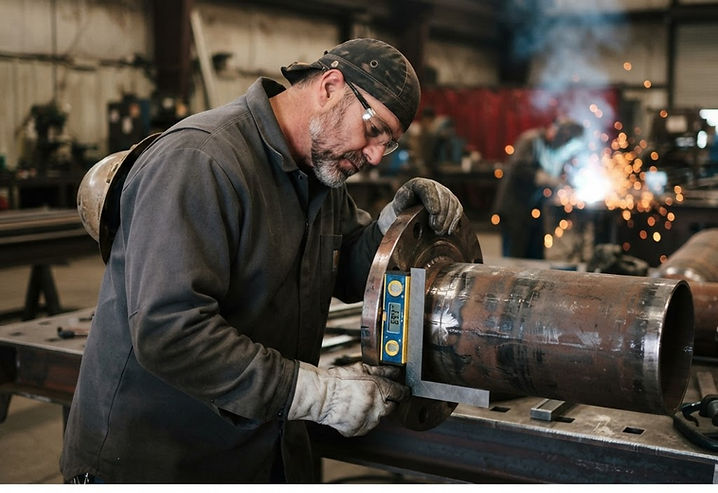
Maintaining perfect flange alignment is the most common challenge when fabricating complex piping spools for oil and gas projects. Even a minor deviation of a few degrees can cause significant bolt stress, potentially leading to leaks during pressure testing or operational service. Every experienced fabricator knows that relying solely on tack welds before full welding often leads to thermal distortion that ruins the alignment.
How do you maintain flange face parallelism during welding?
It is essential to use rigid external alignment jigs rather than relying on the pipe itself to hold the weight of the flange. We often use four-point spider jigs made of scrap angle iron, tack-welded to the inside diameter of the pipe and flange. This maintains the gap and face parallelism throughout the heating and cooling cycle of the root and filler passes.
Always monitor the internal alignment while welding the root pass. If you notice the gap closing or the flange faces pulling out of square, stop the arc immediately. It is much easier to grind out a tack weld and reset the gap than to fix a warped flange after the structural welds are complete.
Ensure that all grounding clamps are attached directly to the pipe or flange being worked on. Stray currents can easily jump through sensitive machined faces, leaving arc strikes that create stress risers. These imperfections are often the primary cause of early failure in rubber lining systems because the lining cannot properly bond to the pitted steel surface.
Why is sequence and weld volume control critical for fit-up?
Excessive heat input is the enemy of precise flange orientation. Use a multi-pass welding sequence with smaller diameter electrodes to keep the heat-affected zone as narrow as possible. This approach mimics the precision methods often seen in specialized hydrogen projects in Europe where metallurgical consistency is strictly regulated.
Follow a balanced welding pattern to distribute the heat evenly around the circumference of the pipe. If you weld one side of the flange completely before moving to the other, the contraction forces will pull the pipe out of alignment. Use this standard sequence to minimize movement:
- Tack the flange at four points using a certified bridge tack method.
- Complete the root pass using a skip-weld pattern to balance internal stresses.
- Alternate fill passes from the top to the bottom and from side to side.
- Ensure the flange is fully supported on a heavy steel welding table until the final cap pass has cooled completely.
Consider the influence of the pipe wall thickness when selecting your weld procedure specification. Thinner wall pipes move significantly more during the welding process, requiring more substantial external bracing. For heavier pipe sections, the mass of the steel helps absorb some of the heat, but the stresses generated by the cooling of the filler metal remain a major risk for misalignment.
By treating the flange as a sensitive component rather than just another pipe fitting, you reduce the need for rework. Implementing these simple physical controls on the shop floor saves significant time during the assembly and testing phases. Precision is not just about measuring twice; it is about managing the thermal behavior of the steel while it is still under your torch.
For the calculations behind this topic, the free AS/NZS standards guide from Engineering Toolbox Australia is a practical starting point.
Further reading
Follow public procurement tenders in Europe across the wider market on Project Atlas Intel.
Calculation tool
Run the numbers for this yourself with the free AS/NZS standards guide from Engineering Toolbox Australia. Treat the result as a first check, then confirm the final design with your engineer.
How K999 can help
Fabrication capacity behind the article
Articles in this section describe work we run every week in Rayong: cutting, forming, welding and assembly, under cover and in the yard, with the documentation that goes with it.
Structural steel fabrication- 01
Two workshops totalling more than 33,000 m² plus an 80,000 m² assembly yard at Sattahip.
- 02
Structural steel fabrication to 10,000 tonnes a year, with the largest single module built at 2,500 tonnes.
- 03
Blast, prime and paint before dispatch, with dimensional reports issued against the approved drawings.
More on Fabrication
All articles


Request for quotation
Need fabricated steel to that standard?
Every enquiry is answered within 48 hours by our estimating team in Rayong. The priced quotation follows once drawings, quantities and standards are confirmed. Stainless steel fabrication, structural steel fabrication, pipe spooling, pressure vessels, steel tanks, mining equipment and conveyors, pig launchers, chutes and hoppers, send the package and we will price it.
Before you request a quotation
Steel fabrication quotation questions
What structural steel fabrication, pressure vessel and pipe spooling packages cost, what to send with an enquiry, and how delivery to site works.
Structural steel fabrication is priced from the section and plate tonnage, the detailing and drawing hours, welding and fitting manhours, NDT requirements, blast and coating system, packing and freight. Grade matters as much as weight: AS/NZS, ASTM, JIS and BS sections carry different mill prices, and heavy built up members take longer than rolled sections. Our Rayong workshop produces around 10,000 tonnes of structural steel fabrication a year, so a clear bill of materials is usually enough to price. Send the drawings and we answer within 48 hours; the priced quotation follows once quantities, standards and delivery dates are confirmed.
For steel fabrication work, send the drawings or IFC package, a bill of materials with material grades, the welding and NDT requirements, the coating specification, the delivery port and your site dates. Add the inspection and test plan, any third party inspection requirement, and whether trial assembly or match marking is needed. Where drawings are still in progress, a scope list with sizes, quantities and duty is enough to start, and the estimate is refined once the final package arrives. Every enquiry is answered within 48 hours, and the priced quotation is issued after scope, standards and quantities are confirmed.
Yes. Pressure vessel fabrication is carried out to ASME Section VIII Div. 1 under our ASME U stamp No. 43,462, or to AS/NZS and BS where the project specifies, covering separators, air receivers, water drums, waste heat recovery units and pig launchers. Steel tanks for fuel, biofuel, chemical, water and food duty are designed in house with our E Tank programme to API, ASME, BS and AS/NZS. Because structural steel, vessels, tanks and their supports are built in the same workshops, one enquiry can cover the vessel package, the tank package and the structural steel that carries them, with a single coating and documentation system and one shipment.
Steel fabrication Australia packages are scheduled from a 33,000 m2 Rayong yard with an 80,000 m2 assembly yard inside Sattahip port, so fabrication, trial assembly, blasting, coating and packing run in one place. Programme length depends on tonnage, material lead times, the coating system and inspection scope, and it is confirmed with the quotation. We quote FOB Laem Chabang, Map Ta Phut or Sattahip, or CIF and DAP to your Australian port, with packing lists, weights, lifting points and a data book per shipment. Staged deliveries can follow your site erection sequence instead of shipping everything at once.
There is no fixed minimum. Pipe spooling Australia packages run at up to 3,000 diameter inches per shift on SCH.40, from a single replacement spool to a full plant piping scope, with spools numbered, X rayed where specified and coated to match erection order. Mining equipment fabrication covers chutes, hoppers, ore bins, transfer towers and conveyor structures with Bisalloy, Hardox, rubber lining or hardfacing fitted in house, from one wear liner set to modules of up to 2,500 tonnes assembled at Sattahip. Send the scope list and we will tell you what the smallest sensible batch is for your programme.