


Fabrication
Optimizing Large Diameter Pipe Fit-up for Industrial Fabrication
This article shares practical methods for managing pipe fit-up tolerances in heavy industrial steel fabrication. It highlights essential techniques for maintaining alignment and weld quality during complex project execution.
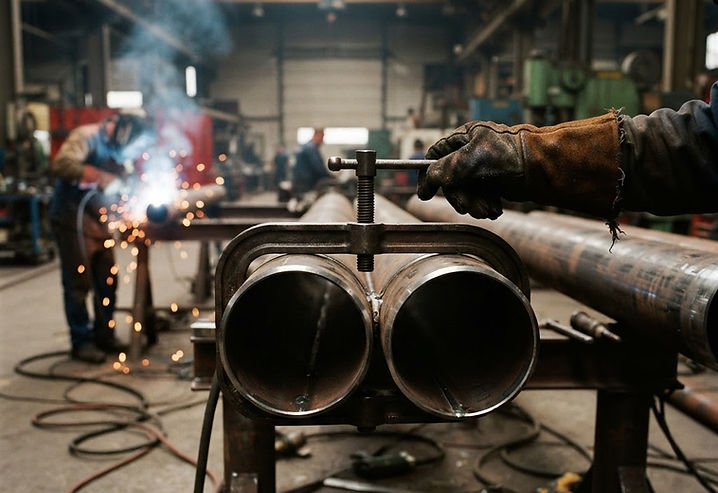
Achieving precise fit-up on large diameter piping is one of the most persistent challenges in industrial steel fabrication. Even minor deviations in root openings can lead to excessive weld volume or structural integrity issues later in the project. These errors often remain hidden until the final stages, causing costly delays that ripple across the entire supply chain.
Our team often sees these bottlenecks when working with various EPC contractors in Southeast Asia who require tight tolerances for high-pressure systems. By refining your workshop approach to spool preparation, you can drastically reduce the amount of rework required in the field.
How do you manage root gap consistency on large bore spool pieces?
Relying solely on tack welding to hold pipe joints is rarely sufficient for heavy wall thicknesses. We recommend using internal hydraulic pipe line-up clamps whenever the configuration allows. These tools apply uniform pressure around the circumference of the joint to force the pipe into a true circle.
If the pipe ends are slightly out of round, you must address this before attempting a tack weld. Never use a sledgehammer to force a fit, as this introduces residual stress that may cause cracking during the service life of the component. Instead, employ heavy-duty bridging clamps that allow for micro-adjustments in both axial and radial directions.
Why is rigorous dimensional verification critical before final welding?
Once you seal a joint with a full-penetration weld, correcting any dimensional errors becomes an expensive ordeal. Implementing a strict inspection and expediting protocol ensures that every spool meets drawing specifications before the arc is struck. This involves checking not just the root gap, but also the overall spool length and nozzle orientation.
Use digital levels and laser alignment tools to verify that flanges remain square to the pipe axis. Many workshops make the mistake of relying on visual checks alone. A formal verification checklist prevents the common trap of cumulative tolerance build-up across a multi-spool assembly.
Proper documentation at this stage also aids in procurement planning, as you can identify material shortages earlier.
What role does weld sequencing play in maintaining pipe geometry?
The intense heat input from welding large diameter pipe will inevitably move the metal. To minimize this, use a balanced welding sequence that distributes heat evenly around the joint. Avoid completing one side of the pipe before moving to the next.
Instead, divide the circumference into four quadrants and weld opposing sides to keep thermal expansion in check. If you are welding heavy wall thicknesses, keep the pipe in a jig or on a turning roll that prevents the spool from sagging under its own weight. This simple support strategy significantly reduces the risk of root face misalignment as the weld pool cools.
Maintaining a consistent temperature gradient is the secret to preventing the spool from bowing or twisting out of tolerance. Good fabrication relies on the understanding that every weld is a dynamic event that changes the geometry of the piece. By managing the fit-up, the support system, and the cooling process with intentional care, you transform a potentially chaotic workshop floor into a controlled environment.
Focus on these foundational techniques to drive higher quality across your industrial steel output.
For the calculations behind this topic, the free piping engineering articles from Engineering Toolbox Australia is a practical starting point.
Further reading
Follow engineering procurement construction companies in Singapore across the wider market on Project Atlas Intel.
Calculation tool
Run the numbers for this yourself with the free piping engineering articles from Engineering Toolbox Australia. Treat the result as a first check, then confirm the final design with your engineer.
How K999 can help
Fabrication capacity behind the article
Articles in this section describe work we run every week in Rayong: cutting, forming, welding and assembly, under cover and in the yard, with the documentation that goes with it.
Structural steel fabrication- 01
Two workshops totalling more than 33,000 m² plus an 80,000 m² assembly yard at Sattahip.
- 02
Structural steel fabrication to 10,000 tonnes a year, with the largest single module built at 2,500 tonnes.
- 03
Blast, prime and paint before dispatch, with dimensional reports issued against the approved drawings.
More on Fabrication
All articles


Request for quotation
Need fabricated steel to that standard?
Every enquiry is answered within 48 hours by our estimating team in Rayong. The priced quotation follows once drawings, quantities and standards are confirmed. Stainless steel fabrication, structural steel fabrication, pipe spooling, pressure vessels, steel tanks, mining equipment and conveyors, pig launchers, chutes and hoppers, send the package and we will price it.
Before you request a quotation
Steel fabrication quotation questions
What structural steel fabrication, pressure vessel and pipe spooling packages cost, what to send with an enquiry, and how delivery to site works.
Structural steel fabrication is priced from the section and plate tonnage, the detailing and drawing hours, welding and fitting manhours, NDT requirements, blast and coating system, packing and freight. Grade matters as much as weight: AS/NZS, ASTM, JIS and BS sections carry different mill prices, and heavy built up members take longer than rolled sections. Our Rayong workshop produces around 10,000 tonnes of structural steel fabrication a year, so a clear bill of materials is usually enough to price. Send the drawings and we answer within 48 hours; the priced quotation follows once quantities, standards and delivery dates are confirmed.
For steel fabrication work, send the drawings or IFC package, a bill of materials with material grades, the welding and NDT requirements, the coating specification, the delivery port and your site dates. Add the inspection and test plan, any third party inspection requirement, and whether trial assembly or match marking is needed. Where drawings are still in progress, a scope list with sizes, quantities and duty is enough to start, and the estimate is refined once the final package arrives. Every enquiry is answered within 48 hours, and the priced quotation is issued after scope, standards and quantities are confirmed.
Yes. Pressure vessel fabrication is carried out to ASME Section VIII Div. 1 under our ASME U stamp No. 43,462, or to AS/NZS and BS where the project specifies, covering separators, air receivers, water drums, waste heat recovery units and pig launchers. Steel tanks for fuel, biofuel, chemical, water and food duty are designed in house with our E Tank programme to API, ASME, BS and AS/NZS. Because structural steel, vessels, tanks and their supports are built in the same workshops, one enquiry can cover the vessel package, the tank package and the structural steel that carries them, with a single coating and documentation system and one shipment.
Steel fabrication Australia packages are scheduled from a 33,000 m2 Rayong yard with an 80,000 m2 assembly yard inside Sattahip port, so fabrication, trial assembly, blasting, coating and packing run in one place. Programme length depends on tonnage, material lead times, the coating system and inspection scope, and it is confirmed with the quotation. We quote FOB Laem Chabang, Map Ta Phut or Sattahip, or CIF and DAP to your Australian port, with packing lists, weights, lifting points and a data book per shipment. Staged deliveries can follow your site erection sequence instead of shipping everything at once.
There is no fixed minimum. Pipe spooling Australia packages run at up to 3,000 diameter inches per shift on SCH.40, from a single replacement spool to a full plant piping scope, with spools numbered, X rayed where specified and coated to match erection order. Mining equipment fabrication covers chutes, hoppers, ore bins, transfer towers and conveyor structures with Bisalloy, Hardox, rubber lining or hardfacing fitted in house, from one wear liner set to modules of up to 2,500 tonnes assembled at Sattahip. Send the scope list and we will tell you what the smallest sensible batch is for your programme.