


Fabrication
Overview of Hopper and Tank Fabrication
Plate development, stiffener layout, nozzle placement and leak testing for hoppers, bins and storage tanks built to drawing.
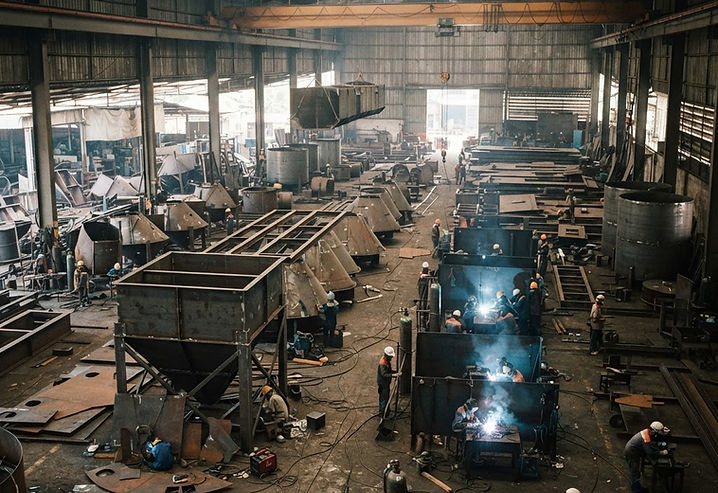
Postthe manufacture of products and materials like food, chemicals, pharmaceuticals etc., transportation is the next step in the process towards ensuring products reaching the end customer. In this regard, hoppers and tanks have wide applications in industries where the top priority is to keep the products or materials sterile. Apart from transportation, they also play vital roles in storage and handling and hence, are in great demand. So, how does the fabrication process of hoppers and tanks facilitate product transportation and what are its benefits in this regard? This blog will look to explore this topic in greater detail.
Stainless Steel Benefits
Stainless steel has multiple application in industry, for example steel fabrication in popular in mining. It is the perfect choice for hoppers and tanks to hold gases, chemicals, beverages, foods and different liquids. It is very flexible this makes it the perfect material for building large industrial storage equipment. Stainless steel does not need higher thickness to build strength. Moreover, stainless steel resists the rust and different types of corrosion that may happen when the substance gets constantly exposed to different liquids.
Stainless steel has a high resistance to heat. Therefore, it can easily hold up against high temperature or sudden heat rise. These properties make it a perfect material for heat induction bending services and for constructing parts of the furnace, such as the boiler rooms, lining ovens etc. There is no change to the properties nor the strength of the steel even when exposed to higher temperatures of the furnace.

Quality of Hoppers and Tanks
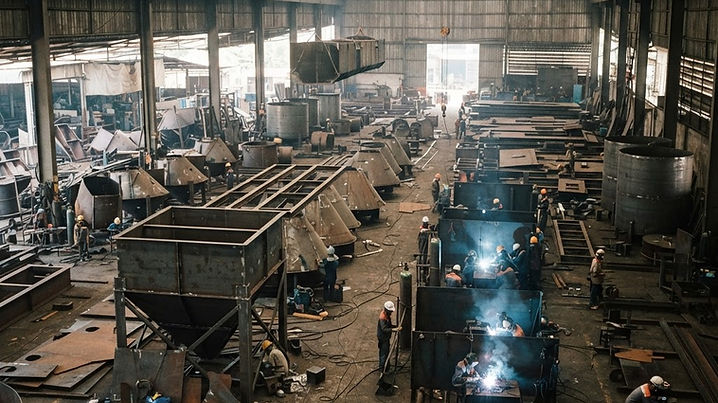
Quality is of utmost importance during tank and hopper fabrication. In most cases, only companies having wide experience and knowledge possess the capability and resources to build hoppers and tanks that could pass the strict requirements and standards mandated by the administration for medical, EPA, and food facilities and manufacturers. With the best fabrication companies, the customer can expect top class products custom made to perfectly fit industry requirements. These companies do all the tank and hopper fabrication work in- house at their workshop. As result, there is faster and more efficient delivery of orders. While operating under strict industry standards, reputed companies design, cut and fabricate the stainless steel to create hoppers for multiple industries. They also possess the technology to maintain the strict hygiene and safety requirements for the food and drug industry.
The custom made stainless steel fabrication combines traditional forge and hammer methods with the latest technologies such as AutoCAD, water jet cutting, and plasma cutting to create industry grade tanks and hoppers. These modern technologies ensure accuracy related to the tank and hopper fabrication. This helps to accurately anticipate the kind of end product that a customer would receive.
Features and Applications
Stainless steel tanks and hoppers are versatile, possess a safe and contained method of storing powder, customizable for variety of applications and are FDA compliant. Common shapes of stainless steel hoppers and tanks include wedge, cone or pyramid shapes. Stainless steel hoppers are created with interior specific applications. Therefore, the inner portion of the tank or the hopper is built to accommodate sensitive ingredients and to handle most of the weight, pressure and temperature. Multiple methods are utilized in hopper fabrication like sawing, steel laser cutting, rolling, machining and welding.
Last Thoughts
As the use of hoppers and tanks becomes more widespread, fabrication has an increasingly important part to play in ensuring precision and fitment without compromising on effectiveness in industry. This blog highlights that experienced and knowledgeable firms can leverage fabrication properly for hoppers and tanks; thus, quality of work is very important in this regard. With growth in manufacturing, hopper and tank fabrication is poised to take a giant leap forward!
K999 Thailand carries out work of this kind through its steel tank fabrication team in Rayong.
Further reading
Follow EPC contractors in Southeast Asia across the wider market on Project Atlas Intel.
Calculation tool
Run the numbers for this yourself with the free engineering calculations explained from Engineering Toolbox Australia. Treat the result as a first check, then confirm the final design with your engineer.
How K999 can help
Fabrication capacity behind the article
Articles in this section describe work we run every week in Rayong: cutting, forming, welding and assembly, under cover and in the yard, with the documentation that goes with it.
Structural steel fabrication- 01
Two workshops totalling more than 33,000 m² plus an 80,000 m² assembly yard at Sattahip.
- 02
Structural steel fabrication to 10,000 tonnes a year, with the largest single module built at 2,500 tonnes.
- 03
Blast, prime and paint before dispatch, with dimensional reports issued against the approved drawings.
More on Fabrication
All articles


Request for quotation
Need fabricated steel to that standard?
Every enquiry is answered within 48 hours by our estimating team in Rayong. The priced quotation follows once drawings, quantities and standards are confirmed. Stainless steel fabrication, structural steel fabrication, pipe spooling, pressure vessels, steel tanks, mining equipment and conveyors, pig launchers, chutes and hoppers, send the package and we will price it.
Before you request a quotation
Steel fabrication quotation questions
What structural steel fabrication, pressure vessel and pipe spooling packages cost, what to send with an enquiry, and how delivery to site works.
Structural steel fabrication is priced from the section and plate tonnage, the detailing and drawing hours, welding and fitting manhours, NDT requirements, blast and coating system, packing and freight. Grade matters as much as weight: AS/NZS, ASTM, JIS and BS sections carry different mill prices, and heavy built up members take longer than rolled sections. Our Rayong workshop produces around 10,000 tonnes of structural steel fabrication a year, so a clear bill of materials is usually enough to price. Send the drawings and we answer within 48 hours; the priced quotation follows once quantities, standards and delivery dates are confirmed.
For steel fabrication work, send the drawings or IFC package, a bill of materials with material grades, the welding and NDT requirements, the coating specification, the delivery port and your site dates. Add the inspection and test plan, any third party inspection requirement, and whether trial assembly or match marking is needed. Where drawings are still in progress, a scope list with sizes, quantities and duty is enough to start, and the estimate is refined once the final package arrives. Every enquiry is answered within 48 hours, and the priced quotation is issued after scope, standards and quantities are confirmed.
Yes. Pressure vessel fabrication is carried out to ASME Section VIII Div. 1 under our ASME U stamp No. 43,462, or to AS/NZS and BS where the project specifies, covering separators, air receivers, water drums, waste heat recovery units and pig launchers. Steel tanks for fuel, biofuel, chemical, water and food duty are designed in house with our E Tank programme to API, ASME, BS and AS/NZS. Because structural steel, vessels, tanks and their supports are built in the same workshops, one enquiry can cover the vessel package, the tank package and the structural steel that carries them, with a single coating and documentation system and one shipment.
Steel fabrication Australia packages are scheduled from a 33,000 m2 Rayong yard with an 80,000 m2 assembly yard inside Sattahip port, so fabrication, trial assembly, blasting, coating and packing run in one place. Programme length depends on tonnage, material lead times, the coating system and inspection scope, and it is confirmed with the quotation. We quote FOB Laem Chabang, Map Ta Phut or Sattahip, or CIF and DAP to your Australian port, with packing lists, weights, lifting points and a data book per shipment. Staged deliveries can follow your site erection sequence instead of shipping everything at once.
There is no fixed minimum. Pipe spooling Australia packages run at up to 3,000 diameter inches per shift on SCH.40, from a single replacement spool to a full plant piping scope, with spools numbered, X rayed where specified and coated to match erection order. Mining equipment fabrication covers chutes, hoppers, ore bins, transfer towers and conveyor structures with Bisalloy, Hardox, rubber lining or hardfacing fitted in house, from one wear liner set to modules of up to 2,500 tonnes assembled at Sattahip. Send the scope list and we will tell you what the smallest sensible batch is for your programme.