


Fabrication
Post Pandemic Fabrication Supply Chain
Longer lead times and volatile steel prices pushed fabricators toward early mill booking, local stock and dual sourcing.
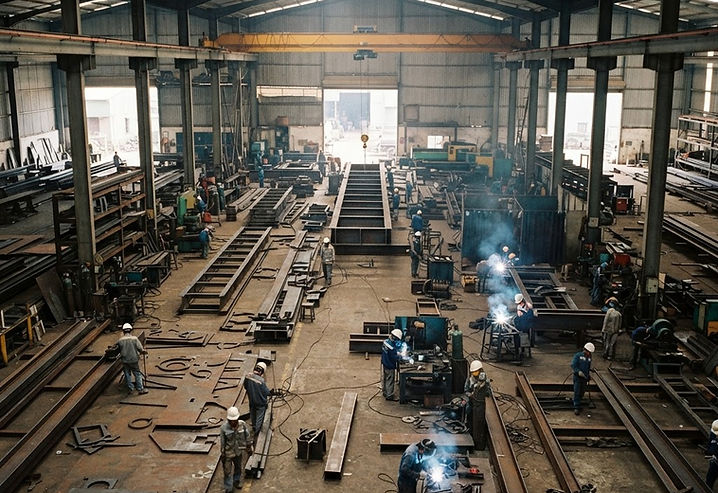
The COVID 19 pandemic had led to the disruption of the fabrication and manufacturing supply chain. First came the supply shock, where many fabricators dealt with canceled orders not from lack of demand but because manufacturers could not get other needed parts for the final product. Then came the second punch, this time on the demand side, as unemployment spiked dramatically. manufacturers reacted by reducing or halting orders altogether. Now that the severity of the pandemic has considerably diminished, there is expected to be an evolution of the metal fabrication supply chain. There may be new trends and factors coming up in this regard, and this blog will look to deep dive into this topic.
Transparency
Supplier management and optimization is a critical requirement in supply chain management since one would want the plumbing set up for multiple supply chains so that one can turn on the faucet here or there, depending on the timing. To do that in some cases, manufacturers reduced the number of faucets (suppliers) to just a few large, highly reliable ones. This in part has helped make some of the largest heavy steel manufacturing companies even larger. The COVID 19 crisis might spur more dual sourcing. If the disease reemerges in a certain locale and everyone at a certain plant needs to go home, will another supplier elsewhere be able to pick up the slack? Such dual sourcing might add a bit of supply chain complexity which is a challenge facing the metal fabrication industry. It goes back again to supply chain transparency, not just between a fabricator and its customer, but also wherever value is added within the entire supply chain. Manufacturers might accomplish this in various ways, one of them being by contracting directly with the lower tiered suppliers, including metal fabricators. Fabricators might still send welded components to an assembler, which then sends them on to the manufacturer. But the assembler might act simply as a toll processor. In this sense, the supply chain would evolve into a kind of network.
Reshoring and Tracking Financial Health

Overseas work has been coming back from Asia for years, and the steel tariffs of 2018 and the COVID 19 pandemic have accelerated those efforts. According to a survey, 64% of manufacturing and industrial companies are likely to nearshore or reshore because of pandemic related concerns. In that same survey, 53% of businesses reported difficulty receiving COVID related supply chain information from their Chinese suppliers. A change in geography does change the risk level, however, supplier location is only a piece of the puzzle. Transparency is still the name of the game. An opaque supplier relationship can have negative consequences, whether that supplier is down the street or an ocean away.
Transparency will include information related not only to where components are in the supply chain, but also the financial health of suppliers. An audit might give a snapshot of a supplier’s liquidity, leverage, efficiency, savings due to process automation, and access to cash. But how will this financial situation change over time? Again, demand for such transparency has been building for years, especially in certain industries.
Make vs. Buy
The COVID 19 pandemic is likely to enable more make versus buy analyses and evaluations. The variables in the make versus buy decision will remain the same, including available suppliers, shipping logistics, and the nature and mix of products being manufactured. But the potential of disease outbreaks or other external shocks around the globe will lead more companies to further scrutinize their decisions. It is likely that the pandemic will not lead to some massive vertical integration movement. Bringing in a process that is too far outside a manufacturer’s wheelhouse still will not be practical in many cases. This will be particularly true with processes that require certain expertise, like high end welding and other specialty fabrication processes such as development of pressure vessels.
The Last Chapter
COVID 19 has tested the agility of industrial supply chains. As the economy picks up in a postpandemic world, it is essential to ensure that the lessons learnt during those hard times are not lost, but used to drive innovations in supply chains going forward. As the saying goes, a chain is only as strong as its weakest link and supply chains need to iron out their shortfalls to emerge stronger in the long run!
K999 Thailand carries out work of this kind through its structural steel fabrication team in Rayong.
Further reading
Follow EPC contractors in Southeast Asia across the wider market on Project Atlas Intel.
How K999 can help
Fabrication capacity behind the article
Articles in this section describe work we run every week in Rayong: cutting, forming, welding and assembly, under cover and in the yard, with the documentation that goes with it.
Structural steel fabrication- 01
Two workshops totalling more than 33,000 m² plus an 80,000 m² assembly yard at Sattahip.
- 02
Structural steel fabrication to 10,000 tonnes a year, with the largest single module built at 2,500 tonnes.
- 03
Blast, prime and paint before dispatch, with dimensional reports issued against the approved drawings.
More on Fabrication
All articles


Request for quotation
Need fabricated steel to that standard?
Every enquiry is answered within 48 hours by our estimating team in Rayong. The priced quotation follows once drawings, quantities and standards are confirmed. Stainless steel fabrication, structural steel fabrication, pipe spooling, pressure vessels, steel tanks, mining equipment and conveyors, pig launchers, chutes and hoppers, send the package and we will price it.
Before you request a quotation
Steel fabrication quotation questions
What structural steel fabrication, pressure vessel and pipe spooling packages cost, what to send with an enquiry, and how delivery to site works.
Structural steel fabrication is priced from the section and plate tonnage, the detailing and drawing hours, welding and fitting manhours, NDT requirements, blast and coating system, packing and freight. Grade matters as much as weight: AS/NZS, ASTM, JIS and BS sections carry different mill prices, and heavy built up members take longer than rolled sections. Our Rayong workshop produces around 10,000 tonnes of structural steel fabrication a year, so a clear bill of materials is usually enough to price. Send the drawings and we answer within 48 hours; the priced quotation follows once quantities, standards and delivery dates are confirmed.
For steel fabrication work, send the drawings or IFC package, a bill of materials with material grades, the welding and NDT requirements, the coating specification, the delivery port and your site dates. Add the inspection and test plan, any third party inspection requirement, and whether trial assembly or match marking is needed. Where drawings are still in progress, a scope list with sizes, quantities and duty is enough to start, and the estimate is refined once the final package arrives. Every enquiry is answered within 48 hours, and the priced quotation is issued after scope, standards and quantities are confirmed.
Yes. Pressure vessel fabrication is carried out to ASME Section VIII Div. 1 under our ASME U stamp No. 43,462, or to AS/NZS and BS where the project specifies, covering separators, air receivers, water drums, waste heat recovery units and pig launchers. Steel tanks for fuel, biofuel, chemical, water and food duty are designed in house with our E Tank programme to API, ASME, BS and AS/NZS. Because structural steel, vessels, tanks and their supports are built in the same workshops, one enquiry can cover the vessel package, the tank package and the structural steel that carries them, with a single coating and documentation system and one shipment.
Steel fabrication Australia packages are scheduled from a 33,000 m2 Rayong yard with an 80,000 m2 assembly yard inside Sattahip port, so fabrication, trial assembly, blasting, coating and packing run in one place. Programme length depends on tonnage, material lead times, the coating system and inspection scope, and it is confirmed with the quotation. We quote FOB Laem Chabang, Map Ta Phut or Sattahip, or CIF and DAP to your Australian port, with packing lists, weights, lifting points and a data book per shipment. Staged deliveries can follow your site erection sequence instead of shipping everything at once.
There is no fixed minimum. Pipe spooling Australia packages run at up to 3,000 diameter inches per shift on SCH.40, from a single replacement spool to a full plant piping scope, with spools numbered, X rayed where specified and coated to match erection order. Mining equipment fabrication covers chutes, hoppers, ore bins, transfer towers and conveyor structures with Bisalloy, Hardox, rubber lining or hardfacing fitted in house, from one wear liner set to modules of up to 2,500 tonnes assembled at Sattahip. Send the scope list and we will tell you what the smallest sensible batch is for your programme.