


Welding & Testing
Preventing Hydrogen Induced Cracking in Heavy Section Carbon Steel
This guide outlines practical strategies for mitigating hydrogen induced cracking during heavy section welding. Proper preheat control and moisture management are essential for structural integrity in industrial projects.

Managing hydrogen induced cracking is a critical challenge when working with heavy section carbon steel components. In the fast paced environment of industrial steel fabrication, minor deviations in welding protocols often lead to significant rework costs and schedule delays. Understanding the relationship between moisture, cooling rates, and joint restraint is essential for every engineer managing high pressure piping or structural steel fabrication projects. By focusing on root cause prevention rather than remedial inspection, shops can maintain higher quality standards while keeping production lines moving.
How can hydrogen be effectively controlled during industrial welding processes?
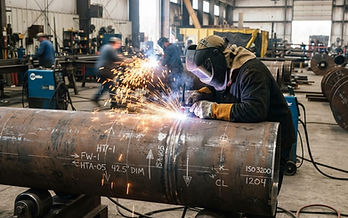
The primary culprit in underbead cracking is the presence of hydrogen, which enters the weld pool through atmospheric moisture or contaminated consumables. When welding thick sections, the residual stress within the joint is naturally higher due to the mass of the steel acting as a heat sink. As the weld cools, hydrogen trapped in the lattice structure migrates toward the heat affected zone.
If the cooling rate is too rapid, the steel hardens, creating a brittle structure that is highly susceptible to cracking. Fabricators should strictly manage the storage of low hydrogen electrodes and flux cored wires. Using heated holding ovens is not merely a suggestion but a requirement for maintaining electrode integrity.
Beyond consumables, ambient humidity in coastal regions like Rayong can significantly increase the hydrogen potential. Implementing a formal preheat verification process is the best defense against these issues, ensuring the base material temperature remains above the specified threshold throughout the entire welding sequence.
What are the most effective techniques for optimizing joint design and welding sequences?
Beyond metallurgy, the geometry of the joint and the sequence of the weld passes play a vital role in preventing failure. When approaching complex tasks like pipe spooling, engineers must account for the accumulation of internal stresses. If a thick joint is welded too quickly with high heat input, the expansion and contraction cycles can initiate micro fractures before the weld even cools to room temperature.
A practical floor strategy is to use a balanced welding sequence, which distributes heat more evenly across the joint cross section. Furthermore, utilizing proper backstepping techniques can help manage the longitudinal shrinkage stresses inherent in heavy plate work. Project managers often consult sources for industrial project intelligence to understand how similar heavy section welding challenges have been resolved on international sites.
By integrating these lessons into the welding procedure specification, teams can minimize the likelihood of laminar tearing and hydrogen cracking in high constraint joints.
How can fabricators ensure precision in inspection and quality control for heavy sections?
Quality control practices must extend beyond standard visual inspections. For heavy section welding, waiting for the full cooling cycle is mandatory before conducting non destructive testing. Rushing to perform ultrasonic testing while the component is still warm can provide inaccurate results or miss delayed cracking that occurs hours after the final pass.
Integrating hold points into the manufacturing plan allows for a controlled cooling period, during which the material is shielded from rapid temperature drops that could accelerate cracking. Documentation of these temperature logs acts as a vital record for the client, providing confidence that the structural integrity of the project has been maintained throughout the fabrication process. Ultimately, the most successful shops treat hydrogen control as a continuous culture of diligence rather than a series of one off inspections.
Further reading
Follow Infrastructure across the wider market on Project Atlas Intel.
How K999 can help
Welding and inspection practice
The welding procedures, welder qualifications and inspection routines described here are the ones applied to every spool, vessel and frame that leaves our workshop.
Inspection and expediting- 01
Qualified procedures for carbon steel, stainless steel and nickel alloys, with welder performance records held per joint type.
- 02
Dimensional and weld inspection in house, with third party witness arranged for client hold points.
- 03
Inspection and expediting support that follows the job from raw material receipt through to load out.
More on Welding & Testing
All articles


Request for quotation
Need fabricated steel to that standard?
Every enquiry is answered within 48 hours by our estimating team in Rayong. The priced quotation follows once drawings, quantities and standards are confirmed. Stainless steel fabrication, structural steel fabrication, pipe spooling, pressure vessels, steel tanks, mining equipment and conveyors, pig launchers, chutes and hoppers, send the package and we will price it.
Before you request a quotation
Steel fabrication quotation questions
What structural steel fabrication, pressure vessel and pipe spooling packages cost, what to send with an enquiry, and how delivery to site works.
Structural steel fabrication is priced from the section and plate tonnage, the detailing and drawing hours, welding and fitting manhours, NDT requirements, blast and coating system, packing and freight. Grade matters as much as weight: AS/NZS, ASTM, JIS and BS sections carry different mill prices, and heavy built up members take longer than rolled sections. Our Rayong workshop produces around 10,000 tonnes of structural steel fabrication a year, so a clear bill of materials is usually enough to price. Send the drawings and we answer within 48 hours; the priced quotation follows once quantities, standards and delivery dates are confirmed.
For steel fabrication work, send the drawings or IFC package, a bill of materials with material grades, the welding and NDT requirements, the coating specification, the delivery port and your site dates. Add the inspection and test plan, any third party inspection requirement, and whether trial assembly or match marking is needed. Where drawings are still in progress, a scope list with sizes, quantities and duty is enough to start, and the estimate is refined once the final package arrives. Every enquiry is answered within 48 hours, and the priced quotation is issued after scope, standards and quantities are confirmed.
Yes. Pressure vessel fabrication is carried out to ASME Section VIII Div. 1 under our ASME U stamp No. 43,462, or to AS/NZS and BS where the project specifies, covering separators, air receivers, water drums, waste heat recovery units and pig launchers. Steel tanks for fuel, biofuel, chemical, water and food duty are designed in house with our E Tank programme to API, ASME, BS and AS/NZS. Because structural steel, vessels, tanks and their supports are built in the same workshops, one enquiry can cover the vessel package, the tank package and the structural steel that carries them, with a single coating and documentation system and one shipment.
Steel fabrication Australia packages are scheduled from a 33,000 m2 Rayong yard with an 80,000 m2 assembly yard inside Sattahip port, so fabrication, trial assembly, blasting, coating and packing run in one place. Programme length depends on tonnage, material lead times, the coating system and inspection scope, and it is confirmed with the quotation. We quote FOB Laem Chabang, Map Ta Phut or Sattahip, or CIF and DAP to your Australian port, with packing lists, weights, lifting points and a data book per shipment. Staged deliveries can follow your site erection sequence instead of shipping everything at once.
There is no fixed minimum. Pipe spooling Australia packages run at up to 3,000 diameter inches per shift on SCH.40, from a single replacement spool to a full plant piping scope, with spools numbered, X rayed where specified and coated to match erection order. Mining equipment fabrication covers chutes, hoppers, ore bins, transfer towers and conveyor structures with Bisalloy, Hardox, rubber lining or hardfacing fitted in house, from one wear liner set to modules of up to 2,500 tonnes assembled at Sattahip. Send the scope list and we will tell you what the smallest sensible batch is for your programme.