


Industry News
Quality Management Drivers and Solutions
Client specification, code compliance and rework cost are the drivers behind formal quality management in fabrication.
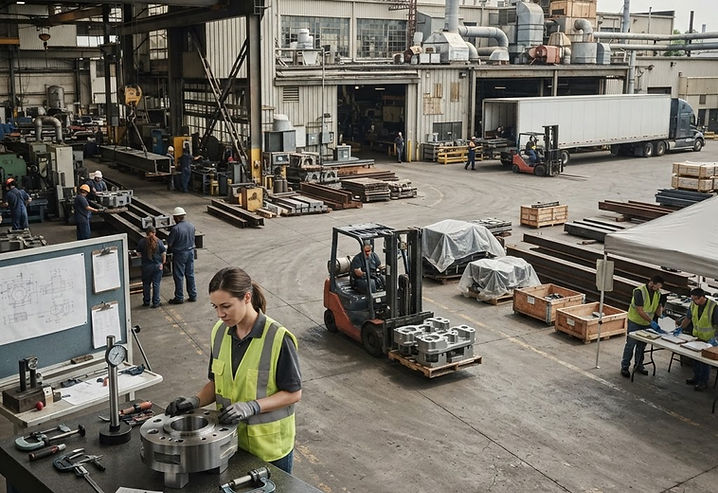
Today’s end consumers demand quality, and they are quick to try a competitive product when disappointment hits. For manufacturers, the quest to achieve less variability, more consistency and enhanced customer satisfaction has never been more critical. To consistently produce high quality products, the key is to improve standards of quality control throughout the manufacturing process, and that requires an effective quality management system with the ability to oversee all activities and tasks that must be accomplished to maintain the desired level of excellence. Such a system helps manufacturers identify potential issues and rectify them before they escalate, leading to improved customer relationships and company growth as well as greater productivity and cost efficiencies.
Quality Driving Factors
Customer retention, Given that it can cost up to five times more to acquire new customers than to retain existing ones, customer retention is a top priority. Ensuring high quality standards and delivering consistent standards go a long way towards keeping existing customers.
Compliance, For manufacturers, compliance entails complying with the ISO 9001 standard which helps drive quality management practices in metal fabrication. ISO 9001 helps companies improve quality throughout the operation from development and material sourcing right through to product delivery and customer interaction.

Product recalls, A product recall is something manufacturers try to avoid at all costs. Statistics show that 25% of consumers reported being less likely to buy products from a company involved in a recall and 65% of consumers said they would be less likely to recommend a company following a recall.
Continuous improvement, Continuous improvement is a systematic approach to consistently enhance processes, products (such as water tanks ), and services over time. It involves making incremental and sustainable changes to achieve higher efficiency, effectiveness, and quality. By fostering a culture of continuous improvement, businesses encourage employees at all levels to identify problems, suggest solutions and implement small scale changes to optimize operations.
ERP, Implementing Quality Management
One of the most effective ways of getting quality management right is by implementing an ERP solution that provides the data, tools and infrastructure manufacturers need to gather insights, make informed decisions, and continuously refine their operations to achieve higher levels of efficiency, quality, and competitiveness. A good ERP solution is geared towards helping manufacturers set quality criteria against the products they buy and manufacture to ensure any inputs and outputs from their production lines conform to these standards. This is especially important in today’s competitive market where data is one of the top 3 manufacturing technology trends. Businesses can no longer rely on manual processes and tools to manage quality; it is simply too important to leave up to chance. On the question of customer retention, for example, manufacturers need to manage customer complaints as effectively as possible. An ERP system should provide the tools needed to log, collaborate on, escalate, and resolve customer complaints quickly and smoothly. That way, manufacturers and structural steel fabricators can quickly turn the situation around and build up data at the same time. Similarly, an ERP system with recall management capability enables manufacturers to recall products that are serial or lot traceable. With access to real time information on affected customers, sales orders, Work in Progress jobs, suppliers and purchase orders, manufacturers can quickly ringfence the problem and stop it from spreading. Effective product recall may be a last resort in the realm of quality management, but it is a crucial one.
Closing Statement
Creating a strong quality management process is essential for manufacturing companies. Not only can it help avoid regulatory fines, good quality can also ensure that the firm is meeting customer expectations and drawing repeat business. A fully integrated ERP quality management system helps manufacturers improve quality performance by reducing variability and costs while ultimately improving customer satisfaction. As the saying goes, there is no substitute for quality, and manufacturers need to always abide by this!
K999 Thailand carries out work of this kind through its structural steel fabrication team in Rayong.
Further reading
Follow engineering procurement construction companies in Singapore across the wider market on Project Atlas Intel.
Calculation tool
Run the numbers for this yourself with the free steel weight calculator from Engineering Toolbox Australia. Treat the result as a first check, then confirm the final design with your engineer.
How K999 can help
Where we fit the story
Trade policy, commodity cycles and energy markets decide when projects move, and they decide what gets fabricated. These articles collect the changes we track for our clients.
See our projects- 01
Work delivered for mining, energy, processing and manufacturing clients across Australia and Southeast Asia.
- 02
Fabrication in Rayong with assembly at Sattahip, shipping from Laem Chabang and Map Ta Phut.
- 03
Enquiries answered within 48 hours by our estimating team.
More on Industry News
All articles


Request for quotation
Need fabricated steel to that standard?
Every enquiry is answered within 48 hours by our estimating team in Rayong. The priced quotation follows once drawings, quantities and standards are confirmed. Stainless steel fabrication, structural steel fabrication, pipe spooling, pressure vessels, steel tanks, mining equipment and conveyors, pig launchers, chutes and hoppers, send the package and we will price it.
Before you request a quotation
Steel fabrication quotation questions
What structural steel fabrication, pressure vessel and pipe spooling packages cost, what to send with an enquiry, and how delivery to site works.
Structural steel fabrication is priced from the section and plate tonnage, the detailing and drawing hours, welding and fitting manhours, NDT requirements, blast and coating system, packing and freight. Grade matters as much as weight: AS/NZS, ASTM, JIS and BS sections carry different mill prices, and heavy built up members take longer than rolled sections. Our Rayong workshop produces around 10,000 tonnes of structural steel fabrication a year, so a clear bill of materials is usually enough to price. Send the drawings and we answer within 48 hours; the priced quotation follows once quantities, standards and delivery dates are confirmed.
For steel fabrication work, send the drawings or IFC package, a bill of materials with material grades, the welding and NDT requirements, the coating specification, the delivery port and your site dates. Add the inspection and test plan, any third party inspection requirement, and whether trial assembly or match marking is needed. Where drawings are still in progress, a scope list with sizes, quantities and duty is enough to start, and the estimate is refined once the final package arrives. Every enquiry is answered within 48 hours, and the priced quotation is issued after scope, standards and quantities are confirmed.
Yes. Pressure vessel fabrication is carried out to ASME Section VIII Div. 1 under our ASME U stamp No. 43,462, or to AS/NZS and BS where the project specifies, covering separators, air receivers, water drums, waste heat recovery units and pig launchers. Steel tanks for fuel, biofuel, chemical, water and food duty are designed in house with our E Tank programme to API, ASME, BS and AS/NZS. Because structural steel, vessels, tanks and their supports are built in the same workshops, one enquiry can cover the vessel package, the tank package and the structural steel that carries them, with a single coating and documentation system and one shipment.
Steel fabrication Australia packages are scheduled from a 33,000 m2 Rayong yard with an 80,000 m2 assembly yard inside Sattahip port, so fabrication, trial assembly, blasting, coating and packing run in one place. Programme length depends on tonnage, material lead times, the coating system and inspection scope, and it is confirmed with the quotation. We quote FOB Laem Chabang, Map Ta Phut or Sattahip, or CIF and DAP to your Australian port, with packing lists, weights, lifting points and a data book per shipment. Staged deliveries can follow your site erection sequence instead of shipping everything at once.
There is no fixed minimum. Pipe spooling Australia packages run at up to 3,000 diameter inches per shift on SCH.40, from a single replacement spool to a full plant piping scope, with spools numbered, X rayed where specified and coated to match erection order. Mining equipment fabrication covers chutes, hoppers, ore bins, transfer towers and conveyor structures with Bisalloy, Hardox, rubber lining or hardfacing fitted in house, from one wear liner set to modules of up to 2,500 tonnes assembled at Sattahip. Send the scope list and we will tell you what the smallest sensible batch is for your programme.