


Industry News
Quality Management for Metal Fabrication
Inspection and test plans, welder qualification and dimensional checks form the quality backbone of a fabrication contract.
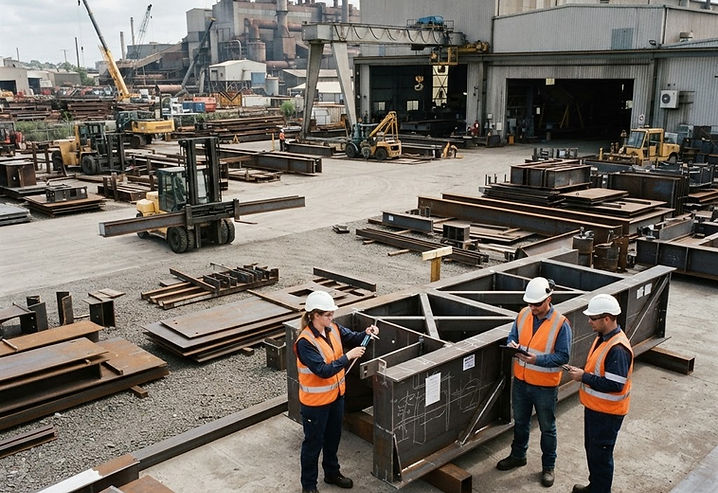
Think of a scenario where a client has contracted out a pipe fabrication project to a vendor. At the end of the project, the product delivered to the client did not meet expectations. What went wrong here? The short answer is quality, defined by ISO 9000:2015 as the “degree to which a set of inherent characteristics of an object fulfills requirements.”, was compromised. Quality is usually the yardstick by which the competency of fabrication companies is judged. There are varying degrees of quality, hence if a fabrication company mentions that it makes “quality” products, further details will be required. This blog will look to provide more insights on this topic.
How Is Quality Measured?
Quality is an essential requirement for a structural steel fabrication product and a fabricator needs to have a robust quality management system in place. A QMS is made up of several components, two of which are quality assurance and quality control. QA focuses on providing confidence that quality requirements will be fulfilled. This component works to prevent errors through quality policies and processes. However, having confidence isn’t always enough, as no system is foolproof. That is where quality control or QC comes in as it focuses on finding and correcting errors before the parts get to the customer. Beyond receiving a product that meets customer requirements and expectations, a formal QMS provides additional value that leads to a positive return on the metal fabrication investment.
Maintaining Consistency and Improving Cost Effectiveness

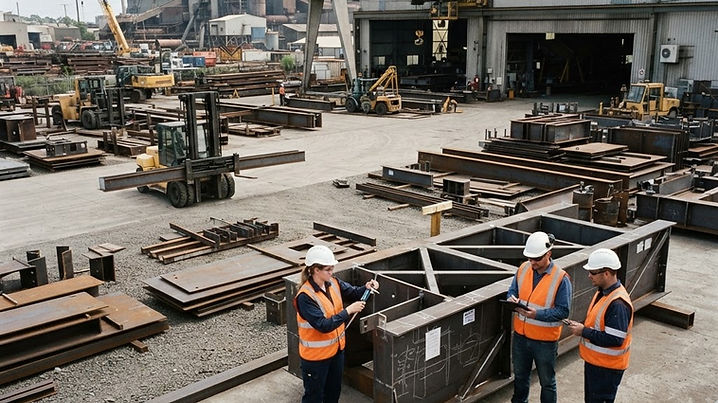
Consistency is a cornerstone of a solid quality management system. If the customer receives products that are within spec sometimes and other batches are out of spec, the fabricator likely does not have a strong quality system in place. A QMS is designed for manufacturing process improvements, ensuring increased efficiency and operational excellence. Automation techniques for fabrication are standardized to improve repeatability for even the most challenging projects. QC checks ensure quality remains consistent from batch to batch.
A successful QMS also innately controls costs. Defective parts can result in scrap and rework, adding unexpected costs to solve. This can also add time to project schedules, creating delays in processes or getting the product to market, resulting in lost revenue.
Ensuring Compliance and Reducing Hazards
Most fabricated products must meet safety, performance, and/or regulatory standards. For instance, products used in the food and beverage industry must meet the requirements of the USDA or FDA for food contact. Many customers may require 3A sanitary standards to be met as well. Other industries, such as aerospace and defense, have tight tolerances for parts and may require a manufacturer to be International Traffic In Arms Regulations (ITAR) compliant.
Defective products can be a safety hazard. An effective QMS has checks in place to anticipate a potential problem before it becomes a safety hazard in metal fabrication. If the product carries an inherent risk where failure could result in catastrophic results, ensuring the fabricator has a string quality system is no longer a nice to have; it is critical. If the product is used in the workplace and is found to be defective and there is an accident, OSHA fines may be levied.
Conclusion
Quality can lead to far reaching effects on customer relationships. When the parts are coming from a metal fabricator that values producing high quality parts consistently, customers will depend more on the fabricator to meet their needs. Conversely, poor quality parts will reflect badly on the fabricator and tarnish its reputation in the market. In an increasingly competitive metal fabrication industry, quality management (or the lack of it!) will be the sieve through which poor fabricators are filtered out!
Further reading
Follow Hydrogen across the wider market on Project Atlas Intel.
Calculation tool
Run the numbers for this yourself with the free engineering unit converter from Engineering Toolbox Australia. Treat the result as a first check, then confirm the final design with your engineer.
How K999 can help
Where we fit the story
Trade policy, commodity cycles and energy markets decide when projects move, and they decide what gets fabricated. These articles collect the changes we track for our clients.
See our projects- 01
Work delivered for mining, energy, processing and manufacturing clients across Australia and Southeast Asia.
- 02
Fabrication in Rayong with assembly at Sattahip, shipping from Laem Chabang and Map Ta Phut.
- 03
Enquiries answered within 48 hours by our estimating team.
More on Industry News
All articles


Request for quotation
Need fabricated steel to that standard?
Every enquiry is answered within 48 hours by our estimating team in Rayong. The priced quotation follows once drawings, quantities and standards are confirmed. Stainless steel fabrication, structural steel fabrication, pipe spooling, pressure vessels, steel tanks, mining equipment and conveyors, pig launchers, chutes and hoppers, send the package and we will price it.
Before you request a quotation
Steel fabrication quotation questions
What structural steel fabrication, pressure vessel and pipe spooling packages cost, what to send with an enquiry, and how delivery to site works.
Structural steel fabrication is priced from the section and plate tonnage, the detailing and drawing hours, welding and fitting manhours, NDT requirements, blast and coating system, packing and freight. Grade matters as much as weight: AS/NZS, ASTM, JIS and BS sections carry different mill prices, and heavy built up members take longer than rolled sections. Our Rayong workshop produces around 10,000 tonnes of structural steel fabrication a year, so a clear bill of materials is usually enough to price. Send the drawings and we answer within 48 hours; the priced quotation follows once quantities, standards and delivery dates are confirmed.
For steel fabrication work, send the drawings or IFC package, a bill of materials with material grades, the welding and NDT requirements, the coating specification, the delivery port and your site dates. Add the inspection and test plan, any third party inspection requirement, and whether trial assembly or match marking is needed. Where drawings are still in progress, a scope list with sizes, quantities and duty is enough to start, and the estimate is refined once the final package arrives. Every enquiry is answered within 48 hours, and the priced quotation is issued after scope, standards and quantities are confirmed.
Yes. Pressure vessel fabrication is carried out to ASME Section VIII Div. 1 under our ASME U stamp No. 43,462, or to AS/NZS and BS where the project specifies, covering separators, air receivers, water drums, waste heat recovery units and pig launchers. Steel tanks for fuel, biofuel, chemical, water and food duty are designed in house with our E Tank programme to API, ASME, BS and AS/NZS. Because structural steel, vessels, tanks and their supports are built in the same workshops, one enquiry can cover the vessel package, the tank package and the structural steel that carries them, with a single coating and documentation system and one shipment.
Steel fabrication Australia packages are scheduled from a 33,000 m2 Rayong yard with an 80,000 m2 assembly yard inside Sattahip port, so fabrication, trial assembly, blasting, coating and packing run in one place. Programme length depends on tonnage, material lead times, the coating system and inspection scope, and it is confirmed with the quotation. We quote FOB Laem Chabang, Map Ta Phut or Sattahip, or CIF and DAP to your Australian port, with packing lists, weights, lifting points and a data book per shipment. Staged deliveries can follow your site erection sequence instead of shipping everything at once.
There is no fixed minimum. Pipe spooling Australia packages run at up to 3,000 diameter inches per shift on SCH.40, from a single replacement spool to a full plant piping scope, with spools numbered, X rayed where specified and coated to match erection order. Mining equipment fabrication covers chutes, hoppers, ore bins, transfer towers and conveyor structures with Bisalloy, Hardox, rubber lining or hardfacing fitted in house, from one wear liner set to modules of up to 2,500 tonnes assembled at Sattahip. Send the scope list and we will tell you what the smallest sensible batch is for your programme.