


Fabrication
Rapid Prototyping - Innovation in the Fabrication Industry
Prototyping compresses design cycles, letting fabricators prove fit and function before committing to production tooling.
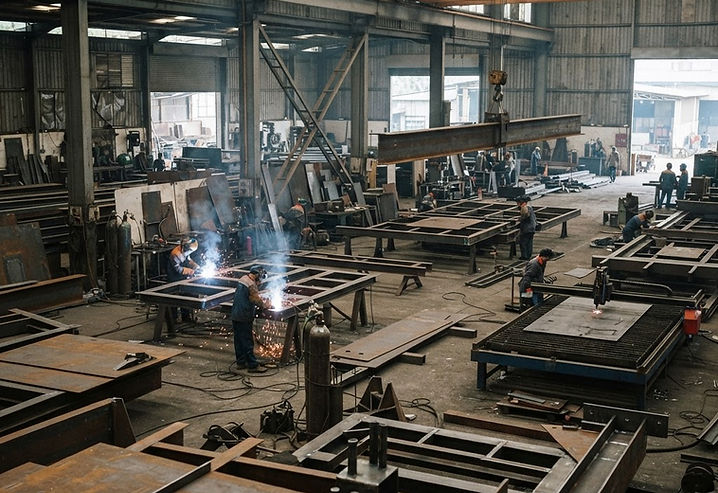
How do companies stay relevant in the ultracompetitive fabrication and manufacturing industry. Fabrication firms are facing challenges as they need to maintain superior raw material quality, stay competitively priced, fulfil common lead schedules and keep up to date with the latest technological advancements, in short, companies need to maintain productivity and quality. An innovation which heavy steel fabrication companies are looking to provide as a service nowadays is rapid prototyping. Rapid prototyping is already in use in industries like product design, robotics, energy, consumer products etc.; however, a question may arise as to how this innovation can be applied to a labor intensive industry like fabrication and what are the resulting impact? This blog will look to answer this question and more going forward.
Rapid Prototyping is a rapid fabricating or machining process that employs CAD experts in addition to high tech Computer Numerical Control machining or structural steel fabrication equipment to create a physical part in a quicker timeframe. It can be used at any stage of the product development cycle for any components or subcomponents. In an engineering product design context, a prototype is a preliminary version of the end product used to evaluate the design, test the technology, analyze the working principle, and provide final product specifications. Prototypes are an integral part of engineering product design and, more importantly, in new product development.
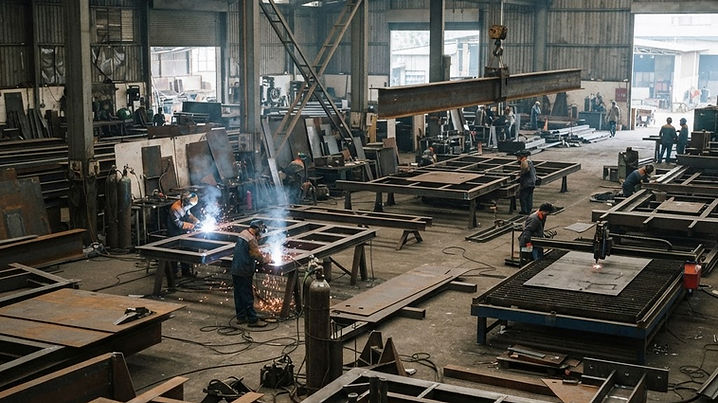
Prototypes can be categorized depending on the degree of accuracy required, product development stage, and purpose. Rapid prototypes don’t necessarily need to look like final products and can vary depending on what the product designer is trying to achieve from the prototype. Rapid prototypes can be classified in terms of accuracy or “Fidelity”. The degree of prototype accuracy can vary from low fidelity to high fidelity in functionality, appearance, user interface, and size. For instance, low fidelity prototypes are very simple and produced very quickly to test the broader concept. e.g., paper sketches to cardboard mock ups. High fidelity prototypes appear and function closer to the final product. They are used in industries where unmatched precision is required and the best use of 3D printing is of essence, e.g., in automotive, robotics, aerospace and defense industries since the production parts are cut precisely.
Some advantages of rapid prototyping are reduced design and development time, reduction in overall product development cost, incorporation of changes instantly, elimination or reduction of risk, minimization of design flaws, functionality testing being allowed at a fraction of the cost, improved and increased user involvement during design stages and an ability to evaluate human factors and ergonomics.
Conversely, some disadvantages of this process are potential lack of accuracy, added initial costs, rapid prototyping processes being expensive and uneconomical, reduced material properties like surface finish and strength, limited material range and possibility of overlooking some key features because they cannot be prototyped.
Multiple rapid prototyping technologies are being used across the fabrication industry, such as Stereolithography (SLA), Direct metal laser sintering (DMLS), Binder jetting, CNC Machining etc. Each of these techniques have their own pros and cons, and are used accordingly in different fabrication and manufacturing scenarios e.g. pipe spool fabrication, automated fabrication etc. While there are clear advantages in incorporating rapid prototyping in processes, production inefficiencies need to be tackled so that longer running fabrication jobs are not put on hold to create prototypes as per urgent client requirements. Hence, prior experience in management and operations will be a necessity if prototyping is to be embedded properly in fabrication. It’s still early days, however prototyping looks to offer an exciting new dimension to the fabrication landscape and it’s up to firms to harness its potential in the days ahead!
Further reading
Follow LNG across the wider market on Project Atlas Intel.
How K999 can help
Fabrication capacity behind the article
Articles in this section describe work we run every week in Rayong: cutting, forming, welding and assembly, under cover and in the yard, with the documentation that goes with it.
Structural steel fabrication- 01
Two workshops totalling more than 33,000 m² plus an 80,000 m² assembly yard at Sattahip.
- 02
Structural steel fabrication to 10,000 tonnes a year, with the largest single module built at 2,500 tonnes.
- 03
Blast, prime and paint before dispatch, with dimensional reports issued against the approved drawings.
More on Fabrication
All articles


Request for quotation
Need fabricated steel to that standard?
Every enquiry is answered within 48 hours by our estimating team in Rayong. The priced quotation follows once drawings, quantities and standards are confirmed. Stainless steel fabrication, structural steel fabrication, pipe spooling, pressure vessels, steel tanks, mining equipment and conveyors, pig launchers, chutes and hoppers, send the package and we will price it.
Before you request a quotation
Steel fabrication quotation questions
What structural steel fabrication, pressure vessel and pipe spooling packages cost, what to send with an enquiry, and how delivery to site works.
Structural steel fabrication is priced from the section and plate tonnage, the detailing and drawing hours, welding and fitting manhours, NDT requirements, blast and coating system, packing and freight. Grade matters as much as weight: AS/NZS, ASTM, JIS and BS sections carry different mill prices, and heavy built up members take longer than rolled sections. Our Rayong workshop produces around 10,000 tonnes of structural steel fabrication a year, so a clear bill of materials is usually enough to price. Send the drawings and we answer within 48 hours; the priced quotation follows once quantities, standards and delivery dates are confirmed.
For steel fabrication work, send the drawings or IFC package, a bill of materials with material grades, the welding and NDT requirements, the coating specification, the delivery port and your site dates. Add the inspection and test plan, any third party inspection requirement, and whether trial assembly or match marking is needed. Where drawings are still in progress, a scope list with sizes, quantities and duty is enough to start, and the estimate is refined once the final package arrives. Every enquiry is answered within 48 hours, and the priced quotation is issued after scope, standards and quantities are confirmed.
Yes. Pressure vessel fabrication is carried out to ASME Section VIII Div. 1 under our ASME U stamp No. 43,462, or to AS/NZS and BS where the project specifies, covering separators, air receivers, water drums, waste heat recovery units and pig launchers. Steel tanks for fuel, biofuel, chemical, water and food duty are designed in house with our E Tank programme to API, ASME, BS and AS/NZS. Because structural steel, vessels, tanks and their supports are built in the same workshops, one enquiry can cover the vessel package, the tank package and the structural steel that carries them, with a single coating and documentation system and one shipment.
Steel fabrication Australia packages are scheduled from a 33,000 m2 Rayong yard with an 80,000 m2 assembly yard inside Sattahip port, so fabrication, trial assembly, blasting, coating and packing run in one place. Programme length depends on tonnage, material lead times, the coating system and inspection scope, and it is confirmed with the quotation. We quote FOB Laem Chabang, Map Ta Phut or Sattahip, or CIF and DAP to your Australian port, with packing lists, weights, lifting points and a data book per shipment. Staged deliveries can follow your site erection sequence instead of shipping everything at once.
There is no fixed minimum. Pipe spooling Australia packages run at up to 3,000 diameter inches per shift on SCH.40, from a single replacement spool to a full plant piping scope, with spools numbered, X rayed where specified and coated to match erection order. Mining equipment fabrication covers chutes, hoppers, ore bins, transfer towers and conveyor structures with Bisalloy, Hardox, rubber lining or hardfacing fitted in house, from one wear liner set to modules of up to 2,500 tonnes assembled at Sattahip. Send the scope list and we will tell you what the smallest sensible batch is for your programme.