


Manufacturing & Technology
Smart Technologies Bridge Skills Shortage
Assisted welding, digital work instructions and machine guidance let fewer experienced people cover more output.
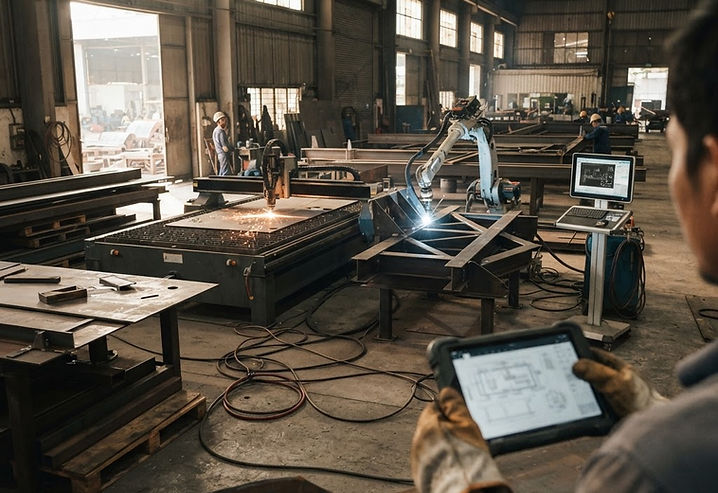
Talk to any Australian manufacturer and they will tell you one of their biggest issues is staffing. And it is not just anecdotal. Research by Ai Group reveals Australian businesses are facing the tightest labour market since the 1970s. The Australian Government’s latest Jobs and Skills Priority List reveals significant shortages of production engineers, software engineers, industrial engineers, mechanical engineers, and electrical engineers. Smart manufacturing technologies have the potential to mitigate staffing issues as a smart factory can autonomously run entire production processes, maximising efficiency while reducing costs. So, what are these smart technologies and what benefits do they bring to the table? Let us find out further in this blog.
A Paradigm Shift
The growing trend of manufacturers and heavy steel fabrication companies embracing smart technologies is backed up by Rockwell Automation’s 2024 State of Smart Manufacturing Report (SoSM). The global study surveyed more than 1,500 manufacturers across 17 countries including 88 businesses in Australia and New Zealand (ANZ). Of the local respondents, 40% have implemented robotics at scale, 33% are piloting robotics implementations and another 23% are at the planning stage. The rising interest in robotics from local manufacturers is not surprising considering the lack of adequate human resources. A higher level of automation allows operations to continue and allows for growth. However, smart manufacturing is complex and could entail high upfront costs, so manufacturers should develop a long term strategy and work with credible experienced partners.
Industrial Internet of Things (IIoT)

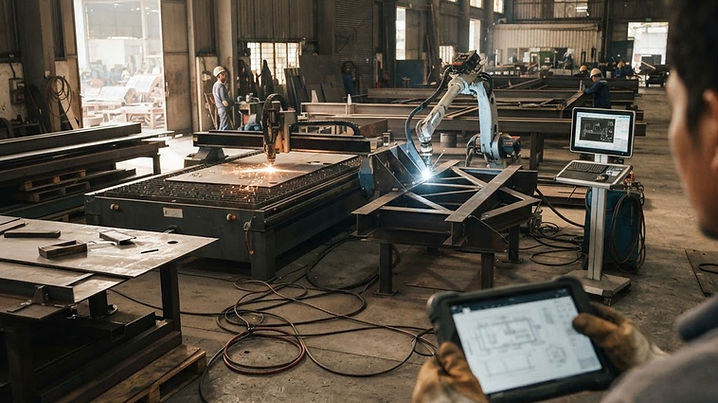
One of the key building blocks in the transition to greater automation is the rise of IIoT, which enables connected devices on the network to transfer data without human to human or human to computer interaction. In ANZ, 30% of the companies surveyed have already implemented IIoT at scale with 60% piloting solutions or working on implementation plans. This bodes well for the future of local manufacturing, IIoT can enhance efficiency and enable predictive maintenance and data driven decision making in industrial processes. ANZ has a 30% implementation rate, but that pales in comparison to China (51%), Canada (41%) and India (48%).
Smart Manufacturing
The National Institute of Standards and Technology defines smart manufacturing as fully integrated, collaborative manufacturing systems that respond in real time to meet changing demands and conditions in the factory, in the supply network and in customer needs. The SoSM Report reveals that 44% of ANZ survey respondents have already adopted this technology in full or in part. Smart manufacturing is also gaining attention at the highest levels of the Australian Government. In November 2023, the House Standing Committee on Industry, Science and Resources put forth the view that the notion that Australian made products cannot compete with foreign alternatives is now outdated. With advanced manufacturing processes and techniques, particularly Industry 4.0 technologies as a manufacturing technology trend, Australian manufacturing have the potential to be globally competitive, including on cost.
Collaborative Robots
Seeking a productivity boost in the face of labour shortages, Australian manufacturers are turning to robots and more specifically, collaborative robots (cobots) which work alongside humans to perform intricate assembly processes or complex tasks such as heat induction bending services. The SoSM Report notes that 34% of ANZ survey respondents have already invested in cobots with another 42% planning to invest in the next 12 months. Australia is significantly ahead of Canada in this regard, which sits at 14% (invested) and 32% (planned).
Closing Words
Going by current numbers, the smart manufacturing ecosystem in Australia is poised to take a quantum leap in 2024 and beyond. In addition to the above technologies, generative AI has the potential to disrupt manufacturing processes and increase automation going forward. Hence, it is time for manufacturers to get “smart”, else they are likely to miss the next generation manufacturing bus!
K999 Thailand carries out work of this kind through its steel fabrication capability team in Rayong.
Further reading
Follow tender intelligence across the wider market on Project Atlas Intel.
Calculation tool
Run the numbers for this yourself with the free AS/NZS steel grades from Engineering Toolbox Australia. Treat the result as a first check, then confirm the final design with your engineer.
How K999 can help
How we apply the technology
Faster quoting, cleaner detailing and fewer site surprises come from the tools we use before the first cut, and the articles here explain how those tools change the work.
3D modelling and detailing- 01
3D modelling and shop detailing that resolves clashes before fabrication starts.
- 02
Fibre laser cutting for plate profiles, with nesting planned around the rolling schedule.
- 03
Project management that reports progress against the same model the client approved.
More on Manufacturing & Technology
All articles

Request for quotation
Need fabricated steel to that standard?
Every enquiry is answered within 48 hours by our estimating team in Rayong. The priced quotation follows once drawings, quantities and standards are confirmed. Stainless steel fabrication, structural steel fabrication, pipe spooling, pressure vessels, steel tanks, mining equipment and conveyors, pig launchers, chutes and hoppers, send the package and we will price it.
Before you request a quotation
Steel fabrication quotation questions
What structural steel fabrication, pressure vessel and pipe spooling packages cost, what to send with an enquiry, and how delivery to site works.
Structural steel fabrication is priced from the section and plate tonnage, the detailing and drawing hours, welding and fitting manhours, NDT requirements, blast and coating system, packing and freight. Grade matters as much as weight: AS/NZS, ASTM, JIS and BS sections carry different mill prices, and heavy built up members take longer than rolled sections. Our Rayong workshop produces around 10,000 tonnes of structural steel fabrication a year, so a clear bill of materials is usually enough to price. Send the drawings and we answer within 48 hours; the priced quotation follows once quantities, standards and delivery dates are confirmed.
For steel fabrication work, send the drawings or IFC package, a bill of materials with material grades, the welding and NDT requirements, the coating specification, the delivery port and your site dates. Add the inspection and test plan, any third party inspection requirement, and whether trial assembly or match marking is needed. Where drawings are still in progress, a scope list with sizes, quantities and duty is enough to start, and the estimate is refined once the final package arrives. Every enquiry is answered within 48 hours, and the priced quotation is issued after scope, standards and quantities are confirmed.
Yes. Pressure vessel fabrication is carried out to ASME Section VIII Div. 1 under our ASME U stamp No. 43,462, or to AS/NZS and BS where the project specifies, covering separators, air receivers, water drums, waste heat recovery units and pig launchers. Steel tanks for fuel, biofuel, chemical, water and food duty are designed in house with our E Tank programme to API, ASME, BS and AS/NZS. Because structural steel, vessels, tanks and their supports are built in the same workshops, one enquiry can cover the vessel package, the tank package and the structural steel that carries them, with a single coating and documentation system and one shipment.
Steel fabrication Australia packages are scheduled from a 33,000 m2 Rayong yard with an 80,000 m2 assembly yard inside Sattahip port, so fabrication, trial assembly, blasting, coating and packing run in one place. Programme length depends on tonnage, material lead times, the coating system and inspection scope, and it is confirmed with the quotation. We quote FOB Laem Chabang, Map Ta Phut or Sattahip, or CIF and DAP to your Australian port, with packing lists, weights, lifting points and a data book per shipment. Staged deliveries can follow your site erection sequence instead of shipping everything at once.
There is no fixed minimum. Pipe spooling Australia packages run at up to 3,000 diameter inches per shift on SCH.40, from a single replacement spool to a full plant piping scope, with spools numbered, X rayed where specified and coated to match erection order. Mining equipment fabrication covers chutes, hoppers, ore bins, transfer towers and conveyor structures with Bisalloy, Hardox, rubber lining or hardfacing fitted in house, from one wear liner set to modules of up to 2,500 tonnes assembled at Sattahip. Send the scope list and we will tell you what the smallest sensible batch is for your programme.