


Industry News
Sustainability in Steel Manufacturing Industry
Energy intensity, scrap recovery and water use define the sustainability profile of steel manufacturing.
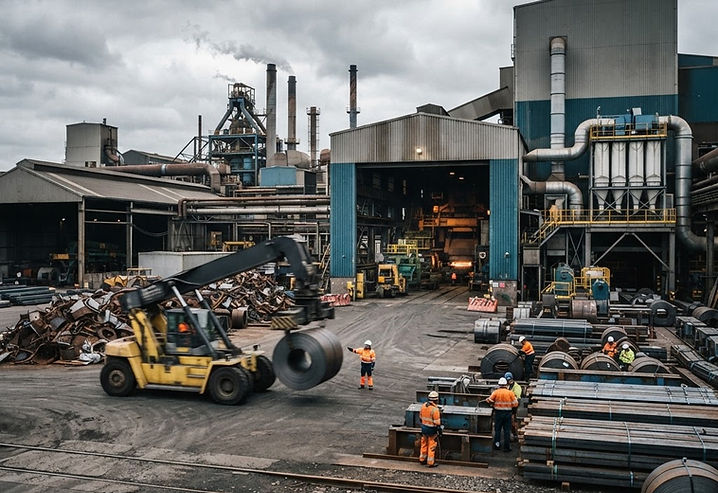
There is currently a trend towards doing business in a sustainable manner. Regulatory bodies have started implementing reporting and disclosure requirements, an example is the Securities and Exchange Board of India (SEBI) implementing Business Responsibility and Sustainability Reporting (BRSR) requirements across Indian firms. Manufacturing is no exception, and sustainable manufacturing looks to be economical decreases negative environmental impacts while conserving energy and natural resources. However, is this really practical in the real world when we normally associate manufacturing with different types of pollution like air, water etc.? Let’s find out more in this blog which looks to analyze this subject in greater detail.
Risks of Unsustainable Manufacturing
Manufacturing and metal and pipe fabrication companies should utilize sustainable practices which are safe, eco friendly and economically good for a business. Unsustainable manufacturing can lead to risks for future generations. Evidence has shown that people living near unsustainable manufacturing companies are at higher risk of negative health impacts. Studies have confirmed that proximity to polluting areas, like factories have led to pregnancy issues like central nervous system defects, oral clefts, chromosome anomalies, perinatal mortality, and low birth weight. Manufacturing facilities have also led to an increase in child cancer rates. Families living near manufacturing facilities and employees are also becoming less tolerant of pollution and elevated health risks with nearby residents raising concerns about effluents and toxic waste.
How to do Metal Fabrication Sustainably
Sustainability is about making choices that encourage the use of cleaner technologies where appropriate, and decreasing wastefulness. While there are differences between fabrication and manufacturing, some best practices can be followed for both with regard to sustainability as detailed below:,
Selection of right lubricants for the concerned application, with an eye toward healthier chemicals.
Understand the technologies and materials used, to reduce failures and scrap.
Pay consideration to coil mill certifications to make sure the material purchased is produced in a mill where sustainability is on their agenda.

Use virtual simulation beneficially to minimize the cost and waste of excessive tryouts and to understand the dynamics of operations and materials at brake press folding.
Maintain oversight on precision manufacturing processes and technologies to avoid costly equipment and personnel inefficiencies and failures.
Keep a strong focus on safety and reduce lost hours.
Use proper filtration and extractors for the steel laser cutting machine.
Keep materials clean and well maintained and welding areas and other workspaces should be hygienic and organized.
Evolve and practice emergency protocols for dangerous equipment conditions, spills, and leaks.
Understand FMEAs and the criticality of each failure mode.
Continuous learning and understanding of operations, and providing guidance to new professionals.
Final Remarks
Today industry, technology and public attitude towards sustainable manufacturing is changing. Manufacturers and heavy steel fabrication companies have little to no excuse to avoid using eco friendly methods in their operations. Impact to the bottom line and potential deterioration in the quality of work were some of the considerations manufacturing companies had when asked to implement a sustainable way of working. Those fears have proved unfounded and there is a growing realization that the solution to offering a safe work and neighborhood environment is the same as directing a manufacturing business sustainably. Awareness of the ecosystem and the impact as a result of operations are topics which have gained importance in recent years and, judging by the growing acceptance and awareness from stakeholders, these will continue to be highlighted going forward!
Further reading
Follow tender opportunities across the wider market on Project Atlas Intel.
Calculation tool
Run the numbers for this yourself with the free rectangular tank volume from Engineering Toolbox Australia. Treat the result as a first check, then confirm the final design with your engineer.
How K999 can help
Where we fit the story
Trade policy, commodity cycles and energy markets decide when projects move, and they decide what gets fabricated. These articles collect the changes we track for our clients.
See our projects- 01
Work delivered for mining, energy, processing and manufacturing clients across Australia and Southeast Asia.
- 02
Fabrication in Rayong with assembly at Sattahip, shipping from Laem Chabang and Map Ta Phut.
- 03
Enquiries answered within 48 hours by our estimating team.
More on Industry News
All articles


Request for quotation
Need fabricated steel to that standard?
Every enquiry is answered within 48 hours by our estimating team in Rayong. The priced quotation follows once drawings, quantities and standards are confirmed. Stainless steel fabrication, structural steel fabrication, pipe spooling, pressure vessels, steel tanks, mining equipment and conveyors, pig launchers, chutes and hoppers, send the package and we will price it.
Before you request a quotation
Steel fabrication quotation questions
What structural steel fabrication, pressure vessel and pipe spooling packages cost, what to send with an enquiry, and how delivery to site works.
Structural steel fabrication is priced from the section and plate tonnage, the detailing and drawing hours, welding and fitting manhours, NDT requirements, blast and coating system, packing and freight. Grade matters as much as weight: AS/NZS, ASTM, JIS and BS sections carry different mill prices, and heavy built up members take longer than rolled sections. Our Rayong workshop produces around 10,000 tonnes of structural steel fabrication a year, so a clear bill of materials is usually enough to price. Send the drawings and we answer within 48 hours; the priced quotation follows once quantities, standards and delivery dates are confirmed.
For steel fabrication work, send the drawings or IFC package, a bill of materials with material grades, the welding and NDT requirements, the coating specification, the delivery port and your site dates. Add the inspection and test plan, any third party inspection requirement, and whether trial assembly or match marking is needed. Where drawings are still in progress, a scope list with sizes, quantities and duty is enough to start, and the estimate is refined once the final package arrives. Every enquiry is answered within 48 hours, and the priced quotation is issued after scope, standards and quantities are confirmed.
Yes. Pressure vessel fabrication is carried out to ASME Section VIII Div. 1 under our ASME U stamp No. 43,462, or to AS/NZS and BS where the project specifies, covering separators, air receivers, water drums, waste heat recovery units and pig launchers. Steel tanks for fuel, biofuel, chemical, water and food duty are designed in house with our E Tank programme to API, ASME, BS and AS/NZS. Because structural steel, vessels, tanks and their supports are built in the same workshops, one enquiry can cover the vessel package, the tank package and the structural steel that carries them, with a single coating and documentation system and one shipment.
Steel fabrication Australia packages are scheduled from a 33,000 m2 Rayong yard with an 80,000 m2 assembly yard inside Sattahip port, so fabrication, trial assembly, blasting, coating and packing run in one place. Programme length depends on tonnage, material lead times, the coating system and inspection scope, and it is confirmed with the quotation. We quote FOB Laem Chabang, Map Ta Phut or Sattahip, or CIF and DAP to your Australian port, with packing lists, weights, lifting points and a data book per shipment. Staged deliveries can follow your site erection sequence instead of shipping everything at once.
There is no fixed minimum. Pipe spooling Australia packages run at up to 3,000 diameter inches per shift on SCH.40, from a single replacement spool to a full plant piping scope, with spools numbered, X rayed where specified and coated to match erection order. Mining equipment fabrication covers chutes, hoppers, ore bins, transfer towers and conveyor structures with Bisalloy, Hardox, rubber lining or hardfacing fitted in house, from one wear liner set to modules of up to 2,500 tonnes assembled at Sattahip. Send the scope list and we will tell you what the smallest sensible batch is for your programme.