


Manufacturing & Technology
Top 3 Manufacturing Technology Trends
Digital twins, collaborative robots and analytics adoption lead the technology agenda in manufacturing plants.
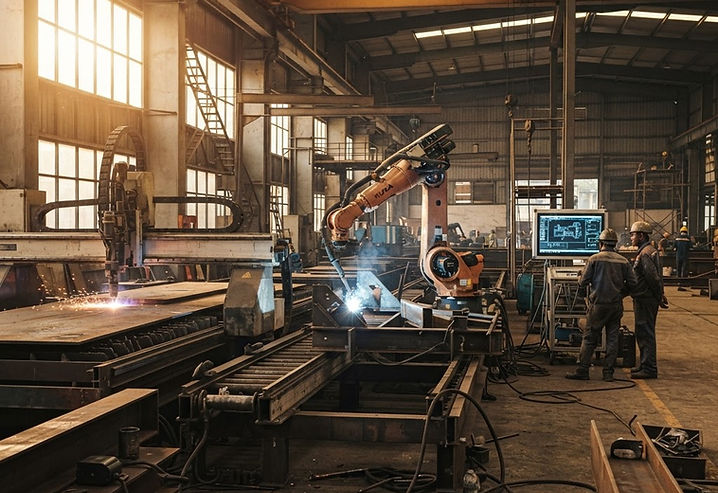
Macroeconomic and microeconomic developments test the resilience of the manufacturing sector each year. Some of these disruptors are the COVID 19 pandemic, increasing inflation, supply chain disruption and labour market shortages, all of which proved challenging for manufacturing and steel fabrication businesses. As a result, there is an increased sense of urgency to strengthen and streamline manufacturing processes as the sector will get tested further in an environment of increased uncertainty and volatility. There are some upcoming technology trends which can help manufacturers grow and overcome industry challenges, this blog will deep dive into this topic to provide further insight.
Power of Cloud
The adoption of cloud technology by manufacturers is accelerating, especially with regard to the rapid growth in adoption of IIoT. A recent survey revealed that 90% of manufacturers plan on moving to the cloud. Despite this, there are manufacturers still reliant on outdated and unstable technology, restricting growth, innovation, and competitiveness. Cloud solutions enable companies to integrate every aspect of their process seamlessly. Having data available on a unified platform provides visibility over the whole production journey. This integration and ability to monitor processes in real time not only enhances operations, but provides insights to streamline production, cut costs, and enable data driven decisions. Migrating to the cloud is already reaping rewards for manufacturers who have made the change. However, as the global economy continues to create turbulence and uncertainty, laggard businesses must consider investing in the right cloud solutions to help them consolidate and connect, otherwise, they risk being left behind.
True Value of Data

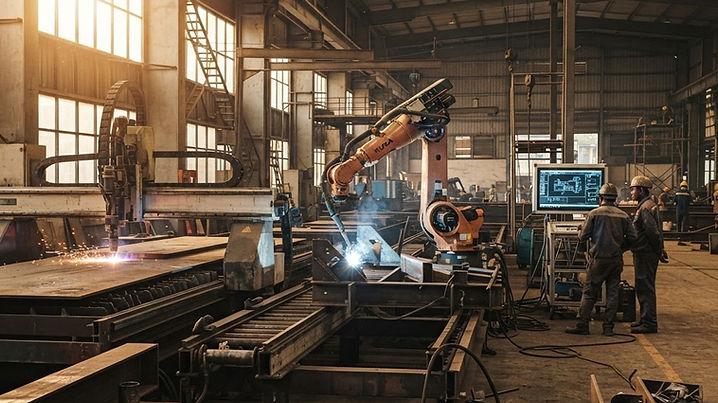
Data is core to manufacturing and has become central to digitalization strategies and can be used to identify changes in customer behaviour, supply chain issues, and production or labour trends. Managing data as a valuable business asset is also important in securing critical control points for manufacturing companies as it can be used to make an analysis that would give insights into various aspects of the industry. A recent survey by the World Economic Forum revealed insufficient skills are the biggest challenge to capturing value from manufacturing data. In this context, there is expected to be an increase in hiring and valuing digital natives who understand analytics and can adopt a data driven approach.
Rise of Automation and Intelligent Integrations
There is expected to be an increase in reliance on digital work instructions and intelligent integrations. Industry 4.0 is a digital transformation that connects manufacturing through “smart” technologies like Blockchain, Internet of Things and Artificial Intelligence. It aids in revolutionizing modern day manufacturing by giving an in depth understanding of product design and process, and by accommodating experimentation. For instance, Epicor Connected Process Control, formerly known as eFlex Systems, a provider of cloud based Manufacturing Execution System (MES) technologies recently acquired by Epicor, helps manufacturers to increase productivity by modernizing their production environments through digital work instructions, advanced process control, and real time visibility in processes such as heat induction bending services. Although the global economic outlook remains uncertain, the manufacturing industry recognizes the disruptive effect of automation as key to becoming more competitive, increasing growth, and improving profitability.
Conclusion
Even as Industry 4.0 continues to help businesses, it is paving the way for Industry 5.0. Still in its nascent stages, Industry 5.0 is advancing the collaboration between humans and machines as a response to increased customization in products. So, technological innovation and collaboration is expected to continue at an increased rate and this is likely to be a recipe of success for manufacturers who are ahead of the curve. In essence, volatility needs to be countered with proactiveness, this can help manufacturers outperform their counterparts in an increasingly competitive world!
K999 Thailand carries out work of this kind through its steel fabrication capability team in Rayong.
Further reading
Follow Petrochemical across the wider market on Project Atlas Intel.
Calculation tool
Run the numbers for this yourself with the free free engineering calculators from Engineering Toolbox Australia. Treat the result as a first check, then confirm the final design with your engineer.
How K999 can help
How we apply the technology
Faster quoting, cleaner detailing and fewer site surprises come from the tools we use before the first cut, and the articles here explain how those tools change the work.
3D modelling and detailing- 01
3D modelling and shop detailing that resolves clashes before fabrication starts.
- 02
Fibre laser cutting for plate profiles, with nesting planned around the rolling schedule.
- 03
Project management that reports progress against the same model the client approved.
More on Manufacturing & Technology
All articles

Request for quotation
Need fabricated steel to that standard?
Every enquiry is answered within 48 hours by our estimating team in Rayong. The priced quotation follows once drawings, quantities and standards are confirmed. Stainless steel fabrication, structural steel fabrication, pipe spooling, pressure vessels, steel tanks, mining equipment and conveyors, pig launchers, chutes and hoppers, send the package and we will price it.
Before you request a quotation
Steel fabrication quotation questions
What structural steel fabrication, pressure vessel and pipe spooling packages cost, what to send with an enquiry, and how delivery to site works.
Structural steel fabrication is priced from the section and plate tonnage, the detailing and drawing hours, welding and fitting manhours, NDT requirements, blast and coating system, packing and freight. Grade matters as much as weight: AS/NZS, ASTM, JIS and BS sections carry different mill prices, and heavy built up members take longer than rolled sections. Our Rayong workshop produces around 10,000 tonnes of structural steel fabrication a year, so a clear bill of materials is usually enough to price. Send the drawings and we answer within 48 hours; the priced quotation follows once quantities, standards and delivery dates are confirmed.
For steel fabrication work, send the drawings or IFC package, a bill of materials with material grades, the welding and NDT requirements, the coating specification, the delivery port and your site dates. Add the inspection and test plan, any third party inspection requirement, and whether trial assembly or match marking is needed. Where drawings are still in progress, a scope list with sizes, quantities and duty is enough to start, and the estimate is refined once the final package arrives. Every enquiry is answered within 48 hours, and the priced quotation is issued after scope, standards and quantities are confirmed.
Yes. Pressure vessel fabrication is carried out to ASME Section VIII Div. 1 under our ASME U stamp No. 43,462, or to AS/NZS and BS where the project specifies, covering separators, air receivers, water drums, waste heat recovery units and pig launchers. Steel tanks for fuel, biofuel, chemical, water and food duty are designed in house with our E Tank programme to API, ASME, BS and AS/NZS. Because structural steel, vessels, tanks and their supports are built in the same workshops, one enquiry can cover the vessel package, the tank package and the structural steel that carries them, with a single coating and documentation system and one shipment.
Steel fabrication Australia packages are scheduled from a 33,000 m2 Rayong yard with an 80,000 m2 assembly yard inside Sattahip port, so fabrication, trial assembly, blasting, coating and packing run in one place. Programme length depends on tonnage, material lead times, the coating system and inspection scope, and it is confirmed with the quotation. We quote FOB Laem Chabang, Map Ta Phut or Sattahip, or CIF and DAP to your Australian port, with packing lists, weights, lifting points and a data book per shipment. Staged deliveries can follow your site erection sequence instead of shipping everything at once.
There is no fixed minimum. Pipe spooling Australia packages run at up to 3,000 diameter inches per shift on SCH.40, from a single replacement spool to a full plant piping scope, with spools numbered, X rayed where specified and coated to match erection order. Mining equipment fabrication covers chutes, hoppers, ore bins, transfer towers and conveyor structures with Bisalloy, Hardox, rubber lining or hardfacing fitted in house, from one wear liner set to modules of up to 2,500 tonnes assembled at Sattahip. Send the scope list and we will tell you what the smallest sensible batch is for your programme.