


Mining & Resources
Trends Shaping Africa's Mining Industry
Local content rules, battery mineral demand and logistics investment are changing how African mine projects buy fabricated steel.
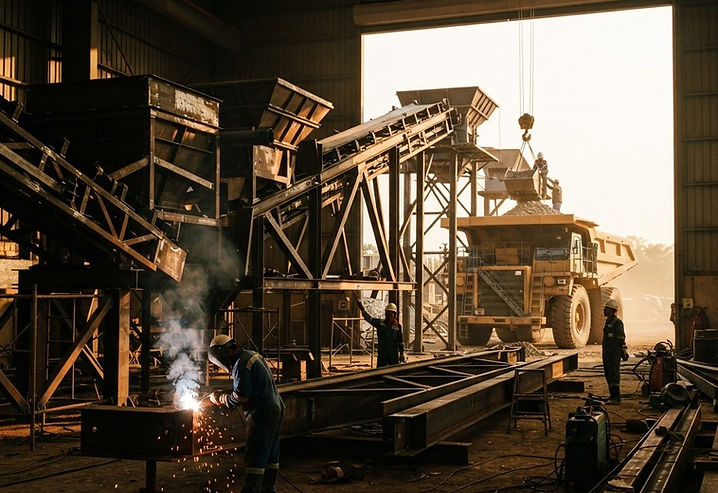
Africa’s mining outlook stands at a crossroads. On one hand, the continent is witnessing a monumental surge in opportunity and demand for its abundant minerals and metals. On the other, however, global insecurity and oscillating commodity prices are steering investments away from perceived “riskier” choices, with Africa potentially missing the opportunity to capitalise on its mineral endowments. The financial dynamics in Africa’s mining sector stand out as companies grapple with the imperative to fund expansions necessary to meet the surging demand for minerals. So, what are some of the major trends defining the mining industry in Africa? This blog will explore this topic in further detail.
Battery Minerals: Powering the Global Energy Transition
The global push toward electrification and renewable energy propels the demand for battery minerals, positioning Africa as a key player with abundant resources. Projections indicate a tripling of demand by 2040, and a sixfold increase by 2050, making Africa a powerhouse with significant contributions to the global supply. After all, the continent is home to over 70% of the world’s cobalt, 60% of manganese, 25% of bauxite, nearly 15% of copper, amongst other minerals deemed “critical” by governments the world over. However, the continent is at a crucial juncture. While its natural resources offer an extraordinary opportunity, concerns persist about the risk of value extraction without the use of advanced techniques such as hyperspectral imaging technology, and insufficient investment in mining plant and equipment hampers the much needed fast tracking critical mineral development for the global energy transition.
Navigating Geopolitical Risk

Just like there is a correlation between steel manufacturing and global trade and industry, the intensification of geopolitical competition will be another key trend for the mining industry in 2024, commanding heightened attention from companies and countries alike. This imperative will be accentuated in the realm of critical minerals, which have assumed paramount importance in driving the global green energy transition. In recent years, we have seen tangible manifestations of this in the form of export controls and resource nationalism, with countries like Zimbabwe banning the export of raw lithium to incentivize local processing and Indonesia, a significant player in nickel, took steps to restrict nickel ore exports. These geopolitical actions pose major risks to global markets, exerting influence over commodity prices, trade relationships, economic conditions, and interconnected variables.
Digital Transformation: Efficiency Gains and Cybersecurity Risks
As in other sectors, digital technologies herald real benefits for the mining industry, especially in operational efficiency. However, digitisation also brings forth escalating cybersecurity threats that pose a tangible risk to the sector’s operational integrity and reputation. Indeed, the increasing prevalence of Internet of devices amplifies vulnerabilities, with potentially catastrophic consequences for unsecured devices within companies’ networks. The introduction of AI based technologies, without robust governance, further elevates the risk of data breaches. In recent years, cyberattacks targeting mining companies have been on the rise globally, underscoring the industry’s vulnerability to the threats posed by digital transformation.
Final Touches
The mining industry faces an investment dilemma, with an extraordinary need for new mine investments to keep pace with future energy transition, estimated at $1.2 trillion across transition metals by 2050. This is hampered by a lack of consensus among heavy steel fabrication companies on who should foot the bill and how the value chain should evolve. Navigating financial complexities while aligning with sustainability goals will demand innovative solutions, impacting the trajectory of the sector. In 2024, sustainability and ESG considerations are expected to shape the industry further, with heightened investor scrutiny, regulatory action, and mounting expectations for sustainability performance. The microscope will likely be on companies’ Net Zero commitments, credible climate plans, tailings management, and biodiversity considerations, aligning with the Taskforce on Nature related Financial Disclosures. So there is a lot of activity happening in Africa’s mining sector, and we need to keep a close eye on developments!
K999 Thailand carries out work of this kind through its mining equipment fabrication team in Rayong.
Further reading
Follow engineering procurement construction companies in Singapore across the wider market on Project Atlas Intel.
How K999 can help
Equipment built for the pit
Mining work is where wear life decides the maintenance budget, so the articles in this section feed directly into how we detail chutes, hoppers, conveyors and wear parts.
Mining equipment and conveyors- 01
Mining equipment and conveyor fabrication with replaceable wear liners and hardfaced contact surfaces.
- 02
Chutes, hoppers and transfer structures detailed for access, lifting and shutdown windows.
- 03
Site assembly planning from the Sattahip yard for modules that ship by sea.
More on Mining & Resources
All articles

Request for quotation
Need fabricated steel to that standard?
Every enquiry is answered within 48 hours by our estimating team in Rayong. The priced quotation follows once drawings, quantities and standards are confirmed. Stainless steel fabrication, structural steel fabrication, pipe spooling, pressure vessels, steel tanks, mining equipment and conveyors, pig launchers, chutes and hoppers, send the package and we will price it.
Before you request a quotation
Steel fabrication quotation questions
What structural steel fabrication, pressure vessel and pipe spooling packages cost, what to send with an enquiry, and how delivery to site works.
Structural steel fabrication is priced from the section and plate tonnage, the detailing and drawing hours, welding and fitting manhours, NDT requirements, blast and coating system, packing and freight. Grade matters as much as weight: AS/NZS, ASTM, JIS and BS sections carry different mill prices, and heavy built up members take longer than rolled sections. Our Rayong workshop produces around 10,000 tonnes of structural steel fabrication a year, so a clear bill of materials is usually enough to price. Send the drawings and we answer within 48 hours; the priced quotation follows once quantities, standards and delivery dates are confirmed.
For steel fabrication work, send the drawings or IFC package, a bill of materials with material grades, the welding and NDT requirements, the coating specification, the delivery port and your site dates. Add the inspection and test plan, any third party inspection requirement, and whether trial assembly or match marking is needed. Where drawings are still in progress, a scope list with sizes, quantities and duty is enough to start, and the estimate is refined once the final package arrives. Every enquiry is answered within 48 hours, and the priced quotation is issued after scope, standards and quantities are confirmed.
Yes. Pressure vessel fabrication is carried out to ASME Section VIII Div. 1 under our ASME U stamp No. 43,462, or to AS/NZS and BS where the project specifies, covering separators, air receivers, water drums, waste heat recovery units and pig launchers. Steel tanks for fuel, biofuel, chemical, water and food duty are designed in house with our E Tank programme to API, ASME, BS and AS/NZS. Because structural steel, vessels, tanks and their supports are built in the same workshops, one enquiry can cover the vessel package, the tank package and the structural steel that carries them, with a single coating and documentation system and one shipment.
Steel fabrication Australia packages are scheduled from a 33,000 m2 Rayong yard with an 80,000 m2 assembly yard inside Sattahip port, so fabrication, trial assembly, blasting, coating and packing run in one place. Programme length depends on tonnage, material lead times, the coating system and inspection scope, and it is confirmed with the quotation. We quote FOB Laem Chabang, Map Ta Phut or Sattahip, or CIF and DAP to your Australian port, with packing lists, weights, lifting points and a data book per shipment. Staged deliveries can follow your site erection sequence instead of shipping everything at once.
There is no fixed minimum. Pipe spooling Australia packages run at up to 3,000 diameter inches per shift on SCH.40, from a single replacement spool to a full plant piping scope, with spools numbered, X rayed where specified and coated to match erection order. Mining equipment fabrication covers chutes, hoppers, ore bins, transfer towers and conveyor structures with Bisalloy, Hardox, rubber lining or hardfacing fitted in house, from one wear liner set to modules of up to 2,500 tonnes assembled at Sattahip. Send the scope list and we will tell you what the smallest sensible batch is for your programme.