


Fabrication
Utility of Punch Press Machine
Turret punch presses still win on repetitive hole patterns and formed features, and where they beat laser cutting on cost.
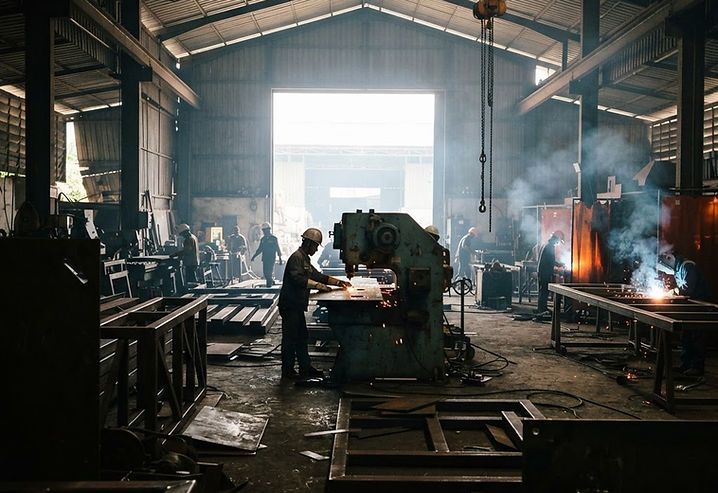
Punch presses are one of several equipment used by manufacturers and heavy steel fabrication companies to manipulate and convert raw materials into finished products. Making uniform shapes out of raw material in large quantities is much easier with the use of punch presses. A punch press may be used by a company if a specific raw material is too difficult to cut manually since it cuts through metal and other hard materials with ease, creating holes that match the die form of the punch press. So, what are the applications and utilities of punch presses? This blog will look to explore this topic in further details.
Types and Applications of Punch Press
Similar to press brake machines, punch presses are used in stamping, punching, bending, shearing, converting, and assembly operations. They differ in terms of drive type and automation. Air driven punch presses are powered by a pneumatic cylinder and are suitable for light duty applications. Hydraulic presses are powered by a fluid filled cylinder and can generate extremely strong forces to form metals and other materials. Manual presses are driven by hand, or powered with manual force that is magnified by a screw, lever, or other mechanism. Mechanical punch presses are driven by a rotary motor and screw, toggle, or lever. By contrast, servo controlled presses are driven directly by a servo motor. Some punch presses are controlled manually, using operator interface devices such as footswitches, pendants, or push button controls. Others include a computer numeric controller (CNC) or programmable logic controller (PLC). Punch presses that are programmed and controlled with a personal computer (PC) interface allow users to set and adjust parameters such as speed and applied load. Indexing machines are fully automatic and can load parts and adjust parameters without operator intervention.
Specifications of Punch Press

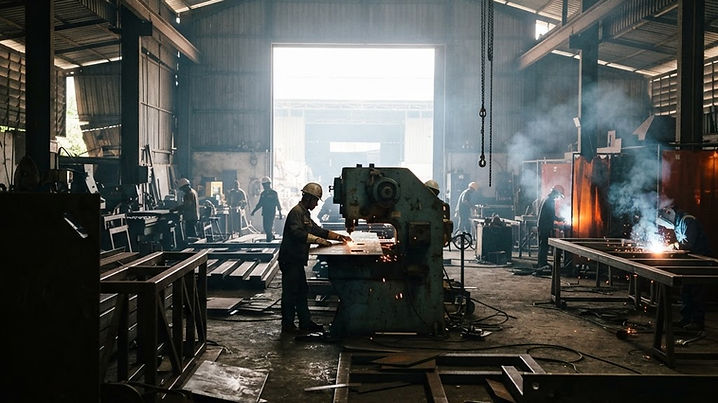
Important specifications for punch presses include operating force, rated capacity, production rate, and sheet capacity. Operating force is the maximum load required to cut or form parts during assembly. Rated capacity is the tons of pressure via pressure vessels that the slide or ram exerts at the bottom of the stroke while working within the range of the press. With mechanical punch presses, operating force is a function of the bending capacity of the main shaft. For all types of punch presses, production rate is the number of operations performed or units produced per unit of time. Typically, this amount is expressed as the number of strokes, hits, cut outs, cycles, or hits per minute. Most manufacturers specify sheet capacity in terms of maximum thickness, working length, and working depth. Working length is the maximum sheet length (largest dimension, X) or working distance from right to lift that can be punched, formed, or converted. Working depth is the maximum sheet (smallest dimension, Y) or working depth from front to back that can be punched, formed, or converted.
Special Features of Punch Press
Punch presses are available with a variety of special features. Some machines include integral shearing capabilities or optional material feeders. Others include laser cutting or monitoring systems. Multistation punch presses include rotary tools and turrets, progressive dies, transfer systems, or multitool die sits. Rotary punch presses index materials and allow operators to select an appropriate tool from the turret. Loading and stacking systems are complete manufacturing cells that often include material handling and degreasing subsystems. They provide sheet, part, and material handling.
Closing Thoughts
Punch presses have a multitude of applications and they are versatile in their use throughout industry. In fabrication, punch presses provide a viable alternative to metal cutting and can also provide a degree of automation with certain types of punch presses. Going forward, it can be safely concluded that punch presses will continue to “punch” above their weight in the metal work world!
Further reading
Follow Oil & Gas across the wider market on Project Atlas Intel.
How K999 can help
Fabrication capacity behind the article
Articles in this section describe work we run every week in Rayong: cutting, forming, welding and assembly, under cover and in the yard, with the documentation that goes with it.
Structural steel fabrication- 01
Two workshops totalling more than 33,000 m² plus an 80,000 m² assembly yard at Sattahip.
- 02
Structural steel fabrication to 10,000 tonnes a year, with the largest single module built at 2,500 tonnes.
- 03
Blast, prime and paint before dispatch, with dimensional reports issued against the approved drawings.
More on Fabrication
All articles


Request for quotation
Need fabricated steel to that standard?
Every enquiry is answered within 48 hours by our estimating team in Rayong. The priced quotation follows once drawings, quantities and standards are confirmed. Stainless steel fabrication, structural steel fabrication, pipe spooling, pressure vessels, steel tanks, mining equipment and conveyors, pig launchers, chutes and hoppers, send the package and we will price it.
Before you request a quotation
Steel fabrication quotation questions
What structural steel fabrication, pressure vessel and pipe spooling packages cost, what to send with an enquiry, and how delivery to site works.
Structural steel fabrication is priced from the section and plate tonnage, the detailing and drawing hours, welding and fitting manhours, NDT requirements, blast and coating system, packing and freight. Grade matters as much as weight: AS/NZS, ASTM, JIS and BS sections carry different mill prices, and heavy built up members take longer than rolled sections. Our Rayong workshop produces around 10,000 tonnes of structural steel fabrication a year, so a clear bill of materials is usually enough to price. Send the drawings and we answer within 48 hours; the priced quotation follows once quantities, standards and delivery dates are confirmed.
For steel fabrication work, send the drawings or IFC package, a bill of materials with material grades, the welding and NDT requirements, the coating specification, the delivery port and your site dates. Add the inspection and test plan, any third party inspection requirement, and whether trial assembly or match marking is needed. Where drawings are still in progress, a scope list with sizes, quantities and duty is enough to start, and the estimate is refined once the final package arrives. Every enquiry is answered within 48 hours, and the priced quotation is issued after scope, standards and quantities are confirmed.
Yes. Pressure vessel fabrication is carried out to ASME Section VIII Div. 1 under our ASME U stamp No. 43,462, or to AS/NZS and BS where the project specifies, covering separators, air receivers, water drums, waste heat recovery units and pig launchers. Steel tanks for fuel, biofuel, chemical, water and food duty are designed in house with our E Tank programme to API, ASME, BS and AS/NZS. Because structural steel, vessels, tanks and their supports are built in the same workshops, one enquiry can cover the vessel package, the tank package and the structural steel that carries them, with a single coating and documentation system and one shipment.
Steel fabrication Australia packages are scheduled from a 33,000 m2 Rayong yard with an 80,000 m2 assembly yard inside Sattahip port, so fabrication, trial assembly, blasting, coating and packing run in one place. Programme length depends on tonnage, material lead times, the coating system and inspection scope, and it is confirmed with the quotation. We quote FOB Laem Chabang, Map Ta Phut or Sattahip, or CIF and DAP to your Australian port, with packing lists, weights, lifting points and a data book per shipment. Staged deliveries can follow your site erection sequence instead of shipping everything at once.
There is no fixed minimum. Pipe spooling Australia packages run at up to 3,000 diameter inches per shift on SCH.40, from a single replacement spool to a full plant piping scope, with spools numbered, X rayed where specified and coated to match erection order. Mining equipment fabrication covers chutes, hoppers, ore bins, transfer towers and conveyor structures with Bisalloy, Hardox, rubber lining or hardfacing fitted in house, from one wear liner set to modules of up to 2,500 tonnes assembled at Sattahip. Send the scope list and we will tell you what the smallest sensible batch is for your programme.