


Manufacturing & Technology
Why Decentralised Automation?
Distributed control at machine level reduces wiring and single points of failure across large fabrication halls.
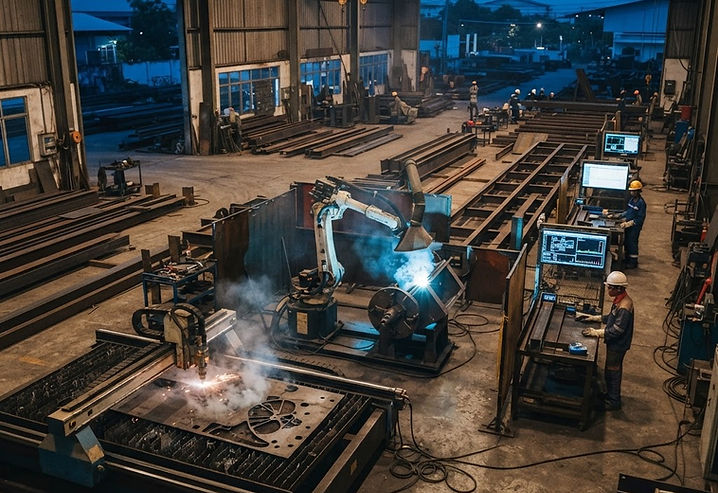
What does the skipper do on a racing yacht? The traditional view of a seafaring captain or skipper is that of one person who makes every tactical and operational decision and who then issues commands to the crew to make it happen. On a racing yacht there simply is not time for all that rigmarole. Each member of the crew has specific functions they perform, and they have trained as a group to work in precise harmony to achieve their common goal using their individual areas of expertise. In these terms, traditional centralised automation is the skipper standing on the quarterdeck (control room) while decentralised automation is the racing yacht where all the crew members (machine modules) perform their functions quickly and efficiently in perfect synchronisation. So, how does decentralised automation work in heavy steel fabrication companies ? Let us find out further in this blog.
Rationale for Decentralised Automation
Traditionally, automation systems had rigid hierarchies that were based around centralised control, as per the well known automation pyramid diagram. The sensors and actuators were always connected to the PLC (Programmable Logic Controller). The PLC was always connected to some other system and so it went. Unfortunately, this well entrenched automation model can be limiting. It requires lengthy decision making paths, and it also ties all the automation together to a single, central point. This means that a single fault or maintenance activity can bring an entire plant to a halt. As technology has advanced, the previously rigid levels have had to become more flexible. We now have sensors that detect machine wear, RFID (radio frequency identification) tags that tell the machine it is correctly configured for heat induction bending services and what it must do, and I/O modules that can decide independently to operate an actuator. It is no longer possible to place the present and future of automation within the constraints of a traditional automation system because it is simply not able to deal efficiently with all the extra capabilities that are now achievable.
Benefits of Decentralised Automation

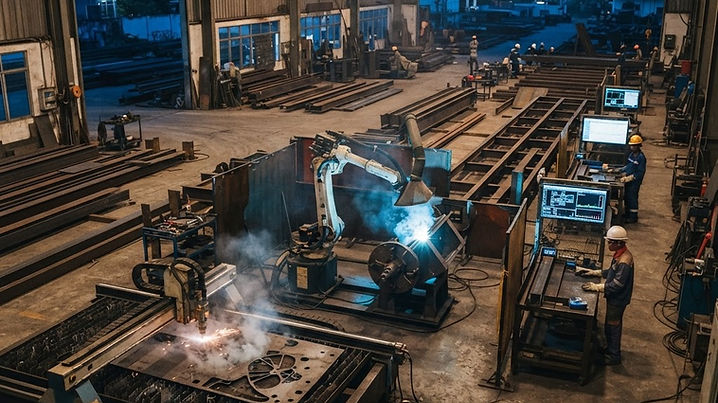
Decentralised automation lays the foundation for a new era of automation. It enables maximum flexibility, and it creates numerous benefits such as:
Fast and easy commissioning, Each different machine, or each individual module is capable of fully independent operation. They can be pretested before installation and issues with one section will not delay the progress of other sections. Wiring is easy thanks to IP67 components and standard industrial quick connectors. Control cabinets can be scaled down or eliminated altogether so that significantly less wiring is required.
Lower machine costs, There is a significant reduction in the necessary central control capacities. By reusing existing modules design costs are also reduced and the reduced wiring and mechanical requirements mean lower personnel costs (such as automation of tube bending ).
Higher machine availability, There is a significant reduction in the risk of failure because decentralised automation has a much lower dependency on a central control system. A good example of this is factory automation driven by electromechanical cylinders. On site machine condition monitoring allows early intervention when issues are detected before failure occurs. Module replacements in the event of a failure are fast, simple and require minimal configuration.
Short time to market, Decentralised automation allows users to respond dynamically to changing requirements. They can fine tune their equipment and process, even during production. Decentralised logic enables the testing of machinery and machine modules offline before delivery. By reusing existing modules, the design phase is shortened.
Closing Thoughts
Decentralisation may not be perfect for every situation, but in most cases, it reduces wiring and hardware and cuts design time. It also reduces manufacturing and installation time, improves efficiency, and minimises downtime. As demonstrated with the racing yacht, having a single central control is often less efficient than having a well trained and coordinated team of experts on the job. Centralised automation? It looks a lot like that outdated ship has sailed!
K999 Thailand carries out work of this kind through its steel fabrication capability team in Rayong.
Further reading
Follow project lifecycle intelligence across the wider market on Project Atlas Intel.
How K999 can help
How we apply the technology
Faster quoting, cleaner detailing and fewer site surprises come from the tools we use before the first cut, and the articles here explain how those tools change the work.
3D modelling and detailing- 01
3D modelling and shop detailing that resolves clashes before fabrication starts.
- 02
Fibre laser cutting for plate profiles, with nesting planned around the rolling schedule.
- 03
Project management that reports progress against the same model the client approved.
More on Manufacturing & Technology
All articles

Request for quotation
Need fabricated steel to that standard?
Every enquiry is answered within 48 hours by our estimating team in Rayong. The priced quotation follows once drawings, quantities and standards are confirmed. Stainless steel fabrication, structural steel fabrication, pipe spooling, pressure vessels, steel tanks, mining equipment and conveyors, pig launchers, chutes and hoppers, send the package and we will price it.
Before you request a quotation
Steel fabrication quotation questions
What structural steel fabrication, pressure vessel and pipe spooling packages cost, what to send with an enquiry, and how delivery to site works.
Structural steel fabrication is priced from the section and plate tonnage, the detailing and drawing hours, welding and fitting manhours, NDT requirements, blast and coating system, packing and freight. Grade matters as much as weight: AS/NZS, ASTM, JIS and BS sections carry different mill prices, and heavy built up members take longer than rolled sections. Our Rayong workshop produces around 10,000 tonnes of structural steel fabrication a year, so a clear bill of materials is usually enough to price. Send the drawings and we answer within 48 hours; the priced quotation follows once quantities, standards and delivery dates are confirmed.
For steel fabrication work, send the drawings or IFC package, a bill of materials with material grades, the welding and NDT requirements, the coating specification, the delivery port and your site dates. Add the inspection and test plan, any third party inspection requirement, and whether trial assembly or match marking is needed. Where drawings are still in progress, a scope list with sizes, quantities and duty is enough to start, and the estimate is refined once the final package arrives. Every enquiry is answered within 48 hours, and the priced quotation is issued after scope, standards and quantities are confirmed.
Yes. Pressure vessel fabrication is carried out to ASME Section VIII Div. 1 under our ASME U stamp No. 43,462, or to AS/NZS and BS where the project specifies, covering separators, air receivers, water drums, waste heat recovery units and pig launchers. Steel tanks for fuel, biofuel, chemical, water and food duty are designed in house with our E Tank programme to API, ASME, BS and AS/NZS. Because structural steel, vessels, tanks and their supports are built in the same workshops, one enquiry can cover the vessel package, the tank package and the structural steel that carries them, with a single coating and documentation system and one shipment.
Steel fabrication Australia packages are scheduled from a 33,000 m2 Rayong yard with an 80,000 m2 assembly yard inside Sattahip port, so fabrication, trial assembly, blasting, coating and packing run in one place. Programme length depends on tonnage, material lead times, the coating system and inspection scope, and it is confirmed with the quotation. We quote FOB Laem Chabang, Map Ta Phut or Sattahip, or CIF and DAP to your Australian port, with packing lists, weights, lifting points and a data book per shipment. Staged deliveries can follow your site erection sequence instead of shipping everything at once.
There is no fixed minimum. Pipe spooling Australia packages run at up to 3,000 diameter inches per shift on SCH.40, from a single replacement spool to a full plant piping scope, with spools numbered, X rayed where specified and coated to match erection order. Mining equipment fabrication covers chutes, hoppers, ore bins, transfer towers and conveyor structures with Bisalloy, Hardox, rubber lining or hardfacing fitted in house, from one wear liner set to modules of up to 2,500 tonnes assembled at Sattahip. Send the scope list and we will tell you what the smallest sensible batch is for your programme.