


Manufacturing & Technology
WHS Duties for Manufacturing Industry
SafeWork NSW, the workplace health and safety regulator in NSW, acknowledges manufacturing as a cornerstone of a strong Australian economy.
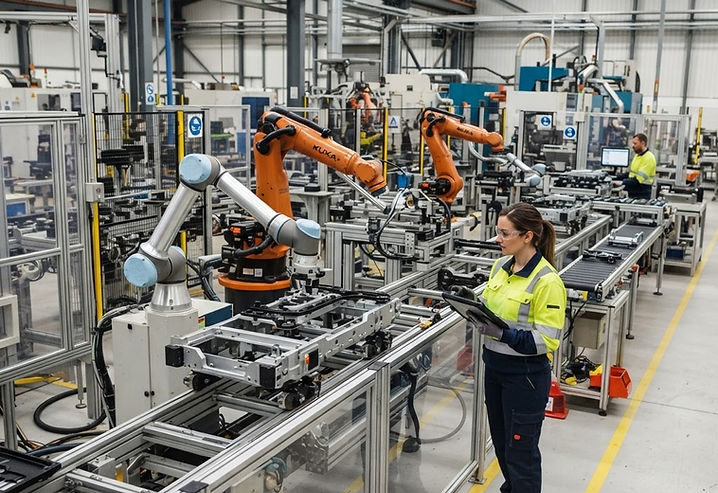
SafeWork NSW, the workplace health and safety regulator in NSW, acknowledges manufacturing as a cornerstone of a strong Australian economy. The regulator has an ongoing commitment to manufacturing which ensures a safe work environment for all workers, achieved by working with NSW businesses to reduce work related fatalities, serious injuries, and illnesses. As part of its education outreach, the regulator will be attending Australian Manufacturing Week, given that the expo attracts diverse manufacturing industries and heavy steel fabrication companies. “It also attracts a large variety of WHS duty holders,” says Natalie Martin, Director of Investigations, Engineering and Enforcement at Safework NSW. “We want to connect and engage with the various WHS duty holders across manufacturing.”
Regulatory Priorities
SafeWork NSW’s Manufacturing Sector Plan was developed to influence safety improvements in NSW manufacturing. In 2023, SafeWork identified specific regulatory priorities across risk types and sectors which includes fire safety in manufacturing. Martin says, “Our regulatory priorities were designed to ensure employers and workers understand their WHS duties so all workers have healthy, safe and productive working lives.” SafeWork has been notified of multiple workplace incidents involving collisions between mobile plant, inadequate guarding, bypassing of safety devices and ineffective energy isolation. “We find there is usually more than one factor contributing to an incident,” says Martin. At the moment, the regulator has a strong focus on people and plant, with forklifts in the spotlight.

Duties and Obligations
All duty holders must be aware of their work health and safety duties, which are not transferable. One person may have more than one duty and more than one person can have the same duty. A strong culture of safety is integral for business. This is underpinned by strong leadership and a genuine commitment in promoting a safety culture in workplaces. “When Safework is making enquiries, we consider every duty holder, this includes designers, manufactures, importers, suppliers, installers and the end user”, says Martin.
Consultation and Hierarchy of Controls
Consultation is essential in managing WHS risks and is a legal requirement under the WHS Act. All duty holders need to collaborate to develop ways to manage risks. Designers, manufacturers, importers, suppliers, installers, officers and persons with management or control roles all have responsibilities to provide information to help other stakeholders minimize safety hazards in manufacturing and fabrication. When it is not reasonably practicable to completely eliminate risks, a ‘hierarchy of controls’ must be used by duty holders to minimise risks. Eliminating the hazard and risk is the highest level of control, followed by reducing the risk through substitution, isolation, and engineering controls. Reducing the risk through administrative controls and protective personal equipment (e.g., mining plant and equipment ) is the lowest level of control as these controls’ effectiveness relies on human behaviour and supervision. Administrative controls are not enough on their own and should only be used to supplement higher level controls. “Some incidents indicate a lack of awareness of the hierarchy of control, often a control that’s too low level has been implemented, such as providing instruction, training and supervision only”, says Martin.
K999 Thailand carries out work of this kind through its steel fabrication capability team in Rayong.
Further reading
Follow EPC contractors in the United States across the wider market on Project Atlas Intel.
How K999 can help
How we apply the technology
Faster quoting, cleaner detailing and fewer site surprises come from the tools we use before the first cut, and the articles here explain how those tools change the work.
3D modelling and detailing- 01
3D modelling and shop detailing that resolves clashes before fabrication starts.
- 02
Fibre laser cutting for plate profiles, with nesting planned around the rolling schedule.
- 03
Project management that reports progress against the same model the client approved.
More on Manufacturing & Technology
All articles

Request for quotation
Need fabricated steel to that standard?
Every enquiry is answered within 48 hours by our estimating team in Rayong. The priced quotation follows once drawings, quantities and standards are confirmed. Stainless steel fabrication, structural steel fabrication, pipe spooling, pressure vessels, steel tanks, mining equipment and conveyors, pig launchers, chutes and hoppers, send the package and we will price it.
Before you request a quotation
Steel fabrication quotation questions
What structural steel fabrication, pressure vessel and pipe spooling packages cost, what to send with an enquiry, and how delivery to site works.
Structural steel fabrication is priced from the section and plate tonnage, the detailing and drawing hours, welding and fitting manhours, NDT requirements, blast and coating system, packing and freight. Grade matters as much as weight: AS/NZS, ASTM, JIS and BS sections carry different mill prices, and heavy built up members take longer than rolled sections. Our Rayong workshop produces around 10,000 tonnes of structural steel fabrication a year, so a clear bill of materials is usually enough to price. Send the drawings and we answer within 48 hours; the priced quotation follows once quantities, standards and delivery dates are confirmed.
For steel fabrication work, send the drawings or IFC package, a bill of materials with material grades, the welding and NDT requirements, the coating specification, the delivery port and your site dates. Add the inspection and test plan, any third party inspection requirement, and whether trial assembly or match marking is needed. Where drawings are still in progress, a scope list with sizes, quantities and duty is enough to start, and the estimate is refined once the final package arrives. Every enquiry is answered within 48 hours, and the priced quotation is issued after scope, standards and quantities are confirmed.
Yes. Pressure vessel fabrication is carried out to ASME Section VIII Div. 1 under our ASME U stamp No. 43,462, or to AS/NZS and BS where the project specifies, covering separators, air receivers, water drums, waste heat recovery units and pig launchers. Steel tanks for fuel, biofuel, chemical, water and food duty are designed in house with our E Tank programme to API, ASME, BS and AS/NZS. Because structural steel, vessels, tanks and their supports are built in the same workshops, one enquiry can cover the vessel package, the tank package and the structural steel that carries them, with a single coating and documentation system and one shipment.
Steel fabrication Australia packages are scheduled from a 33,000 m2 Rayong yard with an 80,000 m2 assembly yard inside Sattahip port, so fabrication, trial assembly, blasting, coating and packing run in one place. Programme length depends on tonnage, material lead times, the coating system and inspection scope, and it is confirmed with the quotation. We quote FOB Laem Chabang, Map Ta Phut or Sattahip, or CIF and DAP to your Australian port, with packing lists, weights, lifting points and a data book per shipment. Staged deliveries can follow your site erection sequence instead of shipping everything at once.
There is no fixed minimum. Pipe spooling Australia packages run at up to 3,000 diameter inches per shift on SCH.40, from a single replacement spool to a full plant piping scope, with spools numbered, X rayed where specified and coated to match erection order. Mining equipment fabrication covers chutes, hoppers, ore bins, transfer towers and conveyor structures with Bisalloy, Hardox, rubber lining or hardfacing fitted in house, from one wear liner set to modules of up to 2,500 tonnes assembled at Sattahip. Send the scope list and we will tell you what the smallest sensible batch is for your programme.