


Energy & Oil Gas
3D Modeling & Visualization in Oil & Gas
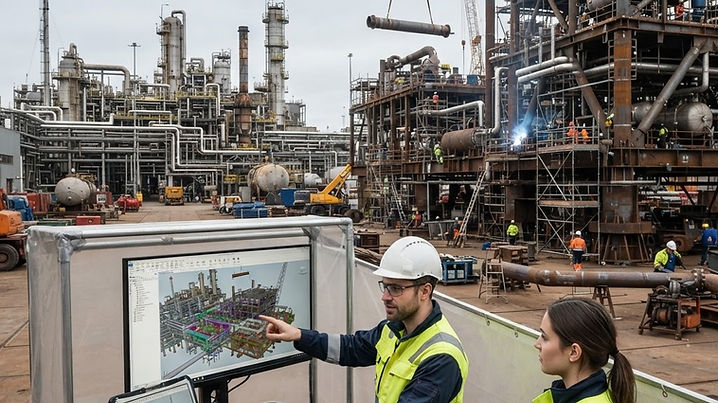
Model based design catches clashes and access problems before fabrication, saving rework on congested plant areas.
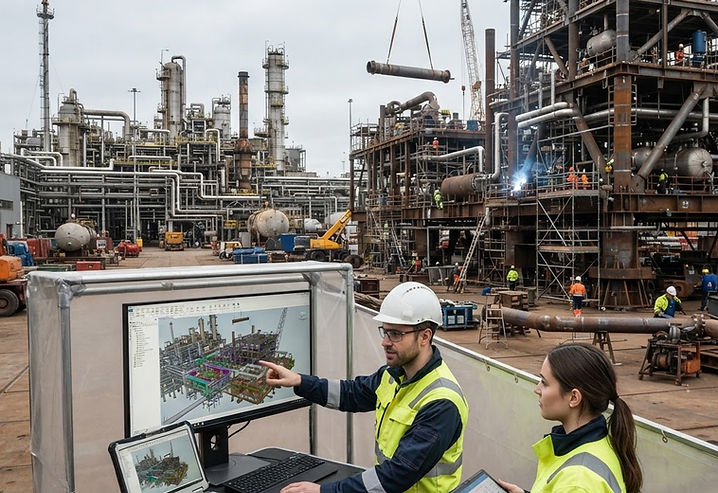
Oil and gas stakeholders always look to assess the geological subsurface situation before subsequent actions are taken via steel fabrication like drilling, refining, transporting etc. Rapid advancements in technology have enabled development of 3D models of potential oil sources and data visualization, thus providing more insights for making business decisions. Visualization has its own challenges characterized by computationally expensive algorithms, a diverse and large number of data sets and a need for greater collaboration. However, this is a fascinating world with the potential to unlock multiple advantages in the oil and gas sector. Let’s deep dive into this topic in this blog.
Building 3D models helps to optimize the exploration and production of oil and gas fields, assess potential and increase yield from oil sources. A higher level of understanding will lead to earlier recognition of problems, reduce avoidable delays and associated substantial expenses. The optimal visualization of 3D geo datasets is vital for geologists and geophysicists to analyze and evaluate geological and geophysical information components with higher confidence. Recent research has shown that only a limited set of visual cues is necessary to create a convincing representation of reality. These cues can be incorporated into design solutions, providing refiners (for example) with a highly intuitive visualization of the subterranean landscape which will assist in streamlining the processes of crude oil refining.
Data Management
Petroleum engineers and geoscientists spend a substantial amount of time combining 2D and 3D data sets from multiple sources to create interpolated 3D digital subsurface models, thus giving an idea if equipment like pressure vessels are required. These datasets are used extensively over longer periods of time by the oil and gas industry in a variety of formats, with varying resolutions and in very large volumes. Middleware enables interactive navigation of largest volumes even on relatively low end machines. The user does not have to wait for all the data to be loaded, only the data actually needed is loaded and multiple users can access the same data simultaneously because they use only their own local system memory to load the data.

Computing
For many years applications enjoyed an automatic increase in performance as CPU vendors competed to increase the clock speed in each new generation of chips. The CPU vendors are now competing to increase the number of “cores” in each new generation of chips. Middleware libraries offers the capability which enables the application to take advantage of multiple cores without changing the application code. They also provide building block algorithms, such as fast Fourier transform (FFT) and convolution that are already highly optimized for new architectures.
Rendering
The rendering of 3D images is a parallel computing task. The ability to program the GPU results in higher quality rendering, sharper definition of shadows and edges in oil wells, new rendering techniques and new opportunities for interaction by combining computing and rendering on the GPU. Combining computing and rendering in the GPU enables techniques including volume clipping (e.g., against horizon surfaces), volume masking (using values of one volume to mask another volume), and volume warping (e.g., horizon flattening).
As the visualization field matures, true oil and gas data integration becomes critical to accurate modelling and subsequent analysis by relevant stakeholders. Some vendors have started offering 4D visualization services in this space, however the correctness of simulation models is yet to be fully determined and its acceptance by industry heavyweights is in progress. Modeling and simulation also needs to take into account advancements in other technologies in processes like drilling so as to provide more precise estimates. It is clear however, that having a clear and concise 3D model of the oil and gas field is an excellent reference prior to commencing operations, however, there should not be sole dependence on these models since they are subject to changes in natural conditions which may alter model dynamics at any point in time!
K999 Thailand carries out work of this kind through its 3D modelling and shop detailing team in Rayong.
Further reading
Follow the major European markets across the wider market on Project Atlas Intel.
How K999 can help
Process equipment for energy projects
Pressure containment and pipeline work carries the tightest documentation on the shop floor, and the articles here track the codes and market conditions behind that work.
Pressure vessels and tanks- 01
Pressure vessels, steel tanks and pig launchers built to ASME and client specifications.
- 02
Pipe spool fabrication with heat induction bending for long radius and tight radius bends.
- 03
Full traceability from mill certificates through weld maps to hydrotest records.
More on Energy & Oil Gas
All articles


Request for quotation
Need fabricated steel to that standard?
Every enquiry is answered within 48 hours by our estimating team in Rayong. The priced quotation follows once drawings, quantities and standards are confirmed. Stainless steel fabrication, structural steel fabrication, pipe spooling, pressure vessels, steel tanks, mining equipment and conveyors, pig launchers, chutes and hoppers, send the package and we will price it.
Before you request a quotation
Steel fabrication quotation questions
What structural steel fabrication, pressure vessel and pipe spooling packages cost, what to send with an enquiry, and how delivery to site works.
Structural steel fabrication is priced from the section and plate tonnage, the detailing and drawing hours, welding and fitting manhours, NDT requirements, blast and coating system, packing and freight. Grade matters as much as weight: AS/NZS, ASTM, JIS and BS sections carry different mill prices, and heavy built up members take longer than rolled sections. Our Rayong workshop produces around 10,000 tonnes of structural steel fabrication a year, so a clear bill of materials is usually enough to price. Send the drawings and we answer within 48 hours; the priced quotation follows once quantities, standards and delivery dates are confirmed.
For steel fabrication work, send the drawings or IFC package, a bill of materials with material grades, the welding and NDT requirements, the coating specification, the delivery port and your site dates. Add the inspection and test plan, any third party inspection requirement, and whether trial assembly or match marking is needed. Where drawings are still in progress, a scope list with sizes, quantities and duty is enough to start, and the estimate is refined once the final package arrives. Every enquiry is answered within 48 hours, and the priced quotation is issued after scope, standards and quantities are confirmed.
Yes. Pressure vessel fabrication is carried out to ASME Section VIII Div. 1 under our ASME U stamp No. 43,462, or to AS/NZS and BS where the project specifies, covering separators, air receivers, water drums, waste heat recovery units and pig launchers. Steel tanks for fuel, biofuel, chemical, water and food duty are designed in house with our E Tank programme to API, ASME, BS and AS/NZS. Because structural steel, vessels, tanks and their supports are built in the same workshops, one enquiry can cover the vessel package, the tank package and the structural steel that carries them, with a single coating and documentation system and one shipment.
Steel fabrication Australia packages are scheduled from a 33,000 m2 Rayong yard with an 80,000 m2 assembly yard inside Sattahip port, so fabrication, trial assembly, blasting, coating and packing run in one place. Programme length depends on tonnage, material lead times, the coating system and inspection scope, and it is confirmed with the quotation. We quote FOB Laem Chabang, Map Ta Phut or Sattahip, or CIF and DAP to your Australian port, with packing lists, weights, lifting points and a data book per shipment. Staged deliveries can follow your site erection sequence instead of shipping everything at once.
There is no fixed minimum. Pipe spooling Australia packages run at up to 3,000 diameter inches per shift on SCH.40, from a single replacement spool to a full plant piping scope, with spools numbered, X rayed where specified and coated to match erection order. Mining equipment fabrication covers chutes, hoppers, ore bins, transfer towers and conveyor structures with Bisalloy, Hardox, rubber lining or hardfacing fitted in house, from one wear liner set to modules of up to 2,500 tonnes assembled at Sattahip. Send the scope list and we will tell you what the smallest sensible batch is for your programme.