


Welding & Testing
Can Cobots Resolve Australia's Welder Shortage?
Collaborative welding robots take the repetitive passes while coded welders cover critical joints, easing pressure on a thinning trades workforce.
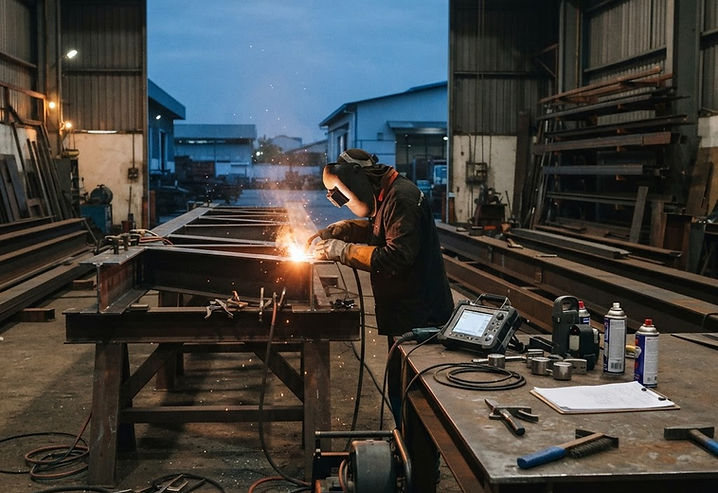
With Weld Australia predicting that Australia will be short 70,000 welders by 2030, robotics companies are hoping to step in and help solve the skills gap by attracting Gen Z with advanced welding technologies, including collaborative robots or cobots, small, flexible collaborative robots built to do tasks within a small footprint. The main beneficiaries would be small to medium sized businesses since larger industrial robots have been used for high speed, heavy duty welding for a long time and their size, safety and programming complexities mean they are generally inaccessible for small to medium sized production facilities. So, how can cobots fill the gap in Australia’s welding industry? Let us deep dive into this blog to find out.
Collaborative Benefits of Using Cobots
A cobot lowers the barrier to entry, potentially lowering the cost of safety devices to reduce machine risk, which ultimately also reduces the footprint of the machine. The smaller size of the cobots also means welders can more easily drive the robot by hand in order to teach them. Teaching a cobot, which resembles a giant arm, to do a TIG or MIG welding task is not as difficult as it seems, it is far easier than learning to weld. Traditionally, the problem has been having a combination of an experienced robot programmer who has minimal welding experience, and an experienced welder with minimal robot programming experience, cobots aim to bridge this gap.
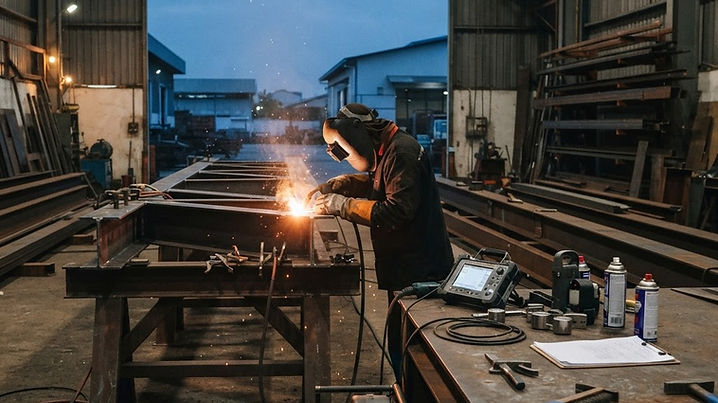
In a typical setup, the welder would be the one programming the robot, setting up the jigs and running the robot until it is able to produce satisfactory results. From there the operator would then unload the completed parts and load in new pieces, locking in the jig and restarting the robot. One welder might also be managing multiple robots and when there are new parts to weld, the welder then reprograms the cobot. The best practice to be followed is to teach the process experts how to use the robots and they can teach and adjust the cobot self sufficiently.
Growth of Companies Using Cobots
Many Australian companies already use cobots to weld and perform other tasks such as machine tending, screwdriving, palletizing, pipe fabrication and materials handling. Cobot welding is one of the fastest growing sectors, driven largely by the welder shortage in Australia now. The solution is particularly suitable for smaller SMEs and workshops that have high mix low volume production and need more versatile options, as well as a level of independence in using their own personnel to adjust the robots rather than having to call in an engineer from a systems integrator. Regarding return on investment, it obviously varies according to application, and if it is welding, it also depends on the complexities and requirements for additional hardware/software. But commonly for Australia, the return on investment for customers has been reported to be on average approximately 1.5 years.
Closing Statement
It is clear that cobots may potentially resolve the welder shortage problem being faced in Australia, however there are other issues to consider in this regard. Welders need to be reassured that cobots will not take away their jobs, and in certain situations, it may be more beneficial to train welding apprentices than to invest in cobots. Thus, cobots are not a one stop solution but a workaround to ensure that Australian heavy steel fabrication companies are not adversely impacted. Having said that, AI and robotics is poised to be the buzzword of the next decade, and the bandwagon is here to stay!
Further reading
Follow project contacts directory across the wider market on Project Atlas Intel.
How K999 can help
Welding and inspection practice
The welding procedures, welder qualifications and inspection routines described here are the ones applied to every spool, vessel and frame that leaves our workshop.
Inspection and expediting- 01
Qualified procedures for carbon steel, stainless steel and nickel alloys, with welder performance records held per joint type.
- 02
Dimensional and weld inspection in house, with third party witness arranged for client hold points.
- 03
Inspection and expediting support that follows the job from raw material receipt through to load out.
More on Welding & Testing
All articles


Request for quotation
Need fabricated steel to that standard?
Every enquiry is answered within 48 hours by our estimating team in Rayong. The priced quotation follows once drawings, quantities and standards are confirmed. Stainless steel fabrication, structural steel fabrication, pipe spooling, pressure vessels, steel tanks, mining equipment and conveyors, pig launchers, chutes and hoppers, send the package and we will price it.
Before you request a quotation
Steel fabrication quotation questions
What structural steel fabrication, pressure vessel and pipe spooling packages cost, what to send with an enquiry, and how delivery to site works.
Structural steel fabrication is priced from the section and plate tonnage, the detailing and drawing hours, welding and fitting manhours, NDT requirements, blast and coating system, packing and freight. Grade matters as much as weight: AS/NZS, ASTM, JIS and BS sections carry different mill prices, and heavy built up members take longer than rolled sections. Our Rayong workshop produces around 10,000 tonnes of structural steel fabrication a year, so a clear bill of materials is usually enough to price. Send the drawings and we answer within 48 hours; the priced quotation follows once quantities, standards and delivery dates are confirmed.
For steel fabrication work, send the drawings or IFC package, a bill of materials with material grades, the welding and NDT requirements, the coating specification, the delivery port and your site dates. Add the inspection and test plan, any third party inspection requirement, and whether trial assembly or match marking is needed. Where drawings are still in progress, a scope list with sizes, quantities and duty is enough to start, and the estimate is refined once the final package arrives. Every enquiry is answered within 48 hours, and the priced quotation is issued after scope, standards and quantities are confirmed.
Yes. Pressure vessel fabrication is carried out to ASME Section VIII Div. 1 under our ASME U stamp No. 43,462, or to AS/NZS and BS where the project specifies, covering separators, air receivers, water drums, waste heat recovery units and pig launchers. Steel tanks for fuel, biofuel, chemical, water and food duty are designed in house with our E Tank programme to API, ASME, BS and AS/NZS. Because structural steel, vessels, tanks and their supports are built in the same workshops, one enquiry can cover the vessel package, the tank package and the structural steel that carries them, with a single coating and documentation system and one shipment.
Steel fabrication Australia packages are scheduled from a 33,000 m2 Rayong yard with an 80,000 m2 assembly yard inside Sattahip port, so fabrication, trial assembly, blasting, coating and packing run in one place. Programme length depends on tonnage, material lead times, the coating system and inspection scope, and it is confirmed with the quotation. We quote FOB Laem Chabang, Map Ta Phut or Sattahip, or CIF and DAP to your Australian port, with packing lists, weights, lifting points and a data book per shipment. Staged deliveries can follow your site erection sequence instead of shipping everything at once.
There is no fixed minimum. Pipe spooling Australia packages run at up to 3,000 diameter inches per shift on SCH.40, from a single replacement spool to a full plant piping scope, with spools numbered, X rayed where specified and coated to match erection order. Mining equipment fabrication covers chutes, hoppers, ore bins, transfer towers and conveyor structures with Bisalloy, Hardox, rubber lining or hardfacing fitted in house, from one wear liner set to modules of up to 2,500 tonnes assembled at Sattahip. Send the scope list and we will tell you what the smallest sensible batch is for your programme.