


Energy & Oil Gas
Correlation between oil prices and stock markets - Fact or Fiction?
Energy costs feed through to industrial earnings, which is why oil price moves ripple across capital goods markets.
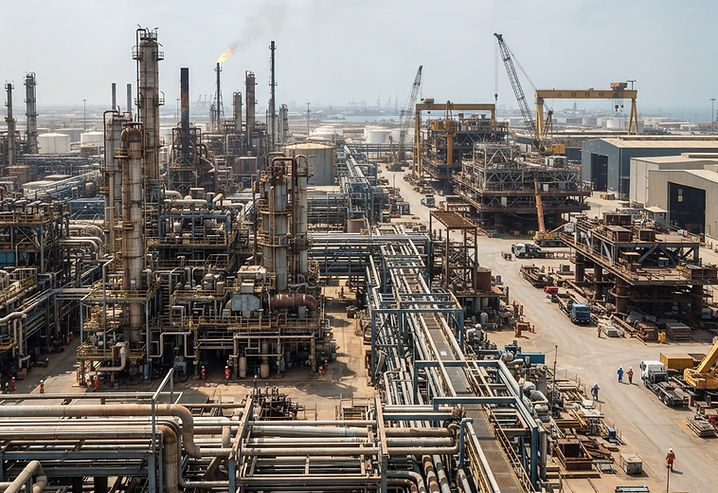
It is a commonly held view that rising oil prices directly and negatively impact the economy and the stock market. This is because it is generally felt that an increase in oil prices will raise input costs for most businesses and force consumers to spend more money on gasoline, thereby reducing the corporate earnings of other ventures. The opposite should be true when oil prices fall. However, does oil really drive stock prices or is the correlation weaker than it is made out to be? In this blog, the likely divergence of oil prices and stock markets will be further explored.
A drop in fuel prices is presumed to directly lead to lower transportation costs which should leave more disposable income in people’s wallets. Also, since many industrial chemicals are refined from oil, lower oil prices benefit the manufacturing sector including lower costs for mining plant and equipment. However, if a country increases its oil production (e.g., the United States), low oil prices can potentially hurt oil companies and affect domestic oil industry workers. High oil prices add to the cost of doing business and these costs are ultimately passed on to the consumers.
It has been theorized that other price factors in the economy, such as wages, interest rates, industrial metals, plastic and computer technology, can offset changes in energy costs. This can lead to a diminished impact of oil price shocks and hence, capital markets remain insulated to an extent. Another possibility is that corporations have become increasingly sophisticated at reading futures markets and are better able to anticipate shifts in factor prices; a firm should be able to switch production processes to compensate for added fuel costs. Some economists suggest that general stock prices often rise on the expectation of an increase in the quantity of money, which occurs independently of oil prices.

It has also been observed that the oil market is much more positive about the economy, both in the U.S. and globally, than are stock traders. History shows that when that kind of dichotomy exists, oil traders are right more often than not, in part due to that enforced short term outlook in oil. Stocks are being driven lower by fear of what might happen and oil is being pushed higher by what actually is happening.
Oil prices are determined by the supply and demand for petroleum based products. During an economic expansion, prices might rise as a result of increased consumption; they might also fall as a result of increased production. For instance, front end oil futures contracts look no further than a month out. Because of that, crude is being less influenced than stocks by what the Fed may or may not do later this year and, right now, the economy is strong.
On the other hand, stock prices rise and fall based on future corporate earnings reports, intrinsic values, investor risk tolerances and a large number of other factors. Even though stock prices are commonly aggregated and lumped together, it is possible that oil prices affect certain sectors much more dramatically than they affect others.
It stands to reason that oil prices impact stock prices in some sectors, e.g., transportation is strongly correlated with oil prices as the dominant input cost for transportation firms is fuel. However, for other sectors, oil is not likely to have a dominant impact partly because the stock markets function differently compared to the oil market. In light of the Russian invasion of Ukraine, the oil market is more volatile than however, however this may be a golden opportunity to invest in some stocks which are trading low now and which have great potential (irrespective of whether they are dependent on oil prices or not!).
K999 Thailand carries out work of this kind through its pressure vessel fabrication team in Rayong.
Further reading
Follow industrial project intelligence across the wider market on Project Atlas Intel.
How K999 can help
Process equipment for energy projects
Pressure containment and pipeline work carries the tightest documentation on the shop floor, and the articles here track the codes and market conditions behind that work.
Pressure vessels and tanks- 01
Pressure vessels, steel tanks and pig launchers built to ASME and client specifications.
- 02
Pipe spool fabrication with heat induction bending for long radius and tight radius bends.
- 03
Full traceability from mill certificates through weld maps to hydrotest records.
More on Energy & Oil Gas
All articles

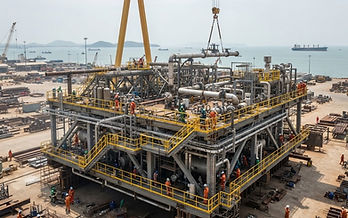

Request for quotation
Need fabricated steel to that standard?
Every enquiry is answered within 48 hours by our estimating team in Rayong. The priced quotation follows once drawings, quantities and standards are confirmed. Stainless steel fabrication, structural steel fabrication, pipe spooling, pressure vessels, steel tanks, mining equipment and conveyors, pig launchers, chutes and hoppers, send the package and we will price it.
Before you request a quotation
Steel fabrication quotation questions
What structural steel fabrication, pressure vessel and pipe spooling packages cost, what to send with an enquiry, and how delivery to site works.
Structural steel fabrication is priced from the section and plate tonnage, the detailing and drawing hours, welding and fitting manhours, NDT requirements, blast and coating system, packing and freight. Grade matters as much as weight: AS/NZS, ASTM, JIS and BS sections carry different mill prices, and heavy built up members take longer than rolled sections. Our Rayong workshop produces around 10,000 tonnes of structural steel fabrication a year, so a clear bill of materials is usually enough to price. Send the drawings and we answer within 48 hours; the priced quotation follows once quantities, standards and delivery dates are confirmed.
For steel fabrication work, send the drawings or IFC package, a bill of materials with material grades, the welding and NDT requirements, the coating specification, the delivery port and your site dates. Add the inspection and test plan, any third party inspection requirement, and whether trial assembly or match marking is needed. Where drawings are still in progress, a scope list with sizes, quantities and duty is enough to start, and the estimate is refined once the final package arrives. Every enquiry is answered within 48 hours, and the priced quotation is issued after scope, standards and quantities are confirmed.
Yes. Pressure vessel fabrication is carried out to ASME Section VIII Div. 1 under our ASME U stamp No. 43,462, or to AS/NZS and BS where the project specifies, covering separators, air receivers, water drums, waste heat recovery units and pig launchers. Steel tanks for fuel, biofuel, chemical, water and food duty are designed in house with our E Tank programme to API, ASME, BS and AS/NZS. Because structural steel, vessels, tanks and their supports are built in the same workshops, one enquiry can cover the vessel package, the tank package and the structural steel that carries them, with a single coating and documentation system and one shipment.
Steel fabrication Australia packages are scheduled from a 33,000 m2 Rayong yard with an 80,000 m2 assembly yard inside Sattahip port, so fabrication, trial assembly, blasting, coating and packing run in one place. Programme length depends on tonnage, material lead times, the coating system and inspection scope, and it is confirmed with the quotation. We quote FOB Laem Chabang, Map Ta Phut or Sattahip, or CIF and DAP to your Australian port, with packing lists, weights, lifting points and a data book per shipment. Staged deliveries can follow your site erection sequence instead of shipping everything at once.
There is no fixed minimum. Pipe spooling Australia packages run at up to 3,000 diameter inches per shift on SCH.40, from a single replacement spool to a full plant piping scope, with spools numbered, X rayed where specified and coated to match erection order. Mining equipment fabrication covers chutes, hoppers, ore bins, transfer towers and conveyor structures with Bisalloy, Hardox, rubber lining or hardfacing fitted in house, from one wear liner set to modules of up to 2,500 tonnes assembled at Sattahip. Send the scope list and we will tell you what the smallest sensible batch is for your programme.