


Energy & Oil Gas
Decarbonizing the Oil and Gas Industry
Electrification, flare reduction and carbon capture are the practical routes to lower emissions from oil and gas operations.
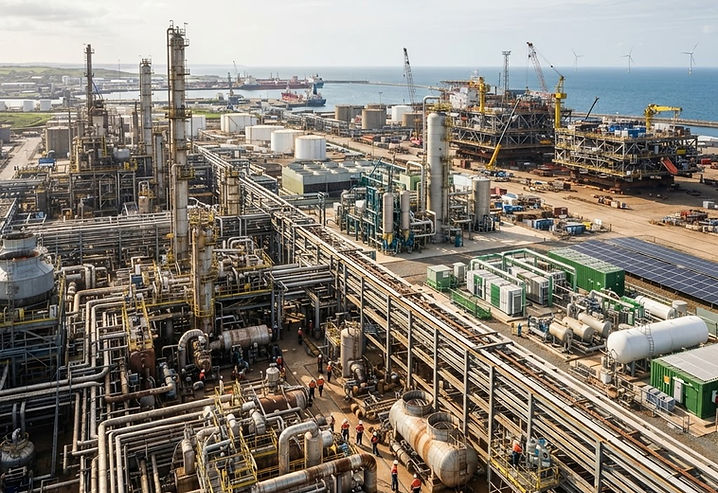
Today, the oil and gas industry’s operations account for 9% of all human made greenhouse gas emissions. It also produces the fuels that create another 33% of global emissions. Thus, the oil and gas industry will have a major role to play for the world to meet its climate change goals. Investors are pushing companies to disclose consistent, comparable and reliable data of their sustainability targets and investments. Activist shareholders are challenging US- and Europe based oil majors on their climate policies and emissions reduction plans. There are other developments which are shaping the way forward for a more sustainable future and which put the future of petrochemicals at stake. Where does the oil and gas industry fit in this scenario? Let’s find out in this blog.
Upstream operations account for two thirds of sector specific emissions. Some of the actions which oil and gas upstream operators can take are listed as follows:,
Changing power sources, One oil and gas company is using on site renewable power generation to provide a cost effective alternative to diesel fuel. By replacing on site renewable power generators with a solar PV and battery setup, oil and gas companies can reduce emissions significantly. Connecting onshore or nearshore rigs and platforms to the central grid (as opposed to decentralized diesel generation) can also work well: for example, in its drive for electrification, Equinor recently connected its Johan Sverdrup field, which lies 140 kilometers offshore, to the grid.
Reducing fugitive emissions, Companies can cut emissions of methane, a powerful greenhouse gas, by improving leak detection and repair (LDAR), installing vapor recovery units (VRU), or applying the best available technology (such as double mechanical seals on pumps, dry gas seals on compressors, and carbon packing ring sets on valve stems).

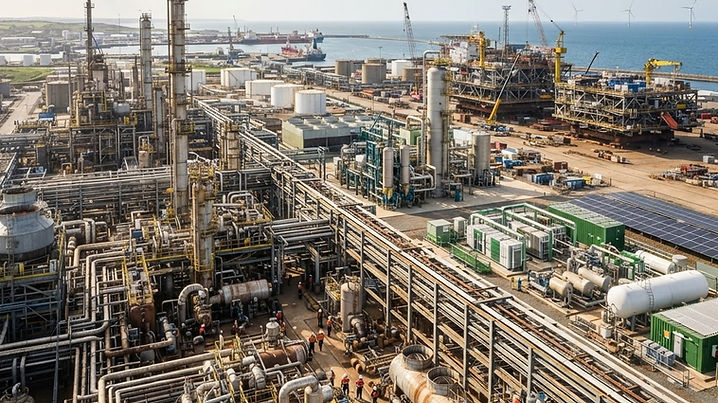
Electrifying equipment, One oil and gas company replaced gas boilers with electric steam production vessels, including high pressure storage for nighttime steam supply, to support separation units with the expectation that the project will pay for itself in less than ten years. In many circumstances, there is already a good business case, on purely financial grounds, for combining the use of solar and gas in place of conventional boilers.
Energy efficiency, Efficiency is a factor in every part of the industry but new downstream specific technologies can make a big difference. Waste heat recovery technology and medium temperature heat pumps in refineries, for example, reduce the amount of primary energy used in distillation.
Green hydrogen, Hydrogen production through electrolysis has become both more technically advanced and less expensive. Bloomberg New Energy Finance estimates that the cost of hydrogen could drop as much as two thirds by 2050. Using renewable energy rather than steam methane reforming to power the electrolysis could offer refineries a way to reduce emissions, a result known as “green hydrogen.” To know more about methane emissions in the US, click here.
Greener feedstocks, Replacing some conventional oil feedstocks in refineries with bio based feedstocks or recycled plastic materials (initially, through pyrolysis or gasification) would also reduce emissions, including Scope 3 emissions. In an increasingly decarbonizing world, this may extend the lifetime of refining assets.
There are multiple options available by upstream and downstream oil and gas operators to reduce emissions. It would come as a pleasant surprise to know that cutting emissions is not necessarily expensive; and an analysis observed that implementing initiatives would most likely lead to a positive Net Present Value (NPV) in the long run. However, implementing these options would require the oil and gas players to come out of their comfort zone and adapt to the sustainable way of working. Climate change is real and these companies need to wake up and smell the coffee!
K999 Thailand carries out work of this kind through its pressure vessel fabrication team in Rayong.
Further reading
Follow tender opportunities across the wider market on Project Atlas Intel.
How K999 can help
Process equipment for energy projects
Pressure containment and pipeline work carries the tightest documentation on the shop floor, and the articles here track the codes and market conditions behind that work.
Pressure vessels and tanks- 01
Pressure vessels, steel tanks and pig launchers built to ASME and client specifications.
- 02
Pipe spool fabrication with heat induction bending for long radius and tight radius bends.
- 03
Full traceability from mill certificates through weld maps to hydrotest records.
More on Energy & Oil Gas
All articles

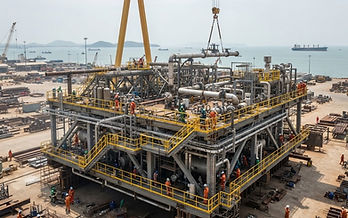

Request for quotation
Need fabricated steel to that standard?
Every enquiry is answered within 48 hours by our estimating team in Rayong. The priced quotation follows once drawings, quantities and standards are confirmed. Stainless steel fabrication, structural steel fabrication, pipe spooling, pressure vessels, steel tanks, mining equipment and conveyors, pig launchers, chutes and hoppers, send the package and we will price it.
Before you request a quotation
Steel fabrication quotation questions
What structural steel fabrication, pressure vessel and pipe spooling packages cost, what to send with an enquiry, and how delivery to site works.
Structural steel fabrication is priced from the section and plate tonnage, the detailing and drawing hours, welding and fitting manhours, NDT requirements, blast and coating system, packing and freight. Grade matters as much as weight: AS/NZS, ASTM, JIS and BS sections carry different mill prices, and heavy built up members take longer than rolled sections. Our Rayong workshop produces around 10,000 tonnes of structural steel fabrication a year, so a clear bill of materials is usually enough to price. Send the drawings and we answer within 48 hours; the priced quotation follows once quantities, standards and delivery dates are confirmed.
For steel fabrication work, send the drawings or IFC package, a bill of materials with material grades, the welding and NDT requirements, the coating specification, the delivery port and your site dates. Add the inspection and test plan, any third party inspection requirement, and whether trial assembly or match marking is needed. Where drawings are still in progress, a scope list with sizes, quantities and duty is enough to start, and the estimate is refined once the final package arrives. Every enquiry is answered within 48 hours, and the priced quotation is issued after scope, standards and quantities are confirmed.
Yes. Pressure vessel fabrication is carried out to ASME Section VIII Div. 1 under our ASME U stamp No. 43,462, or to AS/NZS and BS where the project specifies, covering separators, air receivers, water drums, waste heat recovery units and pig launchers. Steel tanks for fuel, biofuel, chemical, water and food duty are designed in house with our E Tank programme to API, ASME, BS and AS/NZS. Because structural steel, vessels, tanks and their supports are built in the same workshops, one enquiry can cover the vessel package, the tank package and the structural steel that carries them, with a single coating and documentation system and one shipment.
Steel fabrication Australia packages are scheduled from a 33,000 m2 Rayong yard with an 80,000 m2 assembly yard inside Sattahip port, so fabrication, trial assembly, blasting, coating and packing run in one place. Programme length depends on tonnage, material lead times, the coating system and inspection scope, and it is confirmed with the quotation. We quote FOB Laem Chabang, Map Ta Phut or Sattahip, or CIF and DAP to your Australian port, with packing lists, weights, lifting points and a data book per shipment. Staged deliveries can follow your site erection sequence instead of shipping everything at once.
There is no fixed minimum. Pipe spooling Australia packages run at up to 3,000 diameter inches per shift on SCH.40, from a single replacement spool to a full plant piping scope, with spools numbered, X rayed where specified and coated to match erection order. Mining equipment fabrication covers chutes, hoppers, ore bins, transfer towers and conveyor structures with Bisalloy, Hardox, rubber lining or hardfacing fitted in house, from one wear liner set to modules of up to 2,500 tonnes assembled at Sattahip. Send the scope list and we will tell you what the smallest sensible batch is for your programme.