


Energy & Oil Gas
How Robotics Can Transform Oil and Gas
Inspection robots and automated welding raise safety and quality on offshore and refinery work where access is difficult.
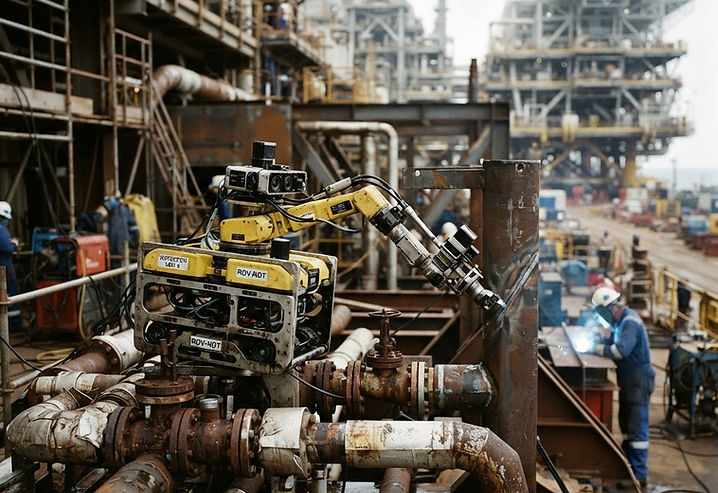
The usage of robotics has increased manifold over the last few years, due to technological advancements and an increased appetite to automate repetitive processes. Oil and gas companies have also started utilizing robots to eradicate inefficient processes, automate dangerous tasks and increase profit margins. It has been observed that the production phase of oil and gas operations is where robotics can add the maximum value. This blog will look to discuss the applications and benefits of robotics in energy and utilities and also look to highlight robotics’ potential to transform this sector.
Offshore installations pose many challenges for human operators due to their inherent nature. Robotics play a key role in each operation type as discussed below:,
Upstream: On locating oil wells, operators start drilling to extract the underlying oil or gas reservoir. Robotics can enable players to undertake automated drilling without the need for human intervention. In addition, industrial robots can also be used for conducting seismic surveys using 3D modeling and visualization that would help reduce the chances of causing a permanent impact on the existing geological structure. An example is an ROV (remotely operated vehicle) that come with a video camera, lights, and artificial arms.
Midstream: Processing, transporting and storing of excavated oil or gas supplies are vulnerable to spillage which can adversely impact the marine ecosystem. Machines and Artificial Intelligence (AI) can assist with midstream inspection and maintenance. They can also help with designing, setting up and efficient remote monitoring of resources. Instances of blockages, corrosion or leakages in steel structural fabrication can be identified and resolved using UAVs (uncrewed aerial vehicles) and UUVs (crewless underwater vehicles).

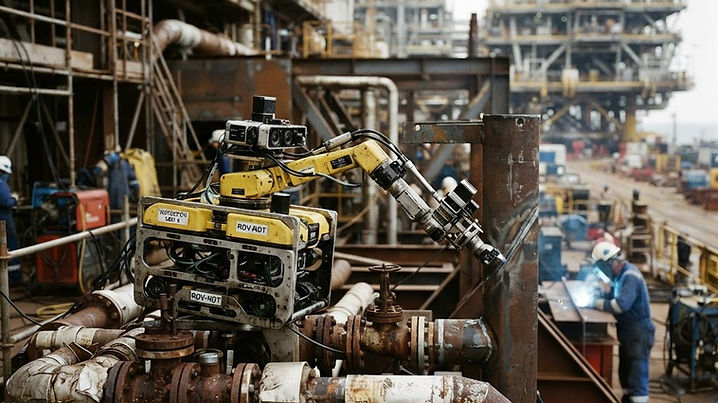
Downstream: The refining and distribution processes of oil and gas refer to offshore areas that are almost too difficult for humans to reach and survive. In these cases, robotics can contribute to material handling and automated refueling without any procedure lapses. Leveraging of AUVs (Autonomous Underwater Vehicles), the torpedo shaped machines that are self operating and can cover a depth of up to 6000 meters helps in improving integrity management, repair and maintenance of machines engaged in downstream operations.
The 3 major ways in which robotics can positively transform oil and gas are detailed as follows:
Eliminating Safety Hazards: Hard manual labor, described as roughnecking, is one of the most dangerous jobs across all industries. Some robots eliminate the need for human roughnecks, which minimizes deaths, injuries, and losses associated with hazardous labor. Roughnecking robots can install drill pipes (developed using pipe fabrication ) in complex environments, such as oil bearing rocks and even out in the ocean. These efficient robots make life much easier for oil rig workers who no longer have to put their lives at risk to supply consumers with oil.
Reducing Costs: Robots lower operational costs because there is less need to install safety measures. Robotic platforms eliminate the need to provide housing, food, heating, cooling and other features. One can save money by not paying for expensive safety gear and robots require no work breaks or benefits.
Increase in Productivity: Advanced robots carry out tasks more efficiently as compared to humans. Robots also decrease the amount of downtime during and between work tasks. Downtime can be extremely costly on oil and gas platforms and one must take measures to minimize the same. Drilling sites and oil rigs benefit in several ways when robots perform essential tasks.
Robotics, Machine Learning (ML) and AI bring many automation benefits to the essentially manual process driven world of oil and gas operations. In spite of advancements in manual excavation techniques, oil and gas is a safer and more productive industry with the integration of robotics. Companies need to invest in technology and tailor their requirements for their respective procedures. A downside is the possibility of shrinkage in size of the manual workforce, however in the long run, this is expected to benefit the energy and utilities industry as a whole. The world of robots is here and now, and we should enjoy the ride!
K999 Thailand carries out work of this kind through its pressure vessel fabrication team in Rayong.
Further reading
Follow Oil & Gas across the wider market on Project Atlas Intel.
How K999 can help
Process equipment for energy projects
Pressure containment and pipeline work carries the tightest documentation on the shop floor, and the articles here track the codes and market conditions behind that work.
Pressure vessels and tanks- 01
Pressure vessels, steel tanks and pig launchers built to ASME and client specifications.
- 02
Pipe spool fabrication with heat induction bending for long radius and tight radius bends.
- 03
Full traceability from mill certificates through weld maps to hydrotest records.
More on Energy & Oil Gas
All articles


Request for quotation
Need fabricated steel to that standard?
Every enquiry is answered within 48 hours by our estimating team in Rayong. The priced quotation follows once drawings, quantities and standards are confirmed. Stainless steel fabrication, structural steel fabrication, pipe spooling, pressure vessels, steel tanks, mining equipment and conveyors, pig launchers, chutes and hoppers, send the package and we will price it.
Before you request a quotation
Steel fabrication quotation questions
What structural steel fabrication, pressure vessel and pipe spooling packages cost, what to send with an enquiry, and how delivery to site works.
Structural steel fabrication is priced from the section and plate tonnage, the detailing and drawing hours, welding and fitting manhours, NDT requirements, blast and coating system, packing and freight. Grade matters as much as weight: AS/NZS, ASTM, JIS and BS sections carry different mill prices, and heavy built up members take longer than rolled sections. Our Rayong workshop produces around 10,000 tonnes of structural steel fabrication a year, so a clear bill of materials is usually enough to price. Send the drawings and we answer within 48 hours; the priced quotation follows once quantities, standards and delivery dates are confirmed.
For steel fabrication work, send the drawings or IFC package, a bill of materials with material grades, the welding and NDT requirements, the coating specification, the delivery port and your site dates. Add the inspection and test plan, any third party inspection requirement, and whether trial assembly or match marking is needed. Where drawings are still in progress, a scope list with sizes, quantities and duty is enough to start, and the estimate is refined once the final package arrives. Every enquiry is answered within 48 hours, and the priced quotation is issued after scope, standards and quantities are confirmed.
Yes. Pressure vessel fabrication is carried out to ASME Section VIII Div. 1 under our ASME U stamp No. 43,462, or to AS/NZS and BS where the project specifies, covering separators, air receivers, water drums, waste heat recovery units and pig launchers. Steel tanks for fuel, biofuel, chemical, water and food duty are designed in house with our E Tank programme to API, ASME, BS and AS/NZS. Because structural steel, vessels, tanks and their supports are built in the same workshops, one enquiry can cover the vessel package, the tank package and the structural steel that carries them, with a single coating and documentation system and one shipment.
Steel fabrication Australia packages are scheduled from a 33,000 m2 Rayong yard with an 80,000 m2 assembly yard inside Sattahip port, so fabrication, trial assembly, blasting, coating and packing run in one place. Programme length depends on tonnage, material lead times, the coating system and inspection scope, and it is confirmed with the quotation. We quote FOB Laem Chabang, Map Ta Phut or Sattahip, or CIF and DAP to your Australian port, with packing lists, weights, lifting points and a data book per shipment. Staged deliveries can follow your site erection sequence instead of shipping everything at once.
There is no fixed minimum. Pipe spooling Australia packages run at up to 3,000 diameter inches per shift on SCH.40, from a single replacement spool to a full plant piping scope, with spools numbered, X rayed where specified and coated to match erection order. Mining equipment fabrication covers chutes, hoppers, ore bins, transfer towers and conveyor structures with Bisalloy, Hardox, rubber lining or hardfacing fitted in house, from one wear liner set to modules of up to 2,500 tonnes assembled at Sattahip. Send the scope list and we will tell you what the smallest sensible batch is for your programme.