


Welding & Testing
Importance of CO2 in Welding
How shielding gas mixes and CO2 content change penetration, spatter and deposition rate in MIG welding of carbon steel.
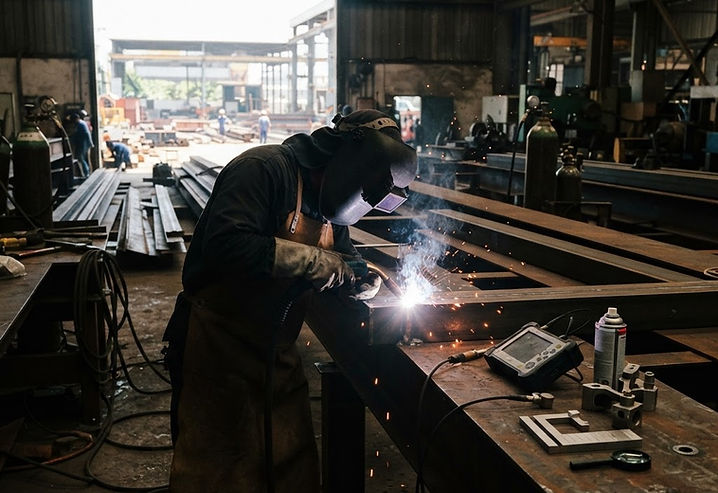
While looking to improve welding performance, the choice of shielding gas by steel fabrication companies is significant. The primary purpose of shielding gas is to prevent exposure of the molten weld pool to oxygen, nitrogen and hydrogen contained in the atmosphere since reaction of these elements with the weld pool can create a variety of problems, including porosity and excessive spatter. Different shielding gases play important roles in determining weld penetration profiles, arc stability, mechanical properties of the finished weld and the transfer process. This is where carbon dioxide (CO2) plays a crucial role as a shielding gas in gas metal arc welding of carbon steels. This topic will be explored further in this blog.
Features of CO2 for Welding
Many MIG welding applications lend themselves to a variety of shielding gas choices, which depend on certain considerations. The cost of the gas, finished weld properties, preparation and postweld clean up, the base material, weld transfer process and your productivity goals all need to be considered when selecting a shielding gas. Argon, Helium, Carbon Dioxide and Oxygen are the four most common shielding gases used in MIG welding, with each providing unique benefits and drawbacks in any given application. Carbon Dioxide (CO2) is the most common of the reactive gases used in MIG welding and the only one that can be used in its pure form without the addition of inert gas.
CO2 is also the least expensive of the common shielding gases, making an attractive choice when material costs are the main priority. Pure CO2 provides very deep weld penetration, which is useful for welding thick material; however, it also produces a less stable arc and more spatters than when it is mixed with other gases. It is also limited to only the short circuit process. For many fabrication companies which use advanced technologies in welding, including those that place emphasis on weld quality, appearance and reducing postweld cleanup, a mixture of between 75 to 95 percent Argon and 5 to 25 percent CO2 will provide a more desirable combination of arc stability, puddle control and reduced spatter than pure CO2.

Benefits of CO2 in Welding
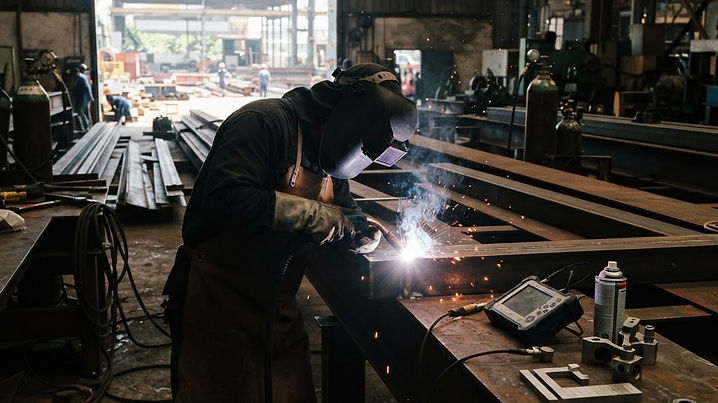
Improved Penetration, Carbon dioxide shielding provides better joint penetration as it promotes high arc voltage during custom welding and assembling. In this way, you can achieve good results for sidewall and root penetration.
Cost Benefit, The advantage of low cost enhances its worth among other shielding gases. Using carbon dioxide shielding instead of oxygen, will not allow oxidation in the weld metal, as oxygen does. Being heavier, it provides better shielding characteristics. Though it is cheaper than Argon and Helium but comparatively fewer quality welds are obtained.
Add on Oxidizing, Due to the high temperature arc, carbon dioxide dissociates into carbon monoxide and oxygen that encourages oxidation. In this case, a little bit oxidizing may prove an accompaniment to GMA welding of carbon steels, by reducing the polar spots during the process as the polar spot’s formation may cause unstable arc and spatter during welding. During spray transfer mode electrodes are connected to positive terminals (anode) of the power source and workpiece with negative (cathode), this type of settings constitutes to reverse polarity.
Removal of Rust, This gas assists in the removal of rust present on the joint. It eliminates rusting by reacting with rust oxides, and in this way, other impurities are also removed. Apart from atmospheric protection, it also helps to prevent weld defects like porosity, lack of fusion, lack of penetration in the weld metal.
The Last Word
With the rise of MIG and TIG welding over the last century, gas is now accepted as a common commodity in workshops. There are many reasons as to why CO2 is often preferred as the shielding gas for GMA welding of carbon steels. It is enormously versatile and, in addition to the above, it helps to improve toughness and reduce surface tension of welds. Thus, the air we breathe out on an ongoing basis during our lives is a greenhouse gas, but is essential to gas welding projects!
K999 Thailand carries out work of this kind through its pipe spool fabrication team in Rayong.
Further reading
Follow Oil & Gas across the wider market on Project Atlas Intel.
Calculation tool
Run the numbers for this yourself with the free civil engineering calculator from Engineering Toolbox Australia. Treat the result as a first check, then confirm the final design with your engineer.
How K999 can help
Welding and inspection practice
The welding procedures, welder qualifications and inspection routines described here are the ones applied to every spool, vessel and frame that leaves our workshop.
Inspection and expediting- 01
Qualified procedures for carbon steel, stainless steel and nickel alloys, with welder performance records held per joint type.
- 02
Dimensional and weld inspection in house, with third party witness arranged for client hold points.
- 03
Inspection and expediting support that follows the job from raw material receipt through to load out.
More on Welding & Testing
All articles


Request for quotation
Need fabricated steel to that standard?
Every enquiry is answered within 48 hours by our estimating team in Rayong. The priced quotation follows once drawings, quantities and standards are confirmed. Stainless steel fabrication, structural steel fabrication, pipe spooling, pressure vessels, steel tanks, mining equipment and conveyors, pig launchers, chutes and hoppers, send the package and we will price it.
Before you request a quotation
Steel fabrication quotation questions
What structural steel fabrication, pressure vessel and pipe spooling packages cost, what to send with an enquiry, and how delivery to site works.
Structural steel fabrication is priced from the section and plate tonnage, the detailing and drawing hours, welding and fitting manhours, NDT requirements, blast and coating system, packing and freight. Grade matters as much as weight: AS/NZS, ASTM, JIS and BS sections carry different mill prices, and heavy built up members take longer than rolled sections. Our Rayong workshop produces around 10,000 tonnes of structural steel fabrication a year, so a clear bill of materials is usually enough to price. Send the drawings and we answer within 48 hours; the priced quotation follows once quantities, standards and delivery dates are confirmed.
For steel fabrication work, send the drawings or IFC package, a bill of materials with material grades, the welding and NDT requirements, the coating specification, the delivery port and your site dates. Add the inspection and test plan, any third party inspection requirement, and whether trial assembly or match marking is needed. Where drawings are still in progress, a scope list with sizes, quantities and duty is enough to start, and the estimate is refined once the final package arrives. Every enquiry is answered within 48 hours, and the priced quotation is issued after scope, standards and quantities are confirmed.
Yes. Pressure vessel fabrication is carried out to ASME Section VIII Div. 1 under our ASME U stamp No. 43,462, or to AS/NZS and BS where the project specifies, covering separators, air receivers, water drums, waste heat recovery units and pig launchers. Steel tanks for fuel, biofuel, chemical, water and food duty are designed in house with our E Tank programme to API, ASME, BS and AS/NZS. Because structural steel, vessels, tanks and their supports are built in the same workshops, one enquiry can cover the vessel package, the tank package and the structural steel that carries them, with a single coating and documentation system and one shipment.
Steel fabrication Australia packages are scheduled from a 33,000 m2 Rayong yard with an 80,000 m2 assembly yard inside Sattahip port, so fabrication, trial assembly, blasting, coating and packing run in one place. Programme length depends on tonnage, material lead times, the coating system and inspection scope, and it is confirmed with the quotation. We quote FOB Laem Chabang, Map Ta Phut or Sattahip, or CIF and DAP to your Australian port, with packing lists, weights, lifting points and a data book per shipment. Staged deliveries can follow your site erection sequence instead of shipping everything at once.
There is no fixed minimum. Pipe spooling Australia packages run at up to 3,000 diameter inches per shift on SCH.40, from a single replacement spool to a full plant piping scope, with spools numbered, X rayed where specified and coated to match erection order. Mining equipment fabrication covers chutes, hoppers, ore bins, transfer towers and conveyor structures with Bisalloy, Hardox, rubber lining or hardfacing fitted in house, from one wear liner set to modules of up to 2,500 tonnes assembled at Sattahip. Send the scope list and we will tell you what the smallest sensible batch is for your programme.