


Energy & Oil Gas
Investing in Oil and Gas
Capital cycles in oil and gas drive the timing of refinery, pipeline and offshore fabrication packages.
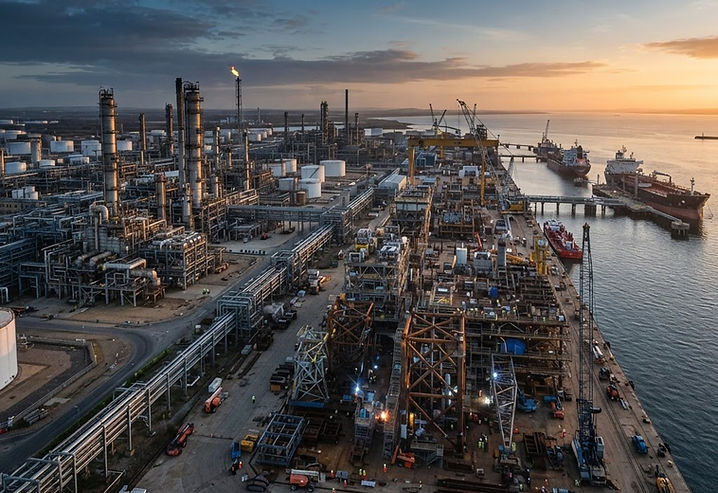
Commodities are a great source of investment and many investors have traded in potatoes, soya, gold, silver etc. over the decades. Some of the major commodity exchanges are the New York Mercantile Exchange (NYMEX) and the Chicago Mercantile Exchange (CME) with the Commodities Futures Trading Commission (CFTC) providing regulatory oversight in this regard. Energy sector investments are also very large as investors look to invest in oil markets and capitalize on energy price fluctuations. Different investment vehicles in the oil and gas sector are available to cater to investors’ preferences and risk appetite. So, what are some of these investment vehicles? Let’s find out more in this blog.
Greater exposure to the price of oil can be gained through an energy sector exchange traded fund (ETF) or exchange traded note (ETN), which typically invests in oil futures contracts rather than energy stocks. Several sector mutual funds that invest mainly in energy related stocks are available like the iShares Global Energy Sector Index Fund (IXC), and energy sector mutual funds, like the T. Rowe Price New Era Fund (PRNEX). These energy specific ETFs and mutual funds invest solely in oil stocks and oil services companies and come with lower risk. Because oil prices are largely uncorrelated to stock market returns or the direction of the U.S. dollar, these products follow the price of oil more closely than energy stocks and can serve as a hedge and a portfolio diversifier.
One can also invest in crude oil options, which are contracts that give the option holder the right (but not the obligation) to buy or sell securities at a fixed price. These securities are derivatives which have oil or other oil related product as the underlying asset whose movements determine the possibility of option exercise. Investing in crude oil options limits the potential for loss and may help protect against adverse commodity price movements.
Crude oil futures are traded on the NYMEX and the CME and are the most actively traded futures contract for a physical commodity. They are popular as they possess strong liquidity and price transparency. Crude oil futures provide individual investors an investment avenue in a vital commodity market. However, crude oil futures are leveraged which increases their risk as compared to other investments. Crude oil investment also impacts the metal fabrication industry due to existing interdependencies.

There are many risks which need to be taken into consideration in the context of investment in the crude oil markets. Some of these risks are highlighted as follows:,
Risk of Loss, Futures contracts are leveraged or “margined,” which means one may be liable for losses above the initial deposit. Risk tolerance, investment experience and securities knowledge should be gauged prior to investment in crude oil futures.
Volatile Market, The crude oil market is subject to periods of high volatility, and over time, oil prices have fluctuated significantly. For example, during the 2020 recession, the price of West Texas Intermediate (WTI) tumbled. At the start of February 2020, the price was $50.06 per barrel. On April 20, 2020, it closed at -$36.98 per barrel.
False Information, Some brokers and firms claim that crude oil investments soar during and after natural disasters. This claim has no real backing, and natural disasters don’t necessarily increase the chances of profiting in commodity futures or options trades based on crude oil. Manipulation of the oil market is also a very real scenario.
Investments in oil and gas are exciting, especially since it is a globally connected market which impacts nearly all economies globally. However, the ever changing geopolitical and economic factors mean that the oil market can also lead to large losses in case of incorrect or short sighted investments. Risks need to be understood and taken into account while investing in the energy industry and measures should be taken to ensure losses are limited. There is a difference between hedging and speculation, in the case of oil markets, speculation is a definite no no!
K999 Thailand carries out work of this kind through its pressure vessel fabrication team in Rayong.
Further reading
Follow Infrastructure across the wider market on Project Atlas Intel.
How K999 can help
Process equipment for energy projects
Pressure containment and pipeline work carries the tightest documentation on the shop floor, and the articles here track the codes and market conditions behind that work.
Pressure vessels and tanks- 01
Pressure vessels, steel tanks and pig launchers built to ASME and client specifications.
- 02
Pipe spool fabrication with heat induction bending for long radius and tight radius bends.
- 03
Full traceability from mill certificates through weld maps to hydrotest records.
More on Energy & Oil Gas
All articles


Request for quotation
Need fabricated steel to that standard?
Every enquiry is answered within 48 hours by our estimating team in Rayong. The priced quotation follows once drawings, quantities and standards are confirmed. Stainless steel fabrication, structural steel fabrication, pipe spooling, pressure vessels, steel tanks, mining equipment and conveyors, pig launchers, chutes and hoppers, send the package and we will price it.
Before you request a quotation
Steel fabrication quotation questions
What structural steel fabrication, pressure vessel and pipe spooling packages cost, what to send with an enquiry, and how delivery to site works.
Structural steel fabrication is priced from the section and plate tonnage, the detailing and drawing hours, welding and fitting manhours, NDT requirements, blast and coating system, packing and freight. Grade matters as much as weight: AS/NZS, ASTM, JIS and BS sections carry different mill prices, and heavy built up members take longer than rolled sections. Our Rayong workshop produces around 10,000 tonnes of structural steel fabrication a year, so a clear bill of materials is usually enough to price. Send the drawings and we answer within 48 hours; the priced quotation follows once quantities, standards and delivery dates are confirmed.
For steel fabrication work, send the drawings or IFC package, a bill of materials with material grades, the welding and NDT requirements, the coating specification, the delivery port and your site dates. Add the inspection and test plan, any third party inspection requirement, and whether trial assembly or match marking is needed. Where drawings are still in progress, a scope list with sizes, quantities and duty is enough to start, and the estimate is refined once the final package arrives. Every enquiry is answered within 48 hours, and the priced quotation is issued after scope, standards and quantities are confirmed.
Yes. Pressure vessel fabrication is carried out to ASME Section VIII Div. 1 under our ASME U stamp No. 43,462, or to AS/NZS and BS where the project specifies, covering separators, air receivers, water drums, waste heat recovery units and pig launchers. Steel tanks for fuel, biofuel, chemical, water and food duty are designed in house with our E Tank programme to API, ASME, BS and AS/NZS. Because structural steel, vessels, tanks and their supports are built in the same workshops, one enquiry can cover the vessel package, the tank package and the structural steel that carries them, with a single coating and documentation system and one shipment.
Steel fabrication Australia packages are scheduled from a 33,000 m2 Rayong yard with an 80,000 m2 assembly yard inside Sattahip port, so fabrication, trial assembly, blasting, coating and packing run in one place. Programme length depends on tonnage, material lead times, the coating system and inspection scope, and it is confirmed with the quotation. We quote FOB Laem Chabang, Map Ta Phut or Sattahip, or CIF and DAP to your Australian port, with packing lists, weights, lifting points and a data book per shipment. Staged deliveries can follow your site erection sequence instead of shipping everything at once.
There is no fixed minimum. Pipe spooling Australia packages run at up to 3,000 diameter inches per shift on SCH.40, from a single replacement spool to a full plant piping scope, with spools numbered, X rayed where specified and coated to match erection order. Mining equipment fabrication covers chutes, hoppers, ore bins, transfer towers and conveyor structures with Bisalloy, Hardox, rubber lining or hardfacing fitted in house, from one wear liner set to modules of up to 2,500 tonnes assembled at Sattahip. Send the scope list and we will tell you what the smallest sensible batch is for your programme.