


Energy & Oil Gas
Manipulation of Oil Market
Production quotas, benchmarks and trading behaviour all influence the price fabricators pay for energy and freight.
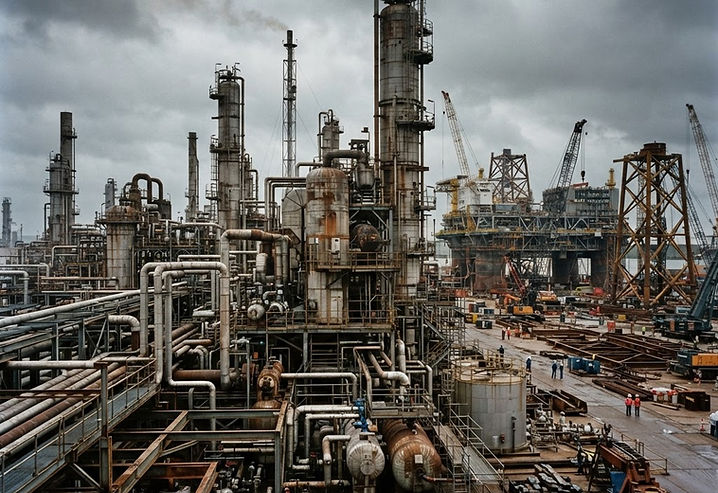
Can oil markets be manipulated after knowing the process of determination of oil prices ? This is the question which is being asked by traders who have observed unusual trends in the oil market, like the price of oil falling to zero and continuing to fall further. This was unprecedented in the history of the oil market and, as a result, investors who had taken long positions on oil found their losses increasing at an exponential rate. So, how does this manipulation take place and who are the major players in this area? Let’s find out more in this regard.
As an example, a trader may be scheduled to purchase tens of thousands of metric tons of fuel, with the price tagged to the daily benchmark provided by S&P Global Platts. In order to save money, the trader would offer to sell small amounts of crude at a price lower than the current spot, or at a loss. The key factor that actually makes the trader money is that oil traders are not required to report their purchases and sales of crude, the process is voluntary. Platts bases its benchmark price based off of the information that traders voluntarily provide. Hence, when a trader reports a sale of the commodity below the current spot price, Platts takes this into account and lowers the spot price.
Next, the trader is able to make his purchase of fuel at a small discount, only a few dollars per ton, but the savings compound quickly. For instance, the trader is scheduled to purchase 100,000 metric tons next week at a price of $100 per ton (the current spot price). This week, the trader will sell some of his crude assets for $95 and report the sale to Platts. Platts will then take the trade into account and lower the spot price to $98 per ton. Then, the trader makes his purchase of 100,000 tons, effectively saving $200,000 on the purchase as the spot price is now artificially $2/ton lower.
With such a seemingly well known scheme plaguing markets, it is tough to imagine how it can possibly still go on. Traders engaged in practices such as those described above do not view their actions as illegal because they did not involve “colluding with competitors, reporting fake prices or other obviously forbidden behavior.” And it would seem that from a legal standpoint, these traders are mostly correct.
Proving market manipulation requires a legal team to show clear intent to mislead markets in order to make a financial gain. Definitive proof of a person or institution’s intent has long been the snag in the legal proceedings for prosecutors. Within the confines of trading, proving intent is often too difficult, allowing many would be market manipulators off the hook. However, the European Union and Platts have stated that they will be looking into the matter in an effort to make oil markets more efficient and safer for all traders.
The role of regulators and regulatory bodies in oil market manipulation is likely to grow in the coming days. The Commodities and Futures Commission (CFTC) has already received a number of complaints and claims in this regard and they have been involved in analyzing crude oil price aberrations to identify cases of market misconduct and the evidence supporting the same. As rogue traders or other individuals employ increasingly sophisticated manipulation methods, the security of the oil and gas market and related industries like steel fabrication needs to be equally robust, so that oil prices are subject to supply and demand and market sentiment factors and nothing else!
K999 Thailand carries out work of this kind through its pressure vessel fabrication team in Rayong.
Further reading
Follow hydrogen projects in Europe across the wider market on Project Atlas Intel.
Calculation tool
Run the numbers for this yourself with the free materials and metallurgy articles from Engineering Toolbox Australia. Treat the result as a first check, then confirm the final design with your engineer.
How K999 can help
Process equipment for energy projects
Pressure containment and pipeline work carries the tightest documentation on the shop floor, and the articles here track the codes and market conditions behind that work.
Pressure vessels and tanks- 01
Pressure vessels, steel tanks and pig launchers built to ASME and client specifications.
- 02
Pipe spool fabrication with heat induction bending for long radius and tight radius bends.
- 03
Full traceability from mill certificates through weld maps to hydrotest records.
More on Energy & Oil Gas
All articles


Request for quotation
Need fabricated steel to that standard?
Every enquiry is answered within 48 hours by our estimating team in Rayong. The priced quotation follows once drawings, quantities and standards are confirmed. Stainless steel fabrication, structural steel fabrication, pipe spooling, pressure vessels, steel tanks, mining equipment and conveyors, pig launchers, chutes and hoppers, send the package and we will price it.
Before you request a quotation
Steel fabrication quotation questions
What structural steel fabrication, pressure vessel and pipe spooling packages cost, what to send with an enquiry, and how delivery to site works.
Structural steel fabrication is priced from the section and plate tonnage, the detailing and drawing hours, welding and fitting manhours, NDT requirements, blast and coating system, packing and freight. Grade matters as much as weight: AS/NZS, ASTM, JIS and BS sections carry different mill prices, and heavy built up members take longer than rolled sections. Our Rayong workshop produces around 10,000 tonnes of structural steel fabrication a year, so a clear bill of materials is usually enough to price. Send the drawings and we answer within 48 hours; the priced quotation follows once quantities, standards and delivery dates are confirmed.
For steel fabrication work, send the drawings or IFC package, a bill of materials with material grades, the welding and NDT requirements, the coating specification, the delivery port and your site dates. Add the inspection and test plan, any third party inspection requirement, and whether trial assembly or match marking is needed. Where drawings are still in progress, a scope list with sizes, quantities and duty is enough to start, and the estimate is refined once the final package arrives. Every enquiry is answered within 48 hours, and the priced quotation is issued after scope, standards and quantities are confirmed.
Yes. Pressure vessel fabrication is carried out to ASME Section VIII Div. 1 under our ASME U stamp No. 43,462, or to AS/NZS and BS where the project specifies, covering separators, air receivers, water drums, waste heat recovery units and pig launchers. Steel tanks for fuel, biofuel, chemical, water and food duty are designed in house with our E Tank programme to API, ASME, BS and AS/NZS. Because structural steel, vessels, tanks and their supports are built in the same workshops, one enquiry can cover the vessel package, the tank package and the structural steel that carries them, with a single coating and documentation system and one shipment.
Steel fabrication Australia packages are scheduled from a 33,000 m2 Rayong yard with an 80,000 m2 assembly yard inside Sattahip port, so fabrication, trial assembly, blasting, coating and packing run in one place. Programme length depends on tonnage, material lead times, the coating system and inspection scope, and it is confirmed with the quotation. We quote FOB Laem Chabang, Map Ta Phut or Sattahip, or CIF and DAP to your Australian port, with packing lists, weights, lifting points and a data book per shipment. Staged deliveries can follow your site erection sequence instead of shipping everything at once.
There is no fixed minimum. Pipe spooling Australia packages run at up to 3,000 diameter inches per shift on SCH.40, from a single replacement spool to a full plant piping scope, with spools numbered, X rayed where specified and coated to match erection order. Mining equipment fabrication covers chutes, hoppers, ore bins, transfer towers and conveyor structures with Bisalloy, Hardox, rubber lining or hardfacing fitted in house, from one wear liner set to modules of up to 2,500 tonnes assembled at Sattahip. Send the scope list and we will tell you what the smallest sensible batch is for your programme.