


Energy & Oil Gas
Oil Spills and How They are Cleaned Up
Containment booms, skimmers and dispersants form the response toolkit, with prevention engineering as the real control.
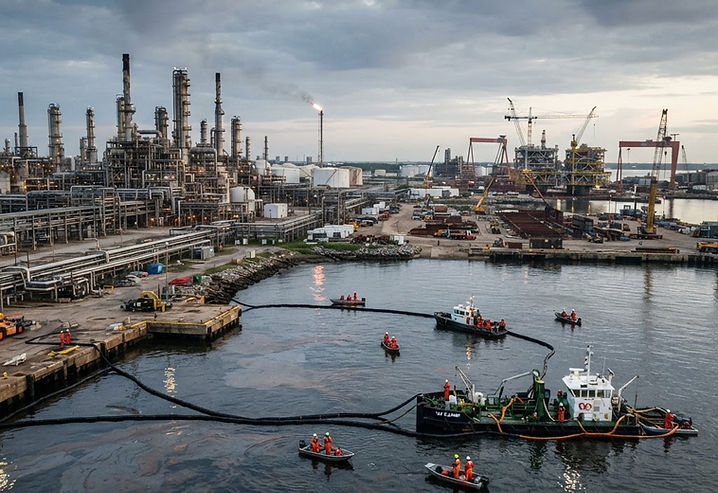
In January and February 2022, there were reports of major oil spills in Peru and USA respectively which caused substantial environmental damage. This is not new; oil spills have been occurring multiple times during a year across the world and in various forms. However, it makes sense to dig deeper into the impacts of an oil spill and how it can be cleaned up by various means. Cleanup and recovery from an oil spill is difficult and depends upon many factors, including the type of oil spilled, the temperature of the water, and the types of shorelines and beaches involved.
An oil spill is a form of pollution where liquid petroleum hydrocarbon is released into the environment, especially the marine ecosystem due to human activity or error. Oil spills may also occur on land; however marine oil spills where oil is released into the ocean or coastal waters is considered to have much more serious consequences. It may be caused by the release of crude oil from tankers, offshore structural steel platforms, drilling rigs and wells, as well as spills of refined petroleum products (such as gasoline, diesel) and their by products.
Oil spills penetrate into the plumage of birds and the fur of mammals, reducing its insulating ability, and making them more vulnerable to temperature fluctuations and reducing their buoyancy in water. Oil can impair a bird’s ability to fly, preventing it from foraging or escaping from predators. As they preen, birds may ingest the oil coating their feathers, irritating the digestive tract and thus altering liver functions. Oil spills can blind marine animals and the ingestion of oil causes dehydration and impairs the digestive process. The spillage of oil can also harm air quality as the chemicals in crude oil are mostly hydrocarbons that contains toxic chemicals such as benzenes, toluene etc. These chemicals can introduce adverse health effects when being inhaled into human body.

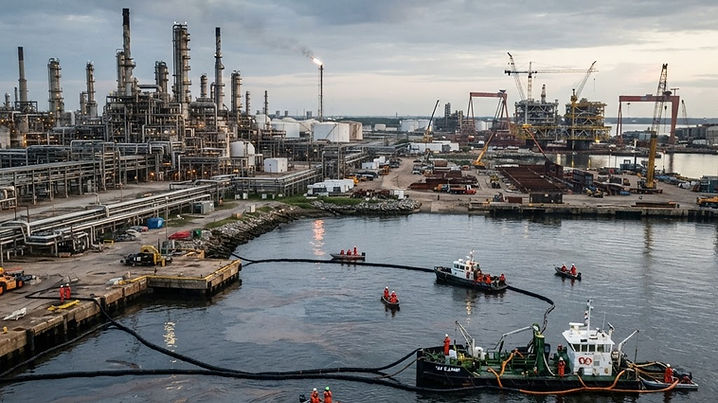
Some of the response methods used for dealing with oil spillage in offshore waters are described below:,
Skimming: This is a process that removes oil from the sea surface before it reaches sensitive areas along a coastline. Sometimes, two boats will tow a collection boom, allowing oil to concentrate within the boom, where it is then picked up by a “skimmer.” From whirring disks to floating drums, skimmers come in various designs but all basically work by removing the oil layer from the surface of the water.
In Situ Burning: This is the process of burning spilled oil where it is on the ocean (“in situ” is Latin for “on site”). Similar to skimming, two boats will often tow a fire retardant collection boom to concentrate enough oil to burn. Burning is sometimes also used in treating oiled marshes. The success of burning oil is dependent on gathering a layer of oil thick enough to maintain a sustained burn. Any burn operation includes careful air monitoring to ensure smoke or residue resulting from the burn do not adversely impact people or wildlife.
Chemical Dispersants: Releasing chemical dispersants, usually from a small plane or a marine vessel, on an oil slick breaks down the oil into smaller droplets, allowing them to mix more easily into the water column. Smaller droplets of oil become more readily available to microbes that will eat them and break them down into less harmful compounds. However, using dispersants has its drawbacks, with potential adverse impacts to the marine life living in the water column and on the seafloor.
Over the decades, there has been immeasurable economic, environmental and social damages caused as a result of oil spills. While the effects of oil spills can be mitigated to an extent, it is clear that stiffer penalties need to be imposed on the culprits. With the growing awareness around ESG risks, oil spills are a real danger and steps must be taken to reduce, if not prevent, such incidents in the future!
K999 Thailand carries out work of this kind through its pressure vessel fabrication team in Rayong.
Further reading
Follow tender intelligence across the wider market on Project Atlas Intel.
How K999 can help
Process equipment for energy projects
Pressure containment and pipeline work carries the tightest documentation on the shop floor, and the articles here track the codes and market conditions behind that work.
Pressure vessels and tanks- 01
Pressure vessels, steel tanks and pig launchers built to ASME and client specifications.
- 02
Pipe spool fabrication with heat induction bending for long radius and tight radius bends.
- 03
Full traceability from mill certificates through weld maps to hydrotest records.
More on Energy & Oil Gas
All articles


Request for quotation
Need fabricated steel to that standard?
Every enquiry is answered within 48 hours by our estimating team in Rayong. The priced quotation follows once drawings, quantities and standards are confirmed. Stainless steel fabrication, structural steel fabrication, pipe spooling, pressure vessels, steel tanks, mining equipment and conveyors, pig launchers, chutes and hoppers, send the package and we will price it.
Before you request a quotation
Steel fabrication quotation questions
What structural steel fabrication, pressure vessel and pipe spooling packages cost, what to send with an enquiry, and how delivery to site works.
Structural steel fabrication is priced from the section and plate tonnage, the detailing and drawing hours, welding and fitting manhours, NDT requirements, blast and coating system, packing and freight. Grade matters as much as weight: AS/NZS, ASTM, JIS and BS sections carry different mill prices, and heavy built up members take longer than rolled sections. Our Rayong workshop produces around 10,000 tonnes of structural steel fabrication a year, so a clear bill of materials is usually enough to price. Send the drawings and we answer within 48 hours; the priced quotation follows once quantities, standards and delivery dates are confirmed.
For steel fabrication work, send the drawings or IFC package, a bill of materials with material grades, the welding and NDT requirements, the coating specification, the delivery port and your site dates. Add the inspection and test plan, any third party inspection requirement, and whether trial assembly or match marking is needed. Where drawings are still in progress, a scope list with sizes, quantities and duty is enough to start, and the estimate is refined once the final package arrives. Every enquiry is answered within 48 hours, and the priced quotation is issued after scope, standards and quantities are confirmed.
Yes. Pressure vessel fabrication is carried out to ASME Section VIII Div. 1 under our ASME U stamp No. 43,462, or to AS/NZS and BS where the project specifies, covering separators, air receivers, water drums, waste heat recovery units and pig launchers. Steel tanks for fuel, biofuel, chemical, water and food duty are designed in house with our E Tank programme to API, ASME, BS and AS/NZS. Because structural steel, vessels, tanks and their supports are built in the same workshops, one enquiry can cover the vessel package, the tank package and the structural steel that carries them, with a single coating and documentation system and one shipment.
Steel fabrication Australia packages are scheduled from a 33,000 m2 Rayong yard with an 80,000 m2 assembly yard inside Sattahip port, so fabrication, trial assembly, blasting, coating and packing run in one place. Programme length depends on tonnage, material lead times, the coating system and inspection scope, and it is confirmed with the quotation. We quote FOB Laem Chabang, Map Ta Phut or Sattahip, or CIF and DAP to your Australian port, with packing lists, weights, lifting points and a data book per shipment. Staged deliveries can follow your site erection sequence instead of shipping everything at once.
There is no fixed minimum. Pipe spooling Australia packages run at up to 3,000 diameter inches per shift on SCH.40, from a single replacement spool to a full plant piping scope, with spools numbered, X rayed where specified and coated to match erection order. Mining equipment fabrication covers chutes, hoppers, ore bins, transfer towers and conveyor structures with Bisalloy, Hardox, rubber lining or hardfacing fitted in house, from one wear liner set to modules of up to 2,500 tonnes assembled at Sattahip. Send the scope list and we will tell you what the smallest sensible batch is for your programme.