


Energy & Oil Gas
Old Tyres and Boots Used in Next Gen Australian Steel Manufacturing
Old tyres, conveyor belts and rubber safety boots have been used in a novel steel manufacturing process commercialized by Australian steel manufacturer Molycop, which will be offered for...
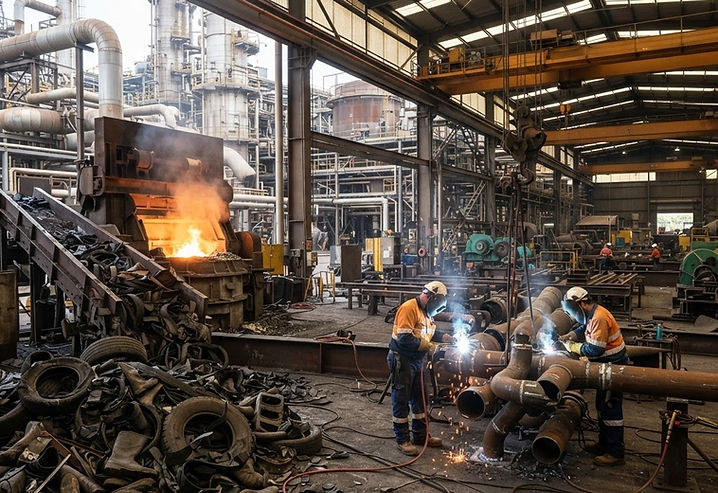
Old tyres, conveyor belts and rubber safety boots have been used in a novel steel manufacturing process commercialized by Australian steel manufacturer Molycop, which will be offered for export to global EAF operators. The process is the result of a collaborative project between Molycop, the UNSW SMaRT Centre, footwear manufacturer Crawford Boots and the Advanced Manufacturing Growth Centre (AMGC). It involves maximizing the recovery and use of waste rubber as a substitute for imported carbonaceous material (‘coke’) used in Molycop’s Electric Arc Furnace (EAF) in Newcastle. Australia’s waste tyre export ban, which began in December 2021, has been a catalyst for companies to find innovative new processing capabilities (such as water tanks ) to reduce the huge tyre landfill problem. The development of this new technology reduces the company’s reliance on imported carbonaceous materials from China by up to 20 per cent. It also removes up to 90,000 tyres from landfill and reduces the steel maker’s electricity consumption and scope one carbon emissions.
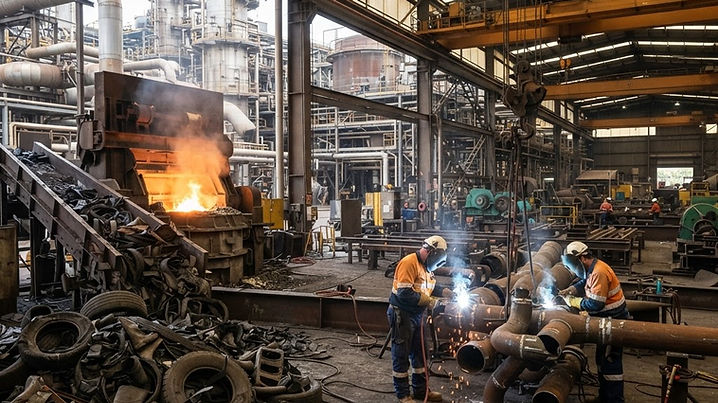
Molycop, alongside its steel fabrication partners, has developed a means to maximize the use of rubber crumb (polymer) as a source of carbon and hydrogen needed in the steel making process. Molycop produces over 240,000 tons of steel each year for train wheels, billet steel, steel bar and grinding media. Sustainability is core to the company’s strategy and integrated into how Molycop does business, said the company’s President of Sustainability, Ian Tooze. Displacing fossil carbon materials is also a key objective in Molycop’s decarbonization pathway. “We are investing in innovative solutions that improve the ways we reduce the consumption of virgin raw materials, recover valuable materials from waste streams, minimize waste and reduce our carbon footprint while we perform quality management. “What we have developed is yielding results and delivering outcomes for Molycop, our customers and communities in which we operate.” The AMGC said the innovation will help Australia’s steel manufacturing sector to be more competitive, through lowered production and import costs, and be more sustainable through decreased emissions and energy consumption.
AMGC’s Managing Director, Dr Jens Goennemann said commercializing great manufacturing ideas is where Australia’s future prosperity lies. “Australia has an opportunity to transform from being a lucky country to a smart one through the commercialization of great ideas that have local and global relevance. While the US has floated new steel tariffs based on carbon emissions, Molycop, UNSW and Crawford Boots together have manufactured a product that will reduce emissions and address waste in steel making, while generating more jobs and revenues for the nation, what more could you ask for?” Director of the UNSW Sustainable Materials Research and Technology (SMaRT) Centre, Professor Veena Sahajwalla said it is crucial for manufacturers and researchers to work to tackle environmental issues, while delivering commercial outcomes. “By working collaboratively with Molycop we have been able to prove that polymer injection works and is commercially viable. It is only through partnerships like this that we can truly achieve positive environmental outcomes at scale. I encourage all manufacturers to engage with your local research institution and challenge them with a business issue that needs solving.”
K999 Thailand carries out work of this kind through its pressure vessel fabrication team in Rayong.
Further reading
Follow engineering procurement construction companies in Singapore across the wider market on Project Atlas Intel.
How K999 can help
Process equipment for energy projects
Pressure containment and pipeline work carries the tightest documentation on the shop floor, and the articles here track the codes and market conditions behind that work.
Pressure vessels and tanks- 01
Pressure vessels, steel tanks and pig launchers built to ASME and client specifications.
- 02
Pipe spool fabrication with heat induction bending for long radius and tight radius bends.
- 03
Full traceability from mill certificates through weld maps to hydrotest records.
More on Energy & Oil Gas
All articles

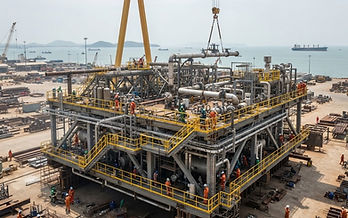

Request for quotation
Need fabricated steel to that standard?
Every enquiry is answered within 48 hours by our estimating team in Rayong. The priced quotation follows once drawings, quantities and standards are confirmed. Stainless steel fabrication, structural steel fabrication, pipe spooling, pressure vessels, steel tanks, mining equipment and conveyors, pig launchers, chutes and hoppers, send the package and we will price it.
Before you request a quotation
Steel fabrication quotation questions
What structural steel fabrication, pressure vessel and pipe spooling packages cost, what to send with an enquiry, and how delivery to site works.
Structural steel fabrication is priced from the section and plate tonnage, the detailing and drawing hours, welding and fitting manhours, NDT requirements, blast and coating system, packing and freight. Grade matters as much as weight: AS/NZS, ASTM, JIS and BS sections carry different mill prices, and heavy built up members take longer than rolled sections. Our Rayong workshop produces around 10,000 tonnes of structural steel fabrication a year, so a clear bill of materials is usually enough to price. Send the drawings and we answer within 48 hours; the priced quotation follows once quantities, standards and delivery dates are confirmed.
For steel fabrication work, send the drawings or IFC package, a bill of materials with material grades, the welding and NDT requirements, the coating specification, the delivery port and your site dates. Add the inspection and test plan, any third party inspection requirement, and whether trial assembly or match marking is needed. Where drawings are still in progress, a scope list with sizes, quantities and duty is enough to start, and the estimate is refined once the final package arrives. Every enquiry is answered within 48 hours, and the priced quotation is issued after scope, standards and quantities are confirmed.
Yes. Pressure vessel fabrication is carried out to ASME Section VIII Div. 1 under our ASME U stamp No. 43,462, or to AS/NZS and BS where the project specifies, covering separators, air receivers, water drums, waste heat recovery units and pig launchers. Steel tanks for fuel, biofuel, chemical, water and food duty are designed in house with our E Tank programme to API, ASME, BS and AS/NZS. Because structural steel, vessels, tanks and their supports are built in the same workshops, one enquiry can cover the vessel package, the tank package and the structural steel that carries them, with a single coating and documentation system and one shipment.
Steel fabrication Australia packages are scheduled from a 33,000 m2 Rayong yard with an 80,000 m2 assembly yard inside Sattahip port, so fabrication, trial assembly, blasting, coating and packing run in one place. Programme length depends on tonnage, material lead times, the coating system and inspection scope, and it is confirmed with the quotation. We quote FOB Laem Chabang, Map Ta Phut or Sattahip, or CIF and DAP to your Australian port, with packing lists, weights, lifting points and a data book per shipment. Staged deliveries can follow your site erection sequence instead of shipping everything at once.
There is no fixed minimum. Pipe spooling Australia packages run at up to 3,000 diameter inches per shift on SCH.40, from a single replacement spool to a full plant piping scope, with spools numbered, X rayed where specified and coated to match erection order. Mining equipment fabrication covers chutes, hoppers, ore bins, transfer towers and conveyor structures with Bisalloy, Hardox, rubber lining or hardfacing fitted in house, from one wear liner set to modules of up to 2,500 tonnes assembled at Sattahip. Send the scope list and we will tell you what the smallest sensible batch is for your programme.