


Fabrication
Optimizing Structural Steel Fabrication for Large Scale Projects
This guide provides practical strategies for managing heavy steel fabrication, focusing on distortion control, inspection accuracy, and workflow efficiency for major industrial projects. These shop floor insights help engineers minimize rework and ensure structural integrity.
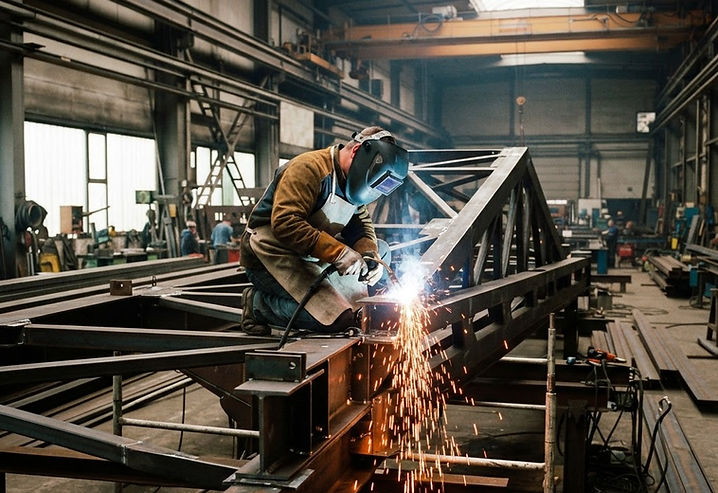
Managing heavy structural steel fabrication requires a bridge between complex engineering drawings and the physical reality of the shop floor. When moving from initial contract award tracking to final delivery, the biggest risks often hide in the smallest details of joint preparation and weld sequence. This guide outlines practical habits to help site engineers maintain quality and project schedules.
How can you mitigate thermal distortion during heavy plate welding?
Heavy plate welding introduces massive heat input that creates significant residual stress. If you ignore this, your final assembly will deviate from tolerance requirements, leading to costly corrective heating or mechanical straightening.
Use symmetrical welding patterns to balance thermal expansion across the joint. If a project involves heavy sections, start from the center and move outward toward the ends.
Sequence your passes to distribute the heat evenly around the joint neutral axis. Always utilize mechanical stiffeners or rigid tack welds to maintain geometry until the main weld is complete.
Which inspection techniques prevent rework before surface finishing?
It is common to discover defects only after a component has moved into the abrasive blasting and painting phase. This timing is disastrous for production schedules because stripping coatings is expensive and slows down your output.
Implement an intermediate inspection gate immediately following NDT clearance. Ensure that all weld spatters are removed and sharp edges are ground smooth before the piece leaves the fabrication bay.
Check for porosity and undercut issues under high-intensity lighting while the steel is still bare. Catching these small surface flaws early saves hundreds of man hours in the long run.
How do you maintain dimensional accuracy on complex site assemblies?
Complex structures often fail to fit during site installation due to cumulative error stacking. Fabricators must prioritize datum consistency throughout the entire build process.
Establish a primary master datum point on every major assembly that aligns with the site coordinate system. Ensure your shop floor measurements are taken from this same master point rather than the nearest edge.
Perform regular tape calibration checks every morning with your quality control team. Small discrepancies in measuring tools will compound rapidly over large structural steel runs.
Consistent, disciplined shop floor management separates top tier projects from those plagued by field modifications. By controlling heat, verifying surfaces before coating, and locking in your datums, you protect both the project budget and the structural safety of the end product. Apply these techniques early to avoid the common pitfalls that compromise industrial fabrication projects.
For the calculations behind this topic, the free steel section properties from Engineering Toolbox Australia is a practical starting point.
Further reading
Follow Oil & Gas across the wider market on Project Atlas Intel.
Calculation tool
Run the numbers for this yourself with the free steel section properties from Engineering Toolbox Australia. Treat the result as a first check, then confirm the final design with your engineer.
How K999 can help
Fabrication capacity behind the article
Articles in this section describe work we run every week in Rayong: cutting, forming, welding and assembly, under cover and in the yard, with the documentation that goes with it.
Structural steel fabrication- 01
Two workshops totalling more than 33,000 m² plus an 80,000 m² assembly yard at Sattahip.
- 02
Structural steel fabrication to 10,000 tonnes a year, with the largest single module built at 2,500 tonnes.
- 03
Blast, prime and paint before dispatch, with dimensional reports issued against the approved drawings.
More on Fabrication
All articles


Request for quotation
Need fabricated steel to that standard?
Every enquiry is answered within 48 hours by our estimating team in Rayong. The priced quotation follows once drawings, quantities and standards are confirmed. Stainless steel fabrication, structural steel fabrication, pipe spooling, pressure vessels, steel tanks, mining equipment and conveyors, pig launchers, chutes and hoppers, send the package and we will price it.
Before you request a quotation
Steel fabrication quotation questions
What structural steel fabrication, pressure vessel and pipe spooling packages cost, what to send with an enquiry, and how delivery to site works.
Structural steel fabrication is priced from the section and plate tonnage, the detailing and drawing hours, welding and fitting manhours, NDT requirements, blast and coating system, packing and freight. Grade matters as much as weight: AS/NZS, ASTM, JIS and BS sections carry different mill prices, and heavy built up members take longer than rolled sections. Our Rayong workshop produces around 10,000 tonnes of structural steel fabrication a year, so a clear bill of materials is usually enough to price. Send the drawings and we answer within 48 hours; the priced quotation follows once quantities, standards and delivery dates are confirmed.
For steel fabrication work, send the drawings or IFC package, a bill of materials with material grades, the welding and NDT requirements, the coating specification, the delivery port and your site dates. Add the inspection and test plan, any third party inspection requirement, and whether trial assembly or match marking is needed. Where drawings are still in progress, a scope list with sizes, quantities and duty is enough to start, and the estimate is refined once the final package arrives. Every enquiry is answered within 48 hours, and the priced quotation is issued after scope, standards and quantities are confirmed.
Yes. Pressure vessel fabrication is carried out to ASME Section VIII Div. 1 under our ASME U stamp No. 43,462, or to AS/NZS and BS where the project specifies, covering separators, air receivers, water drums, waste heat recovery units and pig launchers. Steel tanks for fuel, biofuel, chemical, water and food duty are designed in house with our E Tank programme to API, ASME, BS and AS/NZS. Because structural steel, vessels, tanks and their supports are built in the same workshops, one enquiry can cover the vessel package, the tank package and the structural steel that carries them, with a single coating and documentation system and one shipment.
Steel fabrication Australia packages are scheduled from a 33,000 m2 Rayong yard with an 80,000 m2 assembly yard inside Sattahip port, so fabrication, trial assembly, blasting, coating and packing run in one place. Programme length depends on tonnage, material lead times, the coating system and inspection scope, and it is confirmed with the quotation. We quote FOB Laem Chabang, Map Ta Phut or Sattahip, or CIF and DAP to your Australian port, with packing lists, weights, lifting points and a data book per shipment. Staged deliveries can follow your site erection sequence instead of shipping everything at once.
There is no fixed minimum. Pipe spooling Australia packages run at up to 3,000 diameter inches per shift on SCH.40, from a single replacement spool to a full plant piping scope, with spools numbered, X rayed where specified and coated to match erection order. Mining equipment fabrication covers chutes, hoppers, ore bins, transfer towers and conveyor structures with Bisalloy, Hardox, rubber lining or hardfacing fitted in house, from one wear liner set to modules of up to 2,500 tonnes assembled at Sattahip. Send the scope list and we will tell you what the smallest sensible batch is for your programme.