


Energy & Oil Gas
Paraffin deposition and its prevention and removal
Wax deposition restricts flow in crude lines and is managed with thermal, chemical and mechanical intervention.
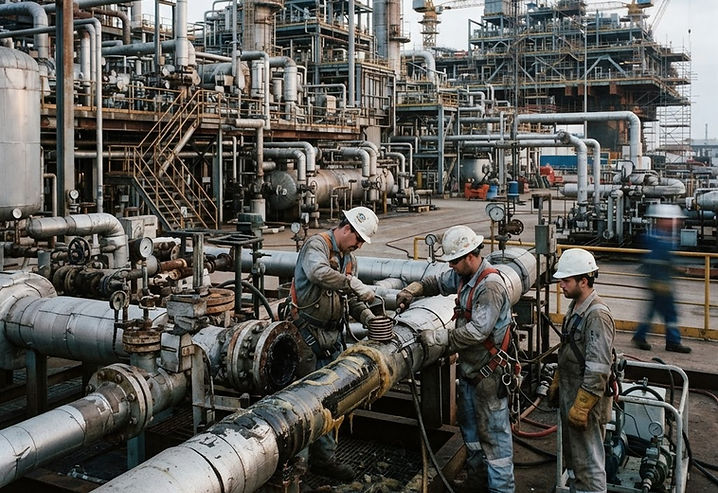
The crude oil production industry has its own share of complications and challenges. One of the most common issues is the formation of organic deposits in and around the boring regions which can severely impact the flow of oil and thereby, slow down the entire mining process. These organic deposits can be either paraffins or asphaltenes and they can occur in tubing or in the pores of the reservoir rock. So how are paraffin deposits formed and what are the ways to eradicate them or mitigate their impact? Let’s take a closer look at this topic.
Paraffins are high molecular weight alkanes that can build up as deposits in the wellbore, in feed lines, etc. These organic deposits can act as chokes within the wellbore, resulting in a gradual decrease in production with time as the deposits increase in thickness. Deposits vary in consistency from soft accumulations to hard, brittle deposits. Usually, the deposits are firmer and harder as the molecular weight of the paraffin deposits increases.
The primary cause of wax or paraffin deposition is simply a loss in solubility in the crude oil. This loss of solubility is usually a result of changes in temperature, pressure, or composition of the crude oil as a result of loss of dissolved gases. paraffins that have the highest melting point and molecular weight are usually the first to separate from solution, with lower molecular weight paraffins separating as the temperature decreases further.
Paraffin accumulations are removed by methods that can be broadly placed into three categories:

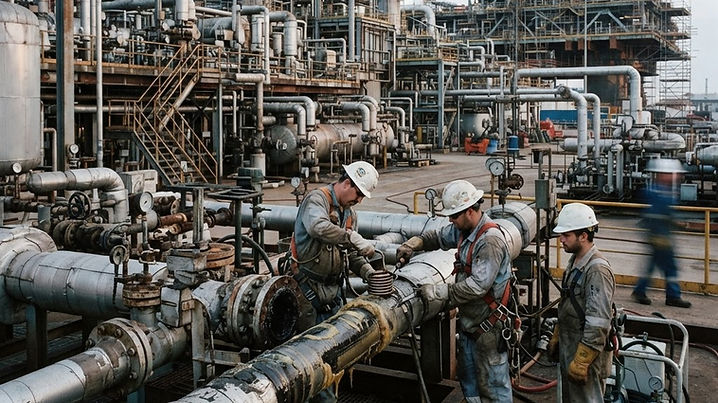
Mechanical removal of paraffin deposits, Mechanical methods such as scrapers, knives, and other tools are most commonly used to remove paraffin deposits in wellbores. They can be very effective and are relatively inexpensive.
Use of solvents to remove paraffin deposits, The most common solvent used to remove paraffin from tubulars and the near wellbore region is crude oil. Hot oiling is the least expensive method, where the oil is heated to temperatures of 300°F or more and this heated oil is then injected or gravity fed into the tubing or annulus. The high temperature ensures that the paraffin deposits are soluble in the injected crude, which is then produced back to the surface.
Use of heat to melt and remove the wax, Steam has been used in a number of cases in which severe paraffin problems have resulted in plugged tubulars. The lack of solubility of paraffin in hot water necessitates the use of surfactants with steam or hot water so that melted paraffin can be removed.
While the methods for removing paraffin accumulation are tried and tested, it would be even better if deposits are not allowed to form in the first place. In this regard, several mechanical adjustments can be made in the production string that can minimize the likelihood of paraffin deposition. In general, these steps are designed to minimize the cooling of the crude oil as it is produced to the surface. This can be accomplished by designing pumping wells or tubing sizes and gas lift systems that maximize the flow of oil to the surface and minimize the heat lost to the surrounding formations. The use of more expensive methods such as plastic coatings on tubulars and electrical heaters is severely limited by cost considerations.
Paraffin inhibitors are a class of compounds that consist of crystal modifiers that prevent the deposition of paraffin onto pipe surfaces and pipe fabrication. These surface active materials retard paraffin deposition by inhibiting the adhesion of paraffin to sites on the tubing walls. Surfactants used in these applications include wetting agents, dispersants, and crystal modifiers. Each of these chemicals needs to be tested for a specific crude oil to evaluate its effectiveness.
In the Oil and Gas industry, continuous and uninhibited production of crude and other energy producing hydrocarbons are necessary to ensure the stability of global demand and supply dynamics. In this regard, paraffin deposits have the potential to impede oil production to a great extent and hence, there has been considerable research into how it can be tackled efficiently so that any adverse impact is minimal. The flip side is the fact that paraffin deposits have other uses in our daily lives, so there may be additional benefits if these deposits are harnessed correctly!
K999 Thailand carries out work of this kind through its pressure vessel fabrication team in Rayong.
Further reading
Follow FEED and FID tracking across the wider market on Project Atlas Intel.
How K999 can help
Process equipment for energy projects
Pressure containment and pipeline work carries the tightest documentation on the shop floor, and the articles here track the codes and market conditions behind that work.
Pressure vessels and tanks- 01
Pressure vessels, steel tanks and pig launchers built to ASME and client specifications.
- 02
Pipe spool fabrication with heat induction bending for long radius and tight radius bends.
- 03
Full traceability from mill certificates through weld maps to hydrotest records.
More on Energy & Oil Gas
All articles


Request for quotation
Need fabricated steel to that standard?
Every enquiry is answered within 48 hours by our estimating team in Rayong. The priced quotation follows once drawings, quantities and standards are confirmed. Stainless steel fabrication, structural steel fabrication, pipe spooling, pressure vessels, steel tanks, mining equipment and conveyors, pig launchers, chutes and hoppers, send the package and we will price it.
Before you request a quotation
Steel fabrication quotation questions
What structural steel fabrication, pressure vessel and pipe spooling packages cost, what to send with an enquiry, and how delivery to site works.
Structural steel fabrication is priced from the section and plate tonnage, the detailing and drawing hours, welding and fitting manhours, NDT requirements, blast and coating system, packing and freight. Grade matters as much as weight: AS/NZS, ASTM, JIS and BS sections carry different mill prices, and heavy built up members take longer than rolled sections. Our Rayong workshop produces around 10,000 tonnes of structural steel fabrication a year, so a clear bill of materials is usually enough to price. Send the drawings and we answer within 48 hours; the priced quotation follows once quantities, standards and delivery dates are confirmed.
For steel fabrication work, send the drawings or IFC package, a bill of materials with material grades, the welding and NDT requirements, the coating specification, the delivery port and your site dates. Add the inspection and test plan, any third party inspection requirement, and whether trial assembly or match marking is needed. Where drawings are still in progress, a scope list with sizes, quantities and duty is enough to start, and the estimate is refined once the final package arrives. Every enquiry is answered within 48 hours, and the priced quotation is issued after scope, standards and quantities are confirmed.
Yes. Pressure vessel fabrication is carried out to ASME Section VIII Div. 1 under our ASME U stamp No. 43,462, or to AS/NZS and BS where the project specifies, covering separators, air receivers, water drums, waste heat recovery units and pig launchers. Steel tanks for fuel, biofuel, chemical, water and food duty are designed in house with our E Tank programme to API, ASME, BS and AS/NZS. Because structural steel, vessels, tanks and their supports are built in the same workshops, one enquiry can cover the vessel package, the tank package and the structural steel that carries them, with a single coating and documentation system and one shipment.
Steel fabrication Australia packages are scheduled from a 33,000 m2 Rayong yard with an 80,000 m2 assembly yard inside Sattahip port, so fabrication, trial assembly, blasting, coating and packing run in one place. Programme length depends on tonnage, material lead times, the coating system and inspection scope, and it is confirmed with the quotation. We quote FOB Laem Chabang, Map Ta Phut or Sattahip, or CIF and DAP to your Australian port, with packing lists, weights, lifting points and a data book per shipment. Staged deliveries can follow your site erection sequence instead of shipping everything at once.
There is no fixed minimum. Pipe spooling Australia packages run at up to 3,000 diameter inches per shift on SCH.40, from a single replacement spool to a full plant piping scope, with spools numbered, X rayed where specified and coated to match erection order. Mining equipment fabrication covers chutes, hoppers, ore bins, transfer towers and conveyor structures with Bisalloy, Hardox, rubber lining or hardfacing fitted in house, from one wear liner set to modules of up to 2,500 tonnes assembled at Sattahip. Send the scope list and we will tell you what the smallest sensible batch is for your programme.