


Welding & Testing
Process of Welding Pipes
From joint preparation and fit up through root, fill and cap passes to NDT, this is how process pipe is welded to a qualified procedure.
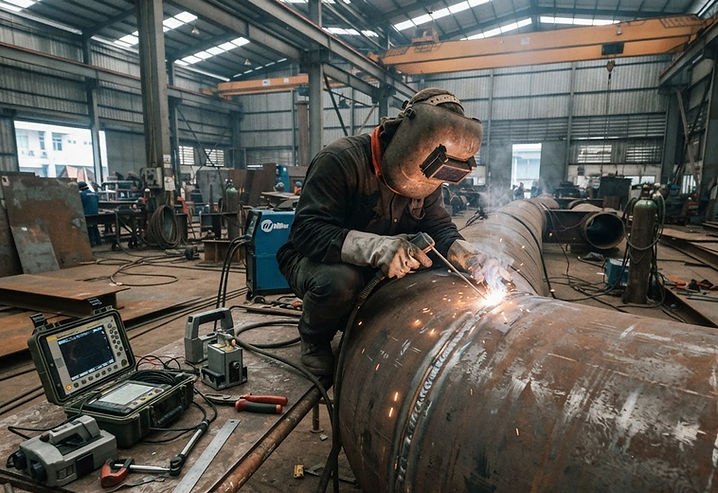
During his career, a metal fabricator will be expected to work on a wide range of jobs, using various metals of different thicknesses. Joining curved pieces of metal is more difficult than welding flat sheets, so by far, the most challenging process one is likely to come across is pipe welding, where it will be required to join cylindrical metal tubes using either SMAW or gas shielded arc welding processes involving pressure vessels. The pipe welding positions and techniques are often quite uncomfortable, especially if the pipe is fixed and access is restricted. As a result, learning the structural welding basics will give one a much better understanding of TIG and MIG welding in general, which is a great foundation for more complex procedures. This blog will explore this topic in further detail.
How to Weld Pipes, Basis Guide and Process
If a welding joint does not use a tacked backing plate, it’s known as open root welding, which is the most common process used while pipe welding. This is particularly difficult because one will essentially be welding across a gap (albeit a small one) so it’s important to use the right technique so that one does not make a mess of the whole job. Every welder will have a ‘good’ side and a ‘bad’ side when it comes to welding, depending on whether they’releft- or right handed. For right handed welders the left hand side of the pipe is the challenge; for left handed welders, it’s the right hand side of the pipe which is the most difficult. Anticipating this obstacle and learning how to overcome it is the best way to ensure super strong, neat welds every time.
Pipe fabrication, and specifically welding, often uses quite thick, heavy duty materials, and the open root nature of the welds means that penetration can be poor if not done properly. Leaving poorly penetrated welds on tough, industrial pipe welding jobs can be disastrous. It will need to be ensure that full penetration is achieved, however since that it’s unlikely that welding can be done from the inside of the pipe as well as the outside, one can combat this potential problem by using a groove weld.

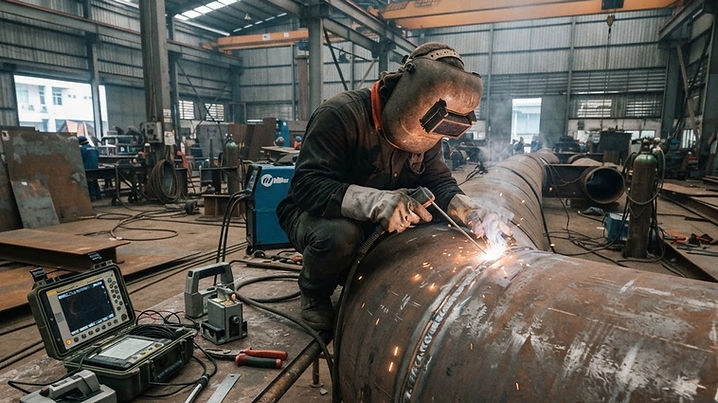
Testing Pipe Welding
Inspecting the weld visually is one such method, which is by far the cheapest, quickest and easiest. It involves nothing more than looking at the weld to discern its quality, which can be a very subjective process. It can’t be used as a reliable method for detecting internal weld defects, so this method is mainly used when poor quality welds won’t put anyone or anything in danger.
Liquid dye penetrant testing is the second method, where a dye is sprayed or brushed onto the surface of the metal. The dye will highlight any surface cracks or imperfections which aren’t visible to the naked eye, making it more effective than a visual inspection, although the cost of the dye does mean that it’s marginally more expensive.
X ray testing is the only really practical method of detecting internal weld defects, which is why it’s used on jobs where the quality of the weld is important for safety reasons. It works in a very similar way to X rays which we have on the human body to look at broken bones, except on a much grander, more industrial scale. As a result, there are some risks associated with this method, so it should only be carried out by trained professionals. These three methods are called nondestructive testing (NDT), where the welds must remain intact. It may be appropriate to actually break apart the pipe weld by separating it into sections and testing the strength and quality of each one.
Conclusion
Mastering the art of pipe welding will take one’s welding career far beyond the potential of hobby or ordinary flat plate welding. The welder will learn some of the most challenging welding techniques in the industry, but will also gain a highly prized skill set which is desired by employers and which will probably lead to a higher salary. One won’t need any extra special equipment, but this isn’t a welding process for the half hearted!
Further reading
Follow offshore wind projects in Europe across the wider market on Project Atlas Intel.
How K999 can help
Welding and inspection practice
The welding procedures, welder qualifications and inspection routines described here are the ones applied to every spool, vessel and frame that leaves our workshop.
Inspection and expediting- 01
Qualified procedures for carbon steel, stainless steel and nickel alloys, with welder performance records held per joint type.
- 02
Dimensional and weld inspection in house, with third party witness arranged for client hold points.
- 03
Inspection and expediting support that follows the job from raw material receipt through to load out.
More on Welding & Testing
All articles


Request for quotation
Need fabricated steel to that standard?
Every enquiry is answered within 48 hours by our estimating team in Rayong. The priced quotation follows once drawings, quantities and standards are confirmed. Stainless steel fabrication, structural steel fabrication, pipe spooling, pressure vessels, steel tanks, mining equipment and conveyors, pig launchers, chutes and hoppers, send the package and we will price it.
Before you request a quotation
Steel fabrication quotation questions
What structural steel fabrication, pressure vessel and pipe spooling packages cost, what to send with an enquiry, and how delivery to site works.
Structural steel fabrication is priced from the section and plate tonnage, the detailing and drawing hours, welding and fitting manhours, NDT requirements, blast and coating system, packing and freight. Grade matters as much as weight: AS/NZS, ASTM, JIS and BS sections carry different mill prices, and heavy built up members take longer than rolled sections. Our Rayong workshop produces around 10,000 tonnes of structural steel fabrication a year, so a clear bill of materials is usually enough to price. Send the drawings and we answer within 48 hours; the priced quotation follows once quantities, standards and delivery dates are confirmed.
For steel fabrication work, send the drawings or IFC package, a bill of materials with material grades, the welding and NDT requirements, the coating specification, the delivery port and your site dates. Add the inspection and test plan, any third party inspection requirement, and whether trial assembly or match marking is needed. Where drawings are still in progress, a scope list with sizes, quantities and duty is enough to start, and the estimate is refined once the final package arrives. Every enquiry is answered within 48 hours, and the priced quotation is issued after scope, standards and quantities are confirmed.
Yes. Pressure vessel fabrication is carried out to ASME Section VIII Div. 1 under our ASME U stamp No. 43,462, or to AS/NZS and BS where the project specifies, covering separators, air receivers, water drums, waste heat recovery units and pig launchers. Steel tanks for fuel, biofuel, chemical, water and food duty are designed in house with our E Tank programme to API, ASME, BS and AS/NZS. Because structural steel, vessels, tanks and their supports are built in the same workshops, one enquiry can cover the vessel package, the tank package and the structural steel that carries them, with a single coating and documentation system and one shipment.
Steel fabrication Australia packages are scheduled from a 33,000 m2 Rayong yard with an 80,000 m2 assembly yard inside Sattahip port, so fabrication, trial assembly, blasting, coating and packing run in one place. Programme length depends on tonnage, material lead times, the coating system and inspection scope, and it is confirmed with the quotation. We quote FOB Laem Chabang, Map Ta Phut or Sattahip, or CIF and DAP to your Australian port, with packing lists, weights, lifting points and a data book per shipment. Staged deliveries can follow your site erection sequence instead of shipping everything at once.
There is no fixed minimum. Pipe spooling Australia packages run at up to 3,000 diameter inches per shift on SCH.40, from a single replacement spool to a full plant piping scope, with spools numbered, X rayed where specified and coated to match erection order. Mining equipment fabrication covers chutes, hoppers, ore bins, transfer towers and conveyor structures with Bisalloy, Hardox, rubber lining or hardfacing fitted in house, from one wear liner set to modules of up to 2,500 tonnes assembled at Sattahip. Send the scope list and we will tell you what the smallest sensible batch is for your programme.