


Energy & Oil Gas
Processes Involved in Crude Oil Refining
Distillation, cracking and treating units define the vessels, columns and alloy piping a refinery needs fabricated.
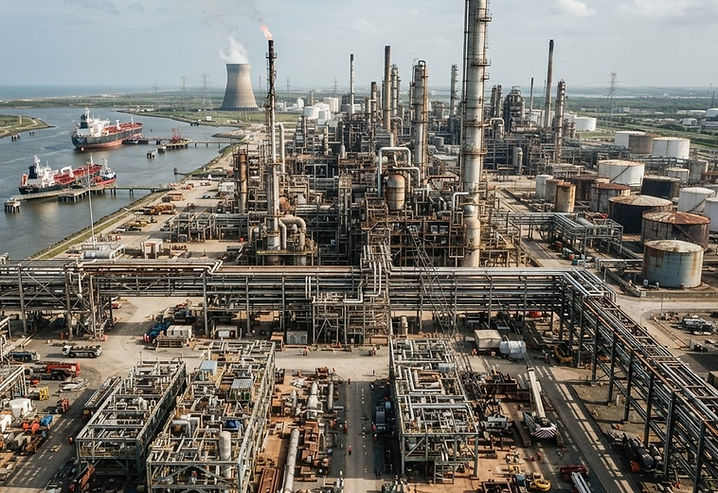
Have you ever wondered how crude oil is converted into end use goods like gasoline, heating oil, cooking gas etc.? It involves a process whereby crude oil is obtained as part of upstream activities, it is refined during midstream activities and finally, it is sold as petroleum products as part of downstream activities. The refining is done in petroleum refineries (with machinery such as pressure vessels ) which are large scale industrial complexes that produce saleable petroleum products from crude oil. This blog will explore further details around the refining process and will look at the various metrics involved in this regard.
Distillation involves the separation of materials based on differences in their volatility. This is the first and most basic step in the refining process, and is the precursor to the subsequent steps of cracking and reforming. In this process, crude oil is heated until it boils and is fed into a distillation column. As the temperature of the crude oil in the distillation column rises, the crude oil separates itself into different components, called “fractions.” which are then captured separately. Each fraction corresponds to a different type of petroleum product (e.g., petrol, paraffin, diesel fuel etc.), depending on the temperature at which that fraction boils off the crude oil mixture.
The heaviest fractions obtained as part of distillation, including the gas oils and residual oils, are lower in value than some of the lighter fractions, so refiners go through a process called “cracking” to break apart the molecules in these fractions. This process can produce some higher value products from heavier fractions. Cracking is most often utilized to produce gasoline and jet fuel from heavy gas oils. Reforming is typically utilized on lower value light fractions, again to produce more gasoline. The reforming process involves inducing chemical reactions under pressure to change the composition of the hydrocarbon chain.
Apart from the above mentioned processes, some of the major chemical processes involved in the oil refining process are stated as follows:,

Desalter unit, This washes out salt from the crude oil before it enters the atmospheric distillation unit.
Distillate hydrotreater, This desulfurizes distillates (such as diesel) after atmospheric distillation. Uses hydrogen to desulfurize the naphtha fraction from the crude oil distillation or other units within the refinery.
Coking units, These process very heavy residual oils into gasoline and diesel fuel, leaving petroleum coke as a residual product.
Isomerization, This converts linear molecules such as normal pentane to higher octane branched molecules for blending into gasoline or feed to pipe fabrication. It is also used to convert linear normal butane into isobutane for use in the alkylation unit.
Cooling Towers, These circulate cooling water, boiler plants generate steam for steam generators, and instrument air systems include pneumatically operated control valves and an electrical substation.
Since modern petroleum refineries are highly automated and technically advanced, nearly all processes are contained within engineering controls and represent a decreased risk of exposure compared to earlier times. However, certain situations or work tasks may subvert these safety mechanisms, and expose workers to a number of chemical (see table above) or physical (described below) hazards. Examples of these scenarios include: System failures (leaks, explosions, etc.), Standard inspection, product sampling, process turnaround, or equipment maintenance/cleaning activities.
The complexity of oil refinery processes corresponds to the staggering array of petroleum products in demand throughout the world. Refining is a very precise set of steps and, if not done correctly, will lead to the end products being compromised with regard to functionality and quality. It also requires significant investment in fixed assets and manpower; thus, a lot of effort is required to ensure that the refining is successful. Hence, the process from “crude” to “refined” is a long one and is very relevant considering the oil demands in the current VUCA world!
Further reading
Follow project lifecycle intelligence across the wider market on Project Atlas Intel.
How K999 can help
Process equipment for energy projects
Pressure containment and pipeline work carries the tightest documentation on the shop floor, and the articles here track the codes and market conditions behind that work.
Pressure vessels and tanks- 01
Pressure vessels, steel tanks and pig launchers built to ASME and client specifications.
- 02
Pipe spool fabrication with heat induction bending for long radius and tight radius bends.
- 03
Full traceability from mill certificates through weld maps to hydrotest records.
More on Energy & Oil Gas
All articles


Request for quotation
Need fabricated steel to that standard?
Every enquiry is answered within 48 hours by our estimating team in Rayong. The priced quotation follows once drawings, quantities and standards are confirmed. Stainless steel fabrication, structural steel fabrication, pipe spooling, pressure vessels, steel tanks, mining equipment and conveyors, pig launchers, chutes and hoppers, send the package and we will price it.
Before you request a quotation
Steel fabrication quotation questions
What structural steel fabrication, pressure vessel and pipe spooling packages cost, what to send with an enquiry, and how delivery to site works.
Structural steel fabrication is priced from the section and plate tonnage, the detailing and drawing hours, welding and fitting manhours, NDT requirements, blast and coating system, packing and freight. Grade matters as much as weight: AS/NZS, ASTM, JIS and BS sections carry different mill prices, and heavy built up members take longer than rolled sections. Our Rayong workshop produces around 10,000 tonnes of structural steel fabrication a year, so a clear bill of materials is usually enough to price. Send the drawings and we answer within 48 hours; the priced quotation follows once quantities, standards and delivery dates are confirmed.
For steel fabrication work, send the drawings or IFC package, a bill of materials with material grades, the welding and NDT requirements, the coating specification, the delivery port and your site dates. Add the inspection and test plan, any third party inspection requirement, and whether trial assembly or match marking is needed. Where drawings are still in progress, a scope list with sizes, quantities and duty is enough to start, and the estimate is refined once the final package arrives. Every enquiry is answered within 48 hours, and the priced quotation is issued after scope, standards and quantities are confirmed.
Yes. Pressure vessel fabrication is carried out to ASME Section VIII Div. 1 under our ASME U stamp No. 43,462, or to AS/NZS and BS where the project specifies, covering separators, air receivers, water drums, waste heat recovery units and pig launchers. Steel tanks for fuel, biofuel, chemical, water and food duty are designed in house with our E Tank programme to API, ASME, BS and AS/NZS. Because structural steel, vessels, tanks and their supports are built in the same workshops, one enquiry can cover the vessel package, the tank package and the structural steel that carries them, with a single coating and documentation system and one shipment.
Steel fabrication Australia packages are scheduled from a 33,000 m2 Rayong yard with an 80,000 m2 assembly yard inside Sattahip port, so fabrication, trial assembly, blasting, coating and packing run in one place. Programme length depends on tonnage, material lead times, the coating system and inspection scope, and it is confirmed with the quotation. We quote FOB Laem Chabang, Map Ta Phut or Sattahip, or CIF and DAP to your Australian port, with packing lists, weights, lifting points and a data book per shipment. Staged deliveries can follow your site erection sequence instead of shipping everything at once.
There is no fixed minimum. Pipe spooling Australia packages run at up to 3,000 diameter inches per shift on SCH.40, from a single replacement spool to a full plant piping scope, with spools numbered, X rayed where specified and coated to match erection order. Mining equipment fabrication covers chutes, hoppers, ore bins, transfer towers and conveyor structures with Bisalloy, Hardox, rubber lining or hardfacing fitted in house, from one wear liner set to modules of up to 2,500 tonnes assembled at Sattahip. Send the scope list and we will tell you what the smallest sensible batch is for your programme.